U.S. Supreme Court pulls tariff rug out from under Trump
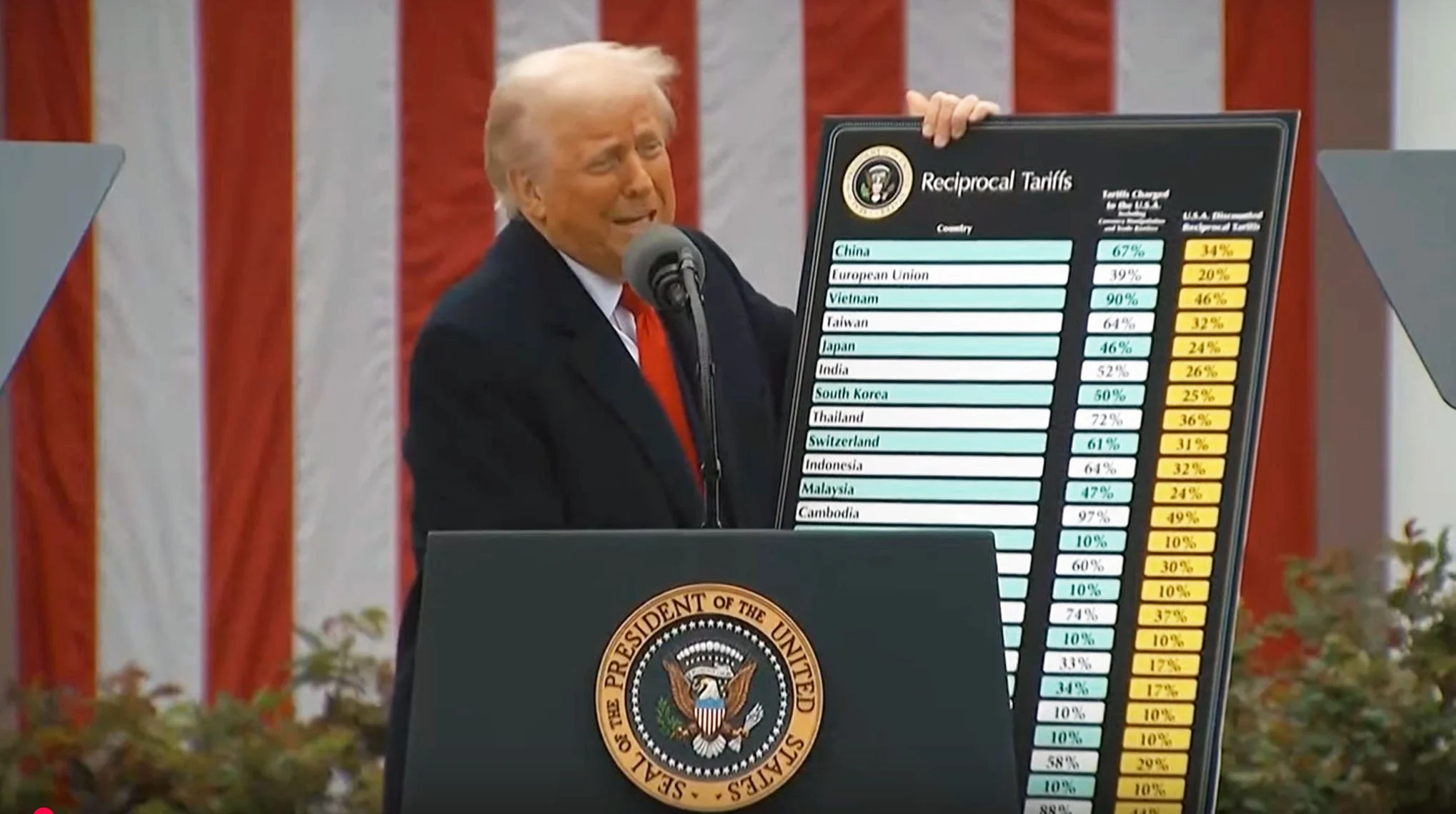
U.S. President Donald Trump, pictured in April 2025, announcing reciprocal trade tariffs against a number of countries. / SCREENSHOT
The U.S. Supreme Court has ruled against a key pillar of Trump’s tariff regime, on the grounds that he acted illegally in using emergency economic powers to impose sweeping duties on trade partners. Canada-U.S. Minister Dominic LeBlanc says the decision reinforces Canada’s position that the tariffs are unjustified.
The 6-3 decision invalidated tariffs imposed under the International Emergency Economic Powers Act, including so-called “fentanyl tariffs” on Canada. Chief Justice John Roberts wrote, “Had Congress intended to convey the distinct and extraordinary power to impose tariffs, it would have done so expressly, as it consistently has in other tariff statutes.”
While more than 90% of Canadian exports remain tariff-free due to exemptions under CUSMA, the court warned that the administration’s interpretation of the law “would represent a transformative expansion of the president’s authority over tariff policy.”
The court disapproved of the administration’s broad use of executive power, with the court emphasizing that “the President operates within a carefully constructed balance of powers.” The court also noted the lack of historical precedent for imposing tariffs under IEEPA. Trade experts expect the Trump administration to rapidly pursue alternative legal tools to rebuild its tariff framework, meaning Canada and other trade partners could continue to face significant economic uncertainty. Key sectoral tariffs against Canadian steel, aluminum, autos and lumber remain in place.
In response, Trump said on social media: “It is my opinion that the Court has been swayed by Foreign Interests, and a Political Movement that is far smaller than people would think — But obnoxious, ignorant, and loud! … The Good News is that there are methods, practices, Statutes, and other Authorities, as recognized by the entire Court and Congress, that are even stronger than the IEEPA TARIFFS, available to me as President of the United States of America.”
He added: “Effective immediately, all National Security TARIFFS, Section 232 and existing Section 301 TARIFFS, remain in place, and in full force and effect. Today I will sign an Order to impose a 10% GLOBAL TARIFF, under Section 122, over and above our normal TARIFFS already being charged, and we are also initiating several Section 301 and other Investigations to protect our Country from unfair Trading practices.”
Section 122 of the Trade Act of 1974 allows for tariffs up to 15 per cent for 150 days before Congress must vote to extend them. Section 338 of the Tariff Act of 1930 authorizes tariffs up to 50 per cent in certain circumstances.
Asked by a reporter whether CUSMA exemptions will be applied to the new 10% global tariff, White House officials said they would release details “once something is signed.”
The Globe and Mail reported: “The White House has also used Section 301 of Trade Act of 1974, which permits tariffs on an entire country following an investigation into alleged unfair trading practices. This has been used most extensively against China.”
Noting Canada still has the “best trade deal” with the U.S., LeBlanc said work will continue to remove the Section 232 tariffs on aluminum, autos, steel and forestry. “We recognize that critical work lies ahead to support Canadian businesses and workers who remain affected by Section 232 tariffs,” he said. “We are working to create growth and opportunities on both sides of the border, while strengthening our collaboration with reliable trading partners and allies around the world.”