Harper and Chrétien join hands on the Arctic
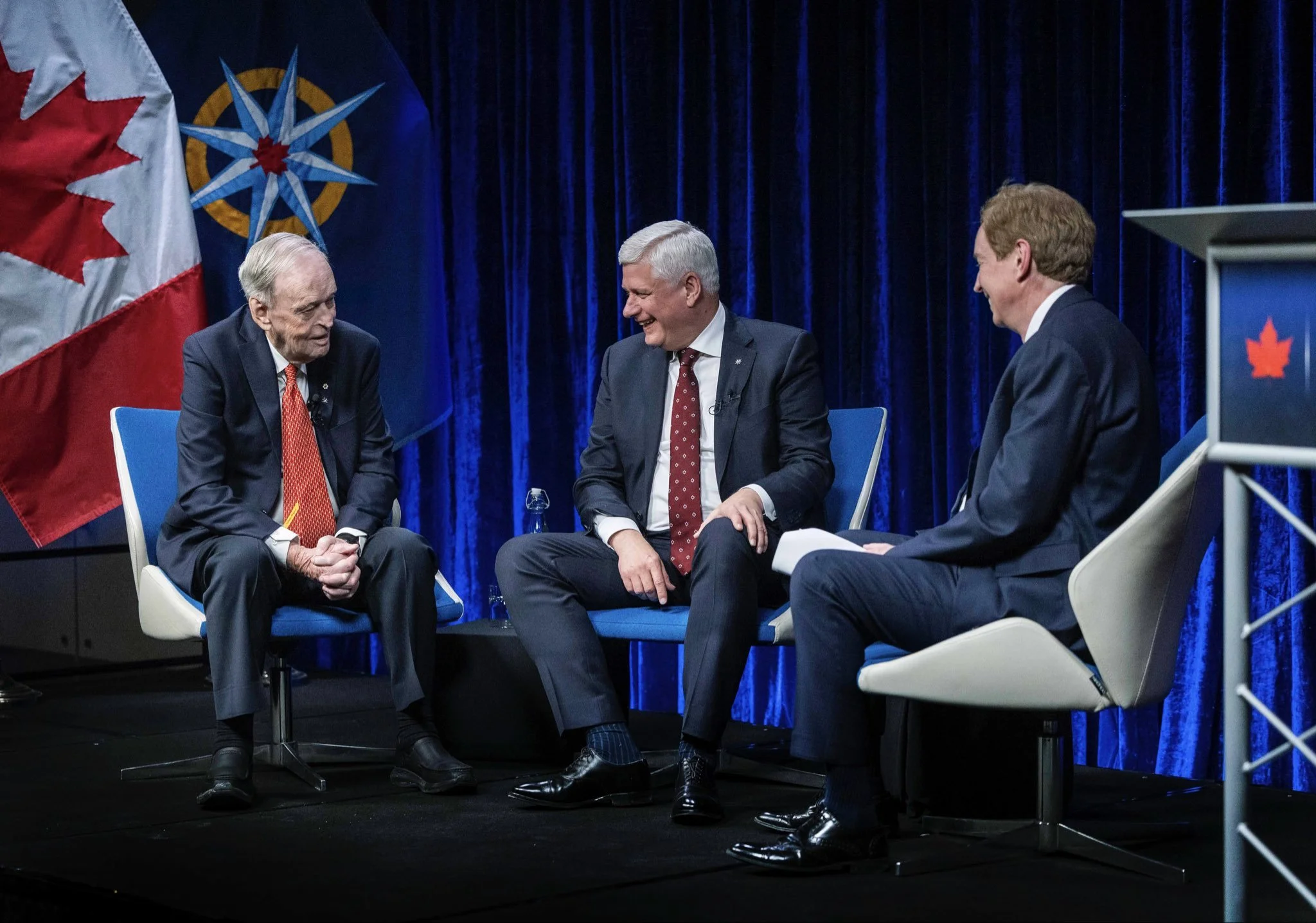
‘I am honoured to receive the Royal Canadian Geographical Society’s Gold Medal, and proud to share the stage with my friend the Right Honourable Jean Chrétien as we discussed Canada’s remarkable history, our shared values, and our enduring sovereignty,’ former prime minister Stephen Harper wrote on social media. / TWITTER PHOTO
Former prime ministers Jean Chrétien and Stephen Harper are urging Canada to reduce its dependence on the U.S. market and strengthen domestic economic competitiveness amid rising global nationalism and a more challenging American trade environment.
Speaking at a Feb. 2 fireside chat hosted by the Royal Canadian Geographical Society, Chrétien and Harper set aside partisan differences to deliver a joint message on the need for trade diversification, Arctic sovereignty, and investment in major infrastructure ahead of the 2026 review of the Canada-U.S.-Mexico Agreement (CUSMA).
“There’s a lot we can do to make ourselves more competitive, more wealthy, and more connected to the world,” Harper said.
Their joint appearance preceded Harper’s remarks at an Ottawa gala marking the 20th anniversary of his Conservative government, where he warned Canada faces an “existential threat” from the United States and must pivot away from its heavy reliance on the American market.
Harper, who was prime minister from 2006 to 2015, described the U.S. approach as increasingly adversarial, pointing to recent actions by President Donald Trump that have raised questions about the durability of existing trade agreements and the implications for Canada’s sovereignty.
“Canada must adapt to new geopolitical realities,” Harper said. “To be clear, these realities mean we must reduce our dependence on the U.S.”
He cautioned that trade relations with the U.S. are unlikely to revert to previous norms, emphasizing that secure access to American markets is no longer assured. While the U.S. is expected to remain Canada’s principal trading partner, Harper said the relationship now requires “balanced and sober reflection.”
With the CUSMA review approaching, Harper urged Ottawa to safeguard Canada’s industrial base, broaden export markets, and, if required, consider tariffs on U.S. goods. He also pressed for immediate action on major infrastructure projects, such as an oil pipeline to the B.C. coast, to support investment and reduce dependence on a single market.
Chrétien, who served as prime minister from 1993 to 2003, described the current moment as “the beginning of the end of the American empire,” arguing Canada is well-positioned to adapt to changes in the global order, citing the country’s political stability, skilled workforce, and strong international reputation.
“We have the land, we have the best educated people in the world, and we have tolerance,” Chrétien said, pointing to Canada’s appeal for newcomers as a key driver of human capital and economic resilience.
Both leaders identified the Arctic as central to Canada’s economic and security strategy. Harper reiterated his government’s "use-it-or-lose-it" approach to the North, emphasizing the need for Canada to monitor and defend its territory independently. He noted that this strategy could also facilitate new trade routes and investment.
“You have to be able to surveil, reach and ultimately defend all of your land, seas and skies without the support of allies,” Harper said.
Both former prime ministers underscored the importance of political unity for economic stability. Harper called on federal leaders to move beyond ideological divisions and prioritize long-term policy objectives, while expressing concern about the influence of social media and the 24-hour news cycle on decision-making.
“You can’t be drawn into the moment of the X tweet,” he said, adding that governments and opposition parties must cooperate on major issues such as sovereignty and trade.
Chrétien echoed concerns about polarization but said Canada has repeatedly navigated geopolitical upheaval by maintaining internal cohesion and shared values.
“I’m not discouraged at all,” he said.