Blois: Ag advocacy has to be aggressive
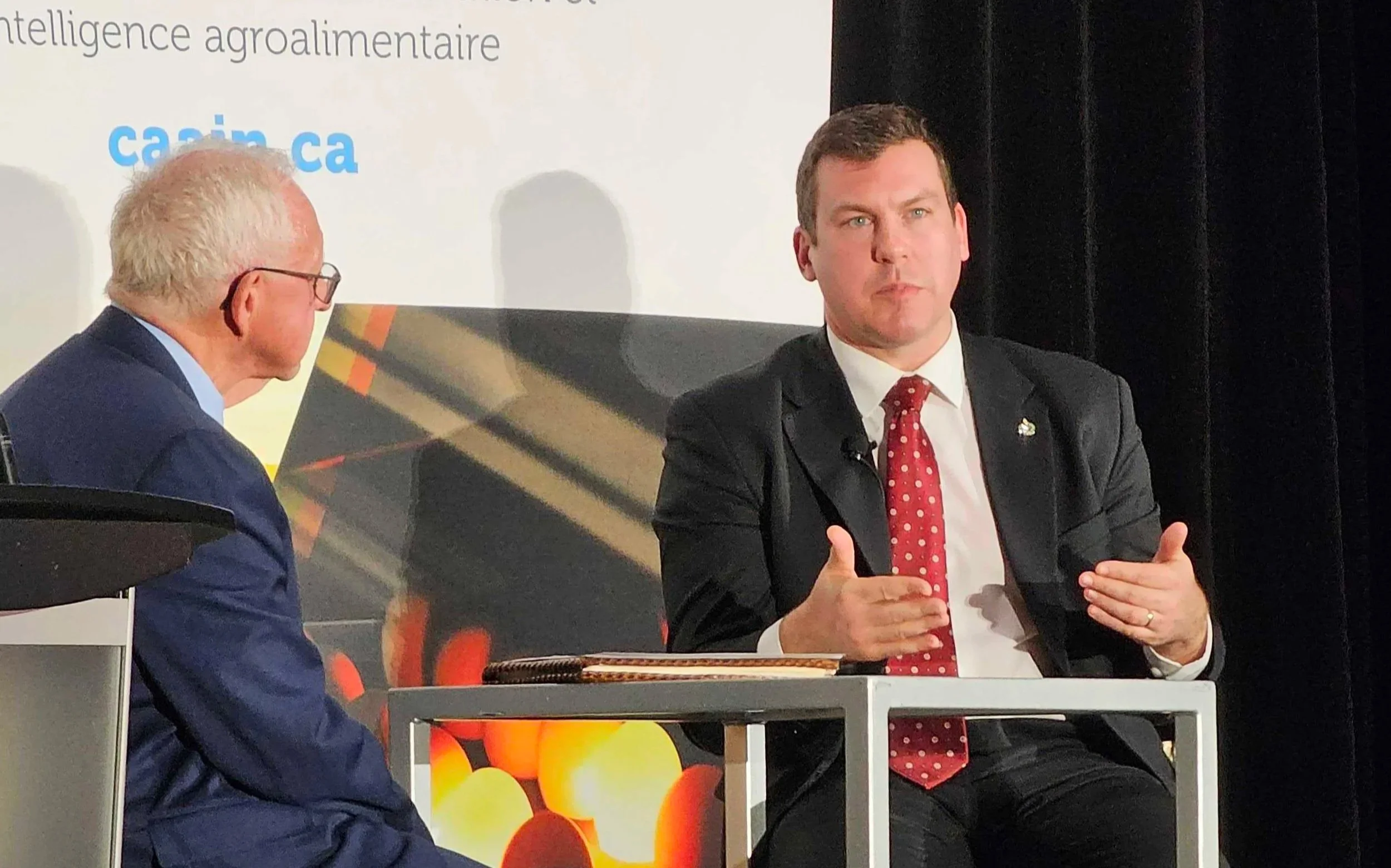
Agriculture is ‘a fundamental pillar of the Canadian economy,’ says Liberal MP Kody Blois, Parliamentary Secretary to the Prime Minister, pictured with Kim McConnell, former CEO of AdFarm. / MEANS & WAYS PHOTO
As the government moves to strengthen domestic food security and expand agricultural trade amid growing global uncertainty, Canada must ensure it can feed and fuel itself if it hopes to defend itself, says Liberal MP Kody Blois, Parliamentary Secretary to the Prime Minister.
Blois warned that Canada can no longer rely heavily on the U.S. and must diversify its trade relationships to protect its economy and national security. Speaking Monday with Kim McConnell, past CEO of AdFarm at a Canadian Agri-food Automation and Intelligence Network event in Ottawa, he highlighted efforts to restore access to Chinese markets for Canadian canola, beef, and pork, while also emphasizing investments in domestic food processing and a new national food security strategy.
“Canada has what the world needs,” Blois said, framing agriculture as “a fundamental pillar of the Canadian economy” that underpins both jobs and national resilience.
The agriculture sector employs one in nine Canadians and contributes more than $150 billion annually to GDP. Blois highlighted the sector’s complexity, with farmers and agribusinesses navigating multiple federal portfolios, from labour to biofuel policy to business risk management programs, and stressed the importance of innovation funding to drive growth.
Ag should be seen as a growth sector
“The work we have to do is to continue to reinforce that this is a growth sector,” Blois said, praising the contributions of farmers, supply chain operators and other stakeholders. He said the government is focused on creating opportunities for young farmers while ensuring Canada remains competitive in a rapidly changing global economy.
Blois urged industry to engage with the government and bring solutions. “Conversations like this matter,” he said, noting there’s also “a lot of conversation on affordability in food” which led the government to introduce the Groceries and Essentials Rebate.
The rebate comes in the form of an increased GST tax credit by 25% over the next five years and provides a one-time top up payment equivalent to a 50% increase to Canadians to address affordability issues this year.
Blois also highlighted the government’s plan to expense greenhouse investments year-over-year — a move he said could benefit thousands of acres of greenhouses in regions such as Southwestern Ontario, Quebec, Delta, B.C., and the Annapolis Valley. “That’s a huge policy win,” Blois said, calling it a major opportunity for producers.
Blois acknowledged past frustrations in Western Canada, where some stakeholders felt previous governments underinvested in regional resources and energy. “I don’t think anyone in this country can say that this Prime Minister does not take seriously every corner of this country,” he said.
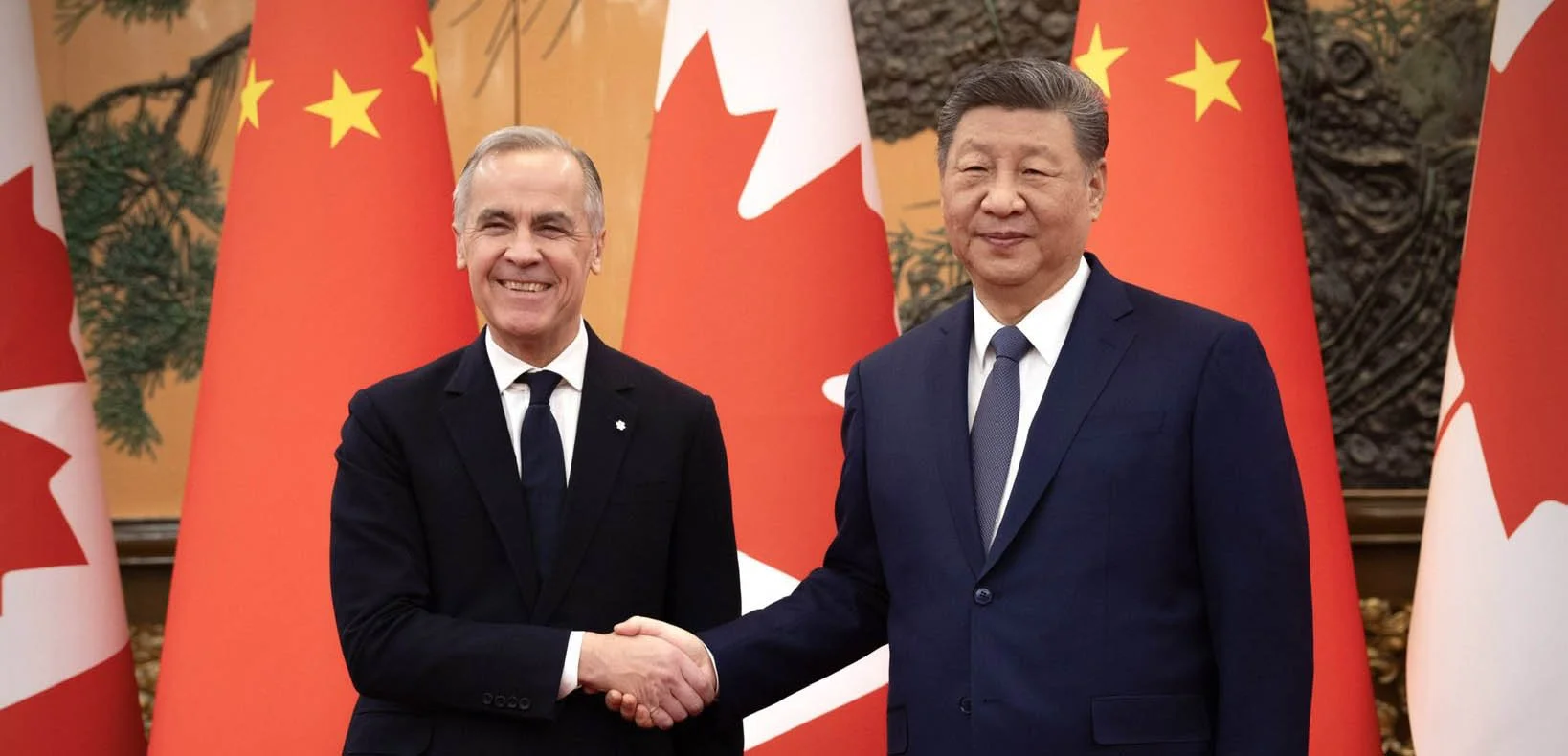
On trade, Blois said the recently signed Canada-China strategic partnership “was the right thing for the national interest.”
Tariffs on lobsters, crabs lifted
Canadian canola meal, lobsters, crabs and peas will no longer be subject to Chinese “anti-discrimination” tariffs from March to at least the end of the year. There was no mention of canola oil, which is subject to a 100% tariff.
In return, up to 49,000 Chinese electric vehicles will be allowed into the Canadian market each year at a 6.1% tariff instead of the current 100% tariff.
“Canada has what the world needs,” Blois said. “We'd be crazy to not be at the table. It doesn't mean we're going to agree with everything, doesn't mean that the table won't have some difficult conversations, but boy, we better be at that table.”
When it comes to the U.S. and the renegotiation of CUSMA, Blois said the government remains “optimistic” and “hopeful that this can be renewed.” He noted, however, that while in China, Carney commented on Canada being a trusted agricultural partner and Xi Jinping, President of China, acknowledged the quality of Canadian agricultural products. Xi noted, despite that, the country always wants to be able to feed itself.
“It's a lesson for every one of us that, yes, we need to continue to explore the tremendous opportunities that exist in China, but very similar to what we started this conversation about, not having our eggs all in the continental back with the United States,” he said. “We’ve got to be careful not to become over leveraged in China. We need to be focused on India, Europe, the U.K.”