Most Americans see through Trump’s anti-Canada tirades
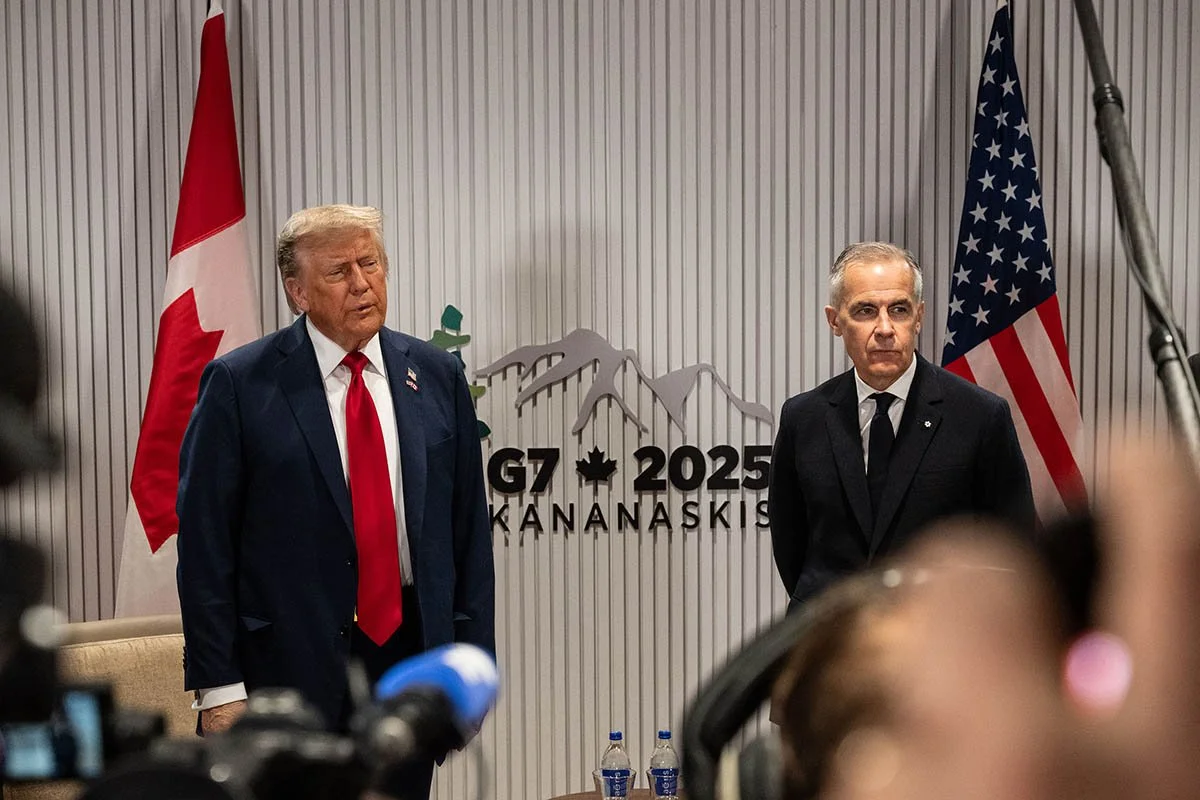
Prime Minister Mark Carney pictured with U.S. President Donald Trump at the G7 Summit June 2025. / GOVERNMENT OF CANADA PHOTO
It’s good news that U.S. members of congress are speaking out against their country’s tariffs on Canada, but the trade relationship will get worse before getting better, says Perrin Beatty.
“We're going into the CUSMA negotiations. We can expect an attempt to negotiate by intimidation,” Beatty, a former cabinet minister and former CEO of the Canadian Chamber of Commerce, told Means & Ways. “We also have a potential referendum coming up in Alberta, and we're already seeing signs of Trump administration interference in domestic Canadian affairs. We can expect that to step up as well. But if we look at it over a longer time span, I believe that Canada can come out of this stronger and more sovereign and more prosperous.”
Six Republicans joined Democrats to pass a resolution challenging Trump’s declaration of a fentanyl emergency at the U.S.–Canada border, which he used to justify broad tariffs on Canada, though it fell short of the votes needed to override a veto and now heads to the Senate. The bipartisan support reflects growing Republican unease with Trump’s trade policies, as lawmakers emphasized that Canada is a close ally and not a threat.
“Canada is our friend. Canada is our ally,” said Democrat Rep. Gregory Meeks, who introduced the resolution. Nebraska representative Don Bacon, one of the Republicans who spoke out against the party leadership, said in a social media post, “Tariffs have been a 'net negative' for the economy and are a significant tax that American consumers, manufacturers, and farmers are paying.”
In response, President Donald Trump repeated on social media that Canada has taken advantage of the U.S. and is “among the worst in the world to deal with.” He added: “TARIFFS make a WIN for us, EASY. Republicans must keep it that way!” It’s expected Trump will veto the resolution.
Majority of Americans still view Canada favourably
A new Abacus Data poll this week showed widespread awareness of Trump-era tariffs, with most respondents believing tariffs have worsened their cost of living, while opinions on trade and Canada are sharply divided along partisan lines. A strong majority of Americans view Canada positively, see it as important to the U.S. economy, and broadly support maintaining the USMCA trade agreement.
“Most Americans continue to view Canada positively,” Abacus pollster David Colletto wrote. “A large majority see Canada as important to the U.S. economy. Among those who have an opinion about CUSMA, views are far more favourable than unfavourable, and there is no broad public appetite to dismantle the agreement. Those baseline attitudes matter. They suggest Canada is entering the review process with a hostile view of the broader American public. Canada is still seen as a trusted economic partner and, in many cases, as a country that functions relatively well.”
He added: “It doesn’t appear that the Trump Administration has been successful in convincing most Americans otherwise, including some within the MAGA and Trump voter universe. Inflation and prices are no longer abstract concerns, and trade policy is increasingly being experienced through the lens of household economics.”
This creates a challenge for Trump domestically, Colletto said. While tariffs may still rile up the Trump base, it carries political risk because voters understand them to mean higher prices for goods. “In that environment, Canada has a form of leverage that did not exist as clearly in earlier trade fights. Canada is economically integrated, geographically close, and widely understood to matter to American jobs and supply chains. If tariffs or disruptions tied to the CUSMA review are perceived to lead to higher prices or unemployment, there is a large audience of Americans primed to notice,” Colletto said.
Limit the damage Trump is doing
Beatty noted that he would like to see the American business community speaking up more when it comes to countering disinformation on the Canada-U.S. trade relationship. “It's clear that the vast majority of American businesses favour CUSMA renewal and favour a stronger relationship with Canada,” he said. “Our priority over the next three years has to be to manage the relationship as well as we can, and to limit the damage that Donald Trump is doing to the bilateral relationship.”
Meanwhile, an international trade lawyer told BNN Bloomberg that separate bilateral agreements with the U.S. and Mexico could still benefit Canada if CUSMA negotiations fall apart.
“There are a lot of provisions in the CUSMA that could be used in a bilateral agreement with Canada, as well as a separate bilateral agreement with Mexico,” Lawrence Herman, international trade lawyer at Cassidy Levy Kent LLP said.
“The point is, we will have an aggressive partner on the other side,” Herman told BNN Bloomberg.
“Canada has to be prepared to say, you know, these are the red lines, and there are certain things that Canada cannot accept.”
He said Canada must decide how long it can keep negotiating if the other side won’t agree to a fair deal. “The priority is to ensure that we get out from this volatile, uncertain, unstable relationship,” said Herman.