Things fall apart; the centre cannot hold
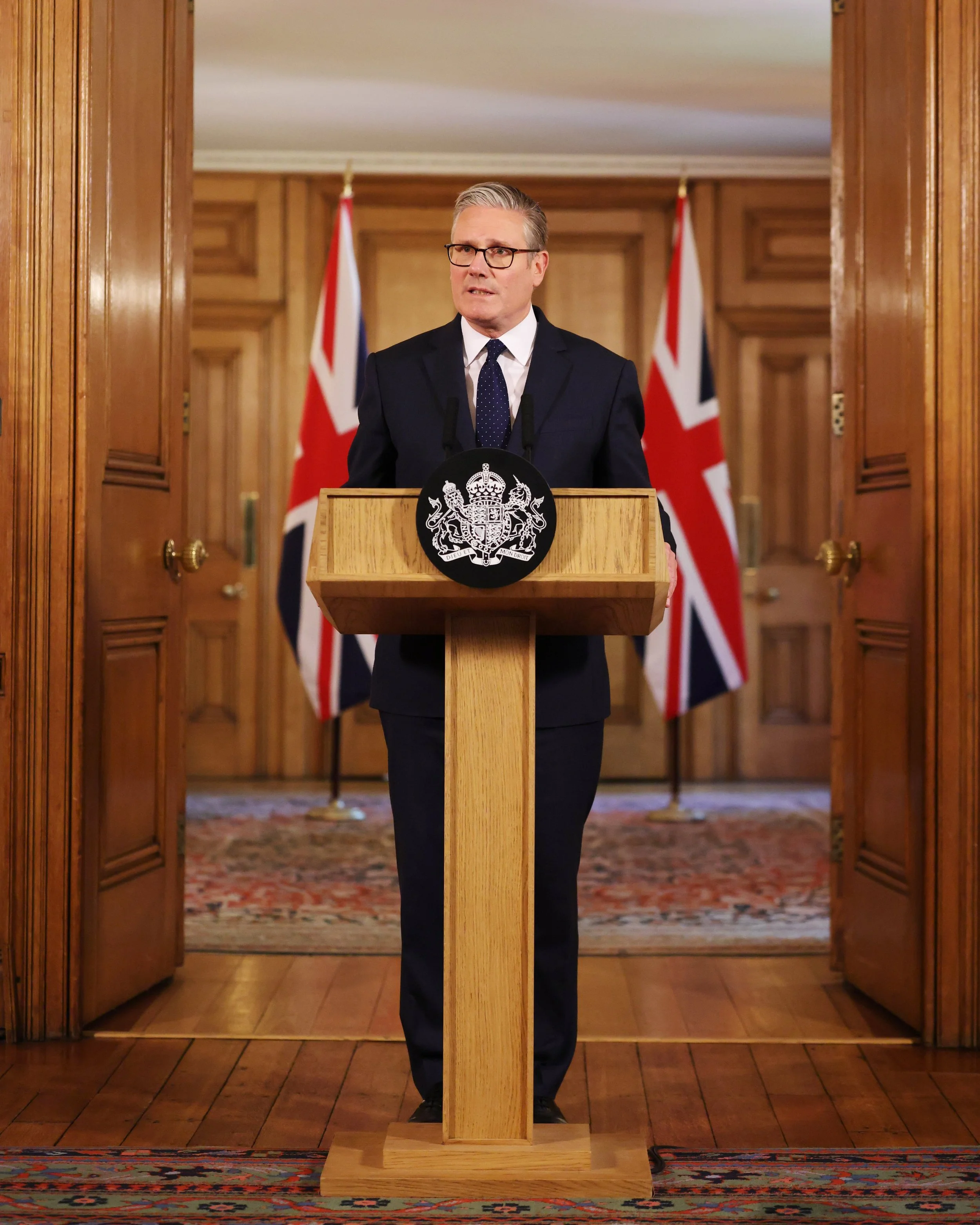
United Kingdom Prime Minister Keir Starmer is the sixth prime minister since 2015 to leave office early. / TWITTER PHOTO
Prime ministerial heads are rolling in the U.K. at a pace not seen since Henry VIII.
This week, Sir Keir Starmer became the sixth British PM to be shown the door since 2015. Only one of them, Rishi Sunak, was democratically “executed” by British voters. But his loss in 2024 to Starmer was epic: the worst result for the Conservatives since the party’s founding in 1834.
All of the others — David Cameron, Theresa May, Boris Johnson, Liz Truss and Starmer — have been whacked by their own MPs, gone feral for various proximate reasons; the fear of likely “Sunakian” electoral oblivion under the interred leaders being a common thread.
Now, fear of defeat is not a surprising worry for MPs in any parliamentary system. For many of them, being an MP is the best job they will ever have. If throwing an unpopular leader overboard strikes them as the best option to save their political skins, they will take it. Even proven electoral winners are not immune to this feral instinct — see Margaret Thatcher and Jean Chrétien.
It is the sheer number of U.K. political whackings that is so striking. From 1945 to 2010, the average term of office for a U.K. PM prior to Cameron was a little over five years; since Cameron left the scene after the 2016 Brexit referendum, it has been around two years. That Starmer was taken out after having won a stonking 174-seat majority not quite two years ago means this is not a Conservative-only affliction.
One is also tempted to conclude that, notwithstanding their implicit political expertise, U.K. MPs over the last decade have been very bad at picking leaders. You could also say the same of U.K voters, but they at least have the excuse of having to choose from among the leaders that the parties have offered up.
So, what has so unsettled a nation for which political stability has been the norm since the Second World War?
Don’t blame Brexit
This week marked the 10-year anniversary of the Brexit referendum, when U.K. voters narrowly voted to leave the European Union (EU).
It is self-evident that the decision to leave the EU, with its single economic market, has unsettled both British politics and the economy.
The endless political mud wrestling and diplomatic blind man’s bluff needed to land an exit deal for the U.K. from the EU became infamous for its chaos, contortions, back-biting and expression of mutual loathing.
There is also a consensus among economists that the net economic impact of Brexit has been negative. The U.K. Office for Budget Responsibility (OBR) is the government’s independent fiscal watchdog. Its post-Brexit trade assumptions imply: a 4% long-term reduction in U.K. GDP due to reduced trade with Europe, lower investment and lower productivity.
In dollar terms, that amounts to the U.K. being around $200 billion poorer per year than it would have been if it had remained in the EU. Of course, that is not good. And it was inflicted on the U.K. by voter choice, rather than by an outside force or unforeseen disruption.
But when you consider that the U.K. GDP is around $4.5 trillion, this projected economic loss could have been rectified through smart policy choices, say, for example, an aggressive program of regulatory slimming down and tax cuts.
If this sounds familiar to you, that’s because this was the very plan that Truss proposed in 2022, which triggered a market panic, the collapse of the pound, an interest rate spike, and, ultimately, her 49-day term of office.
So what is really going on?
You mean the North Sea oil is running out?
As the Mafia has taught us, the problem with multiple whackings is that you may run out of cappos to bump off before you find a rat.
True, Truss, May and Johnson were disasters for different reasons. Sunak could not pull the Conservatives out of the political free fall sparked by his predecessors’ failings. Even with a huge majority, Starmer has governed like some unguided, pilotless drone, blundering into unforced errors, serial policy U-turns and an utlimately terminal Jeffery Epstein related scandal.
The real crux of the matter, the underlying cause of the political chaos, is the enduring underperformance of the U.K. economy pre-Brexit and post-COVID, and the extremely tight fiscal straitjacket this has placed on the PMs, Conservative or Labour.
U.K. GDP growth has typically averaged around 1–1.5% per year, well below the trend of roughly 2–2.5% prior to the 2008 financial crisis. This period has been marked by a sharp slowdown in business investment and persistent low productivity growth, which has been the main constraint on living standards. Despite periodic rebounds, growth has remained uneven, with GDP per capita lagging most G7 peers.
This weakened growth has, in turn, created a structural fiscal deficit that the Conservatives and Labour have had to address by increasing virtually every form of tax at their disposal; indeed, income, earnings and consumption are taxed simultaneously. Towards the end of the Sunak administration, it was reported that the overall tax burden in the U.K. had reached its highest level since the Second World War.
Once upon a time, the U.K. government could rely on a gusher of revenue from North Sea oil to fatten its balance sheet. But current production is now around 70% below its peak in 1999. Opening up new fields would take up to 15 years under the current regulations.
Canada’s economic performance closely mirrors the U.K.’s, but we have all of those natural resources to sell.
The U.K. doesn’t have any cash on hand to use as an alternative to tax increases or to fund new social or economic initiatives. The upper limit of public tolerance for new taxes may have been reached. And its capacity to borrow is structurally constrained by higher interest costs, weak growth and the hangover from the “Truss shocks” that have placed a high-beam market microscope on the government's fiscal credibility.
And all of this is taking place as the U.K., like all economies, is navigating the clean energy transition, the AI revolution, and, more recently, the fracturing of the global trading system.
The centre cannot hold
So compared to all of this, leadership is just a detail. The failures of Starmer and his Conservative predecessors have just made the underlying U.K. economic dilemma more vivid and, let’s be honest, highly entertaining to external political observers.
Unprecedented fragmentation in party support is currently registering in U.K. polling. Traditional Conservative and Labour votes have migrated to the Green Party, the Liberal Democrats and, startlingly, the right-wing Reform Party.
Voters are searching for someone — anyone — who can magic up a plan to get the U.K. out of the economic box it is in. They are looking for answers, not excuses. But there are no easy answers.
So, as poet William Butler Yeats wrote at another time of upheaval: “Things fall apart, the centre cannot hold.”