Riding the Trump roller coaster
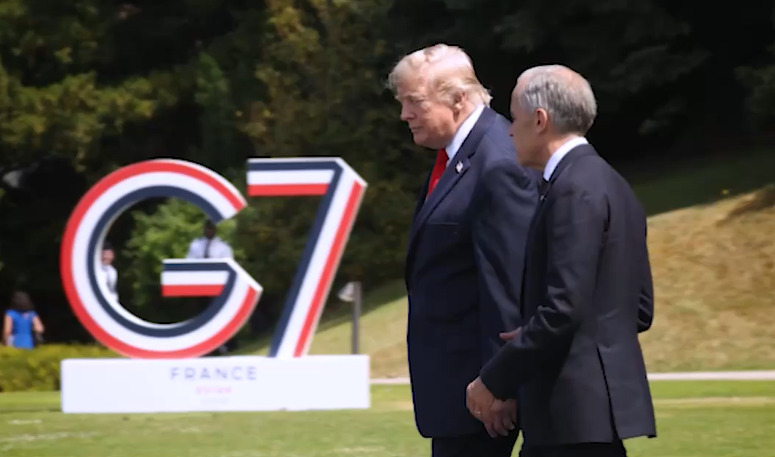
U.S. President Donald Trump pictured with Mark Carney at the G7 Leaders’ Meeting in Evian, France. / SCREENSHOT
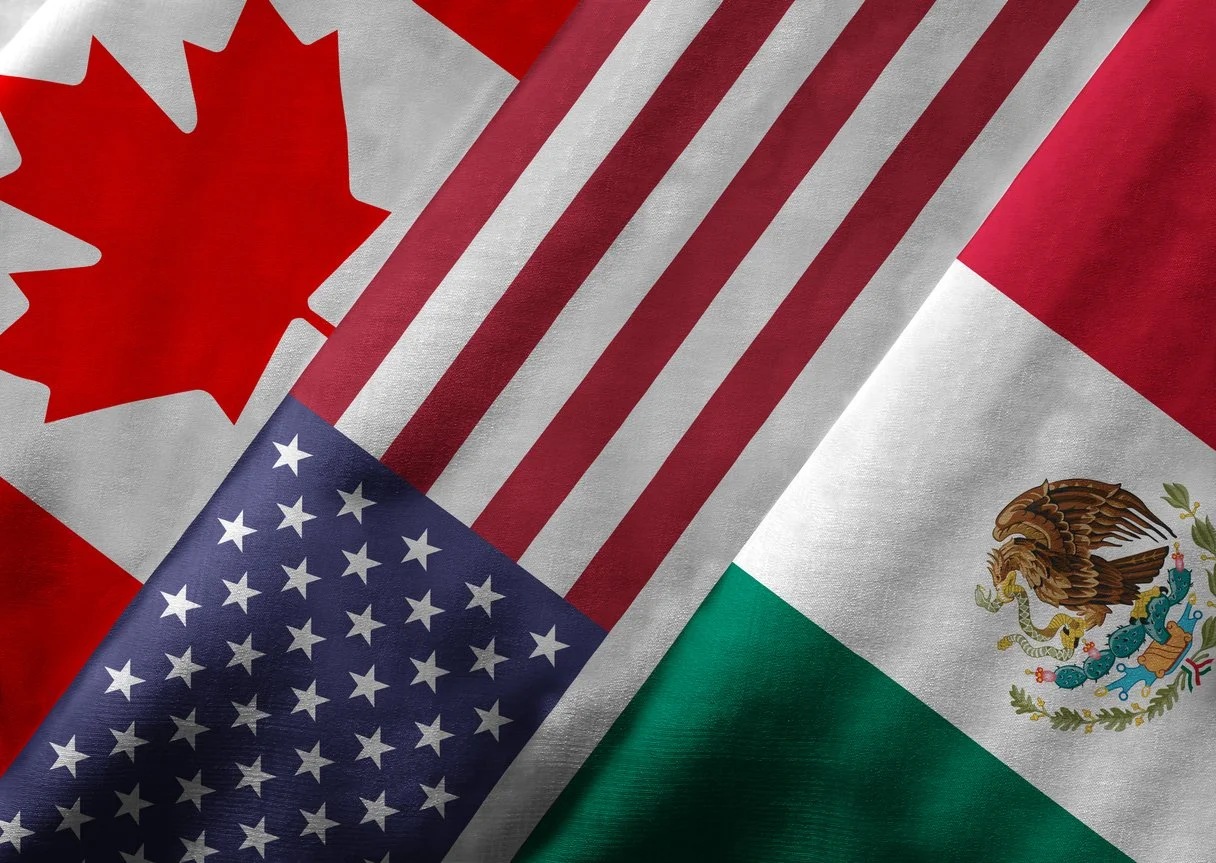
As the July 1 deadline approaches for Canada, the U.S. and Mexico to indicate whether the North American trade agreement will be renewed under the current terms, the real date governments, businesses and Canadians should be watching for is July 24, says a trade expert.
“For me, one of the concerning dates is actually July 24 because that's the date that the global 10% tariff that replaced the [International Emergency Economic Powers Act] IEEPA tariffs expires and will be replaced with something else on the American side. Mexico and Canada currently have a carve-out from that, but that carve-out also expires on July 24. And so for me, that's a date to think about and ensure that we're continuing to engage in a constructive way leading up to that date,” Meredith Lilly, Carleton University professor and former international trade adviser to prime minister Stephen Harper, said this week on the CD Howe Institute podcast.

Canada-U.S. Trade Minister Dominic LeBlanc, pictured with United States Secretary of Commerce Howard Lutnick in France at the recent G7 Leaders’ Meeting. / TWITTER PHOTO
Canada-U.S. Trade Minister Dominic LeBlanc will meet trilaterally with his American and Mexican counterparts for the first time on July 1, the same day each country has to indicate intent to renew CUSMA for another 16 years or send it for annual review until it expires.
While many have focused on the July 1 date, LeBlanc and Canadian Ambassador to the U.S. Mark Wiseman have said that no agreement on that date does not mean the immediate end to free trade.
“It's not a cliff that everyone goes hurling off,” LeBlanc told a US-Canada Summit audience earlier this month.
Lilly said “that’s totally accurate” and that should there be no renewal agreement, CUSMA would continue for 10 more years. She said however, that within those 10 years, the three countries could also agree to renew at anytime. And, any country could also withdraw from the pact on six months notice.
“The three countries will continue to talk and discuss and negotiate in the coming months. It’s my understanding that there's no reason that the three countries couldn't for instance agree to renew on September the first, or some otherdate leading into the fall,” she said. “But we won't see renewal on July the first and for most Canadians July the second will look just like it does on July the first but they won't be on holiday.”
U.S. Ambassador to Canada Pete Hoekstra’s recent remark that Ottawa and Washington are “not anywhere close” to reaching a new trade pact confirmed no deal would be reached by Canada Day. But Prime Minister Mark Carney struck a positive note this week.
‘Real deal’
He said Canada will work with the United States and Mexico to “modernize” the trilateral free-trade pact and that anything can happen when dealing with President Donald Trump.
“What I have seen with the president is that you’re not close to making a deal, and then you make a deal,” Carney said, noting a final deal might have to await decisions between himself and Trump. “Ultimately a breakthrough if you will, on this, will be at that level.”
Carney also reiterated that he has no intention of accepting an agreement that undercuts Canada’s interests.
“We could sign a bad deal this afternoon. We could have signed a bad deal a year ago. We’re not going to sign a bad deal, so it has to be a real deal,” he said at a press conference in Ottawa.
“Despite challenges, Canada maintains the best deal of any major U.S. trading partner, with 85% of our trade remaining tariff-free,” Carney noted.
However, observers expect the CUSMA review to be bruising, with the Americans demanding extra trade concessions as the price of access to their market. Trump has repeatedly slammed CUSMA as unfair, going so far as suggesting recently he might scrap it.
Carney revealed that Trump called him Wednesday, and he had a long talk with the president and other senior White House figures such as Secretary of War Pete Hegseth. The topics were wide-ranging, including on NATO and the Middle East, but CUSMA did not come up, he told reporters.
Economic risk
The uncertainty around the trade deal’s future is an economic risk that decreases investment and slows economic growth, David-Alexandre Brassard, chief economist at CPA Canada, told BNN Bloomberg.
“If you look at the growth of our economy and break it down by component, consumption has done relatively well, although there are some consumer indicators that are worse off than they were a year ago. If you look at the investment level, it hasn’t moved or contracted ever since tariffs were implemented. So, there’s really, again, the uncertainty is really pushing on investments,” he said. “And when you have, in combination, a housing market that’s a bit more struggling, that investment level is getting hit, not only on the business side but also on the housing side. So, it’s impacting.”
He also noted that in three of the four last quarters, the economy shrank (two of them consecutively). Additionally, he said, “job growth has not exactly been stellar” with “barely” anymore jobs than 14 months ago. “Tariffs are one part of the equation, demographics are another one, but I think tariffs have a big role to play in weighing down our economy right now,” he said.
Meanwhile, Steve Verheul, Canada’s former chief trade negotiator who worked on the original CUSMA deal, said the three countries are too integrated and if the U.S. chooses to end the agreement, all of our economies will be worse off.
“We rely heavily on the U.S. economy and we have an integrated economy both with the U.S. and Mexico as part of the North American market. The U.S. thinking that they could go it alone, I think would create significant weaknesses in the U.S. economy, make it far less competitive than it is now and we'd all be in a worse position,” he said on the CD Howe Institute podcast.
‘Time is on our side’
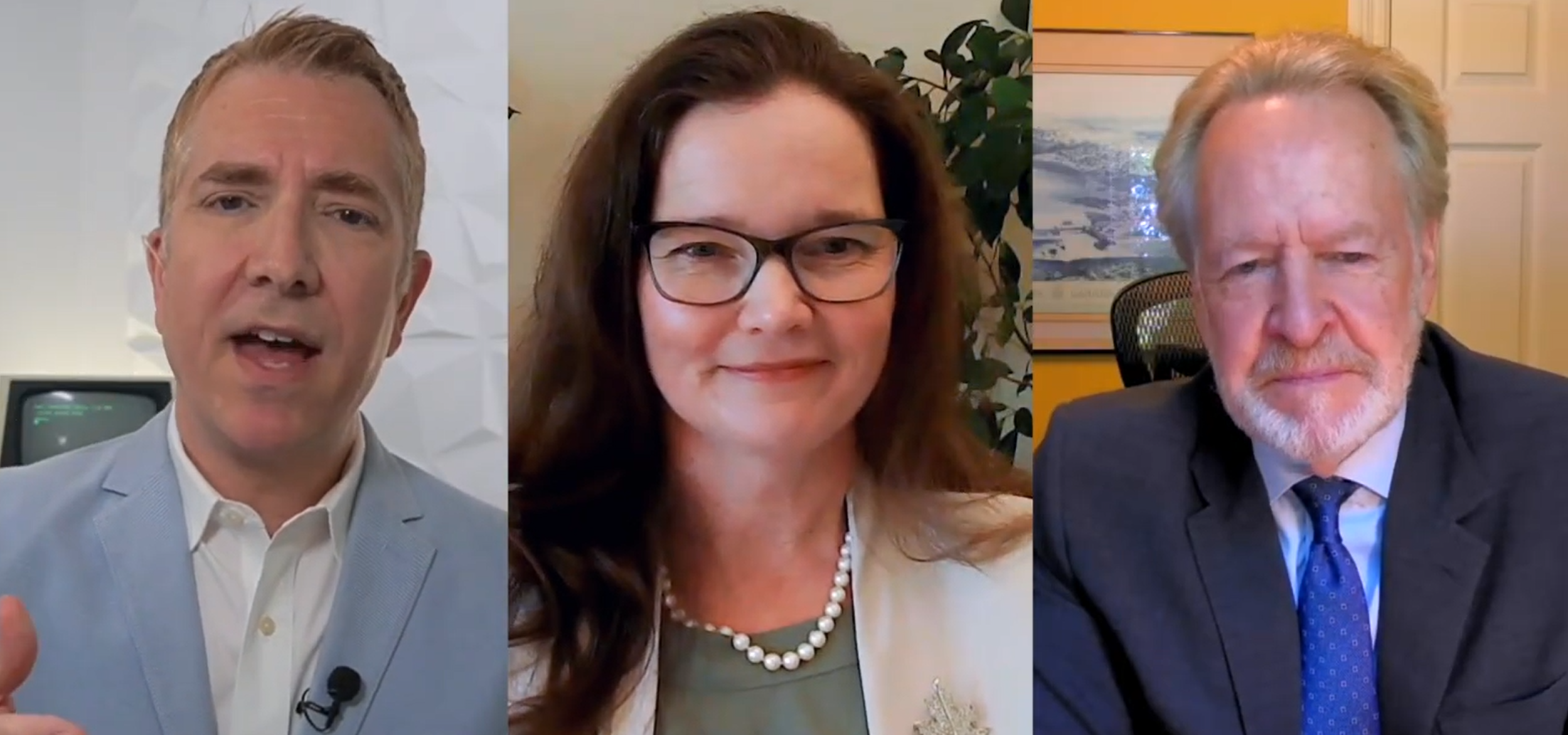
CD Howe Institute podcast host Michael Hainsworth, with Carleton University professor Meredith Lilly and former chief trade negotiator Steve Verheul. / SCREENSHOT
He added that despite the uncertainty, Canada should not be in a hurry to sign a deal at any cost.
“I have certainly been advising the government that it should not be in a hurry in any of this. I think that alot of the U.S. proposals, a lot of the the efforts that they're making at this point are going to be under considerable pressure over time because I think there's fundamental flaws in its approach towards using these tariffs towards trying to reshore production of manufacturing products in particular to the U.S. and pressures will build over time,” he said. “With respect to the kinds of irritants the U.S. has raised, if we're going to make concessions in those areas, we need to get something for it. And that really gets us to the U.S. tariffs on steel, aluminum, autos and other products. We need to see movement on those.”
Lilly agreed that Canada should not be in a rush to sign a deal, but that it was important to engage constructively. “The narrative that Canada may not be fully engaged, I think has been damaging to us. So, it's important that we're there, that we're constructively engaging, and there's lots of things on which we can work on without making concessions in areas where we're sensitive,” she said.
Canadian negotiators should be prepared for the possibility of extraordinary last-minute U.S. demands that could be politically difficult for Canada to accept, Lilly added.
“It's important to plan for them because we know what's going to happen because President Trump has done this with every other country. There's been some kind of big major demand at the end and so we should anticipate what that could be and prepare a plan for what Canada's response would be,” she said.
Meanwhile, although Trump has repeatedly threatened to ‘rip up’ the deal, Verheul said patience is the key.
“He threatened to rip it up in the first term. He he said he would rip up NAFTA. In fact the US had all kinds of extreme proposals at the beginning of the negotiation in the uh in the first term. All of those were dropped over time. So again I think time is on our side to some extent they will be under pressure increasingly to moderate because U.S. business almost unanimously supports extension,” he said. “Almost all Republicans in Congress support extension, the American public support extension and all of those pressures I think will help to get us to the right place over time.”