In other news, the U.S. economy keeps humming along
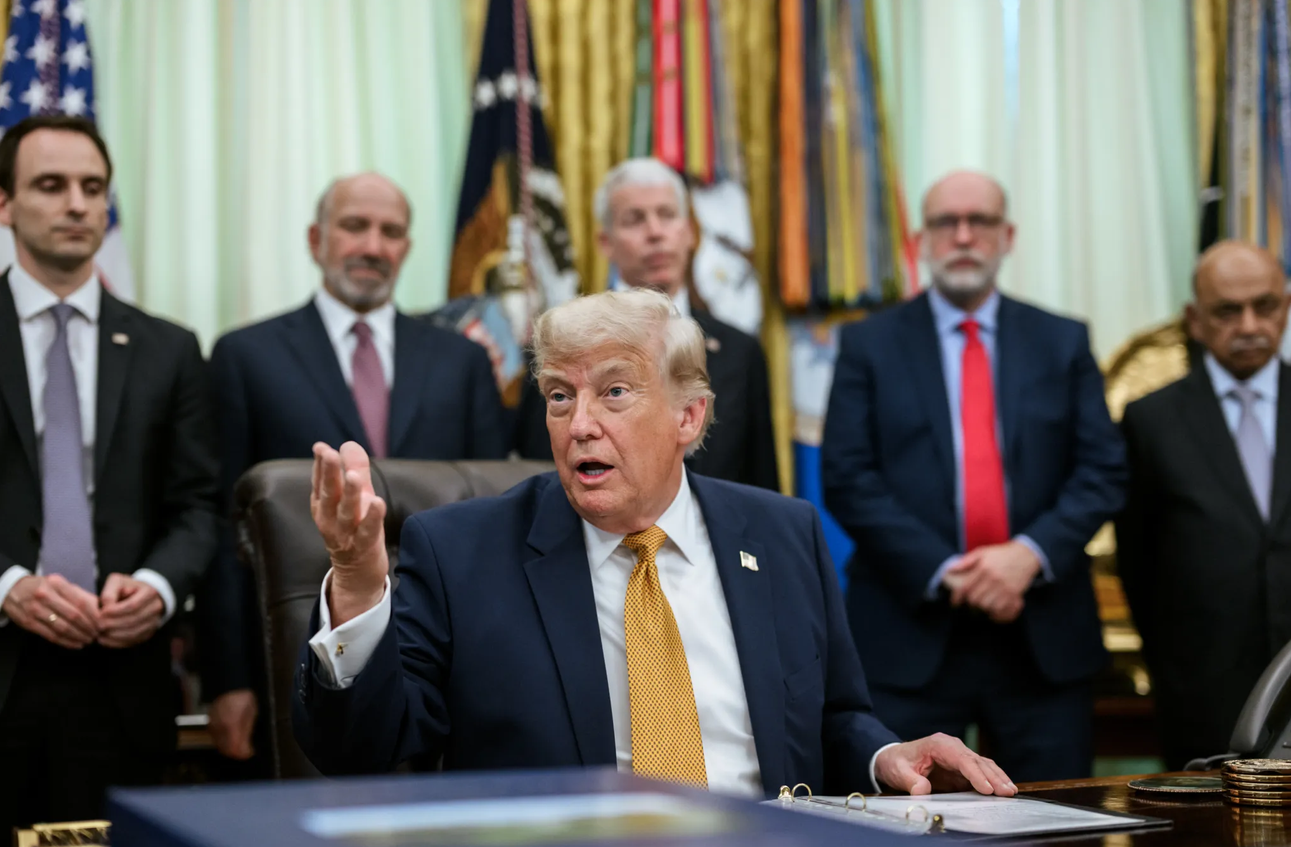
The primary economic downside risks to U.S. economic growth seem to be President Donald Trump himself through his tariffs and the war with Iran, writes Ken Polk. / WHITE HOUSE PHOTO
If you get your American news from the usual 24/7 suspects — CNN, Fox, MSNBC — you can be forgiven for thinking that the main U.S. story these days is the apparent mental decline of the Orange God King (that’s President Donald Trump, if you haven't been keeping up).
True, for news junkies — MAGA-inclined or afflicted with Trump Derangement Syndrome — he is a true media black hole, with gravity so strong that nothing — actual facts included — can escape it. In this febrile, augmented virtual reality, all that seems to be happening is a mercurial Trumpian meltdown about the unwillingness of the Islamic Republic of Iran to bend the knee.
The President has enjoyed great success in bending the Republican Party and the U.S. executive branch to his will. His record is far more mixed in the judicial branch, where some big wins, i.e., curbing abortion, for example, have been balanced by big losses, i.e. banning birthright citizenship. And virtually every indictment his Justice Department has brought against those he sees as political enemies has been more or less laughed out of court.
But his attack on Iran has been a spectacular failure for Trump, one that has escaped even his black hole, peeling off some once reliable right-wing mouthpieces and angering American voters with the gas price shocks they have faced thanks to this misadventure.
His resort to calling the Iranian leadership “scum,” “cuckoo,” and “lunatics” this week is a sure sign that Tehran has gotten under his skin. The resulting resumption of attacks on both sides is having the predictable gyrating effect on oil markets that the alleged ceasefire was supposed to calm.
Yet I digress.
We’re Number 2!
For those not completely obsessed with American politics, the most striking story coming out of the U.S. is that, like the “Energizer Bunny,” its economy keeps on going.
The latest projections by the IMF forecast U.S. GDP growth to be around 2.4% in 2026, first in the G7 and double that projected for second-place Canada. It is expected that the U.S. will lead the G7 in employment growth at 0.5 to 0.8%, with Canada close second. Indeed the IMF projects the U.S. unemployment over the next five years will be at 4% or below, a level that economists define as “full employment.”
The U.S. remains far and away the G7 leader in productivity growth, with a projected 1.8-2% in 2026, over twice the rate of Canada. And it's the same story of investment growth, with the U.S. again lapping the G7 field at 3-4%, and, you guessed it, Canada at 1-2%.
Prime Minister Mark Carney must no doubt salivate at the U.S. numbers, particularly on productivity and investment growth. But coming in second in a field that includes the richest economies is a ranking he will take happily, at least for now.
A strong U.S. economy is always good news for Canada. Even with President Trump’s July 1 decision not to renew CUSMA, the agreement still provides a tariff shield for more than 80% of Canada–U.S. bilateral trade.
AI investment the game-changer
Of course, it is not all economic good news for the U.S.
Consumer spending, long the primary engine of post-pandemic growth, is showing signs of weakening as higher inflation, spiking energy costs, and Trump’s tariffs begin to cut into household budgets; the last two, of course, are almost entirely wounds Trump has inflicted on Americans.
One study estimates that tariffs will add a 1% premium on the inflation rate, with an estimated 50% of the increased tariffs’ cost projected to be passed directly on to consumers. Another study predicts that inflation pressures will deny the U.S. Federal Reserve any room to implement the interest rate cut that the president keeps clamouring for.
Of course, the U.S. fiscal situation is serious and worsening, with interest payments on the accumulated U.S. public debt approaching $1 trillion per year. But since the U.S. dollar is the world's primary reserve currency and the U.S. economy continues to set the global pace for growth, innovation and productivity, and because the U.S. has exceptionally deep capital markets, global investors still view U.S. Treasury securities as the safest assets.
In all of this, it is not surprising to learn that AI is the driver of U.S. economic growth. Indeed, by virtue of being the home of tech hyperscalers like Amazon, Microsoft, Alphabet, Meta and Oracle, the U.S. is not just leading the G7 in AI investment; it's operating in a completely different AI universe worldwide.
In 2025, private U.S. investment in AI was estimated at over $280 billion, with China several astronomical units behind in second place at $12.5 billion. Among G7 countries, Canada ranks somewhere in the middle for both private and public investment in AI.
The Orange God King is his own worst enemy
This scan of the American economy reminds us what an almost miraculous economic machine the country is. For decades, the U.S. has always dominated the commanding economic heights of the global economy, and with AI, there seems to be no sign that this will change.
Indeed, the primary economic downside risk to U.S. economic growth seems to be Orange God King himself through his tariffs and the war with Iran. Try as he might to convince voters otherwise, they seem to have an innate sense that he has been a very poor economic manager.
The economic figures suggest that if the president had merely said and done nothing on the economy since being re-elected, he and the Republican Party would be in a much stronger position heading into what now looks to be a gloomy mid-term election season.
Like a desperate gambler on a losing streak, Trump's relaunching the attacks on Iran suggests he thinks that if he just keeps drawing cards a little longer, his luck has to turn. His recent effort to paint the Democrats outright communist, and Secretary of State Marco Rubio's intention to launch an international anti-Antifa coalition, smacks of a similar desire to put the Democrats on the defensive.
Never underestimate the ability of the Democratic Party to bite down on Republican political bait. But there can be little doubt that, having become his own worst enemy, Trump will try anything to change the political channel.