A lonely voice from across the political void
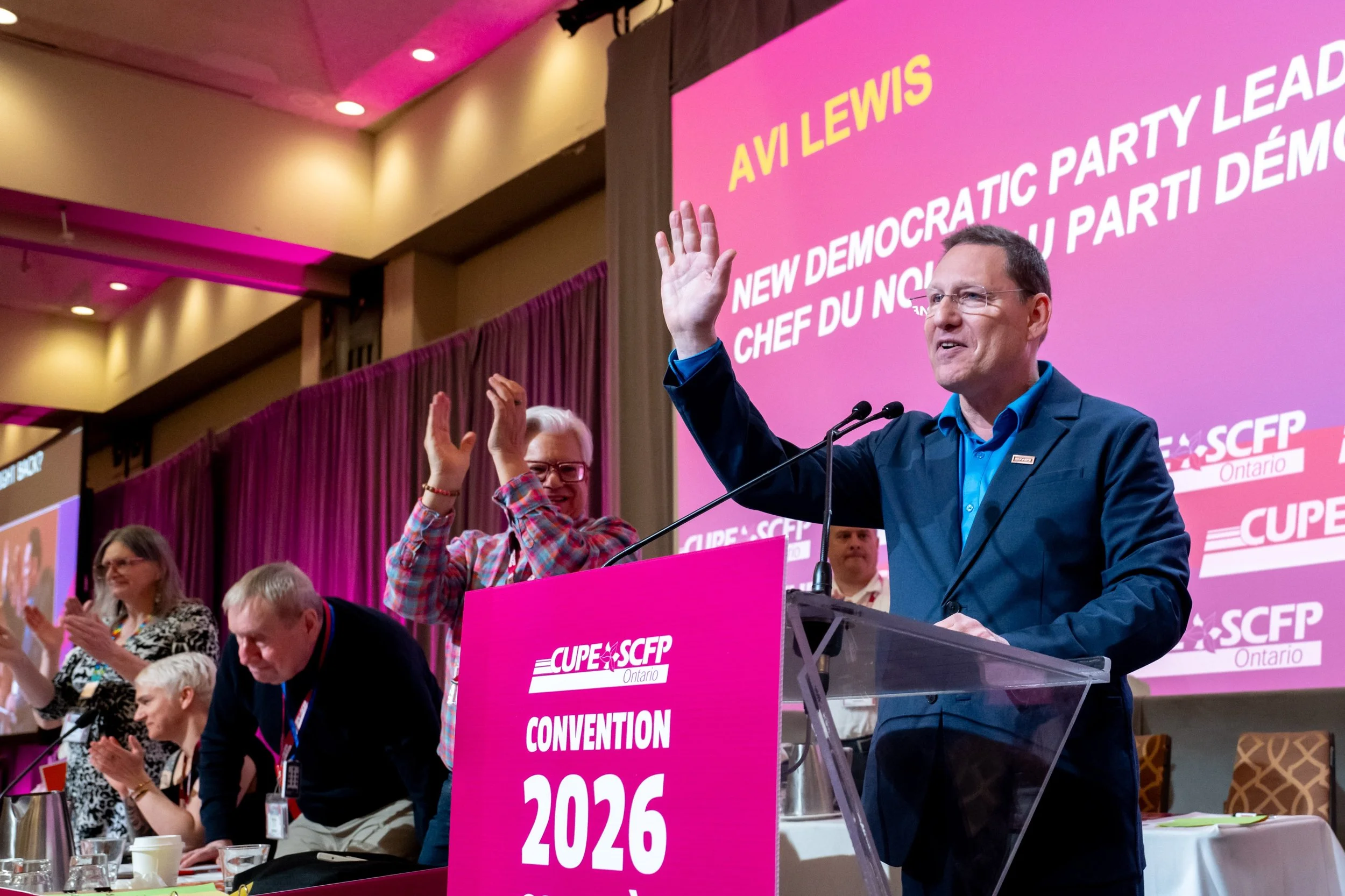
NDP Leader Avi Lewis pictured at a recent CUPE convention. / TWITTER PHOTO
You’d never know it, but NDP Leader Avi Lewis has been very busy. A quick scan shows that he has hosted numerous public events, sat for many interviews and been active on social media.
The fact that he is not earning headlines or even mentions from major media outlets would be a problem for any other party leader. But as a leader rebuilding from the political wreckage of the 2025 election — its worst ever — this is a virtue.
Flying below the mainstream media’s radar, he avoids having to dream up different ways to explain what went so wrong last year, or why it remains a distant third in the poll, or — perhaps most irritating for a new leader — why the NDP has not enjoyed much of a bounce in public support, if any, since he took office.
As proof that discretion is the better part of political recovery, I refer you to one of the rare times that Lewis’ name jumped near the top news aggregator feeds: his announcement in early July that he will not be running in any of the seven seats that have come open for by-elections since the last round of five by-elections were held in April, which he also chose not to run in. It is never a good look for any leader to sit outside the House of Commons. But that is infinitely preferable to losing.
For a party that just 10 years ago was Her Majesty’s Official Opposition, seemingly on the cusp of government, the fall has been hard and understandably disorienting. So, Lewis will benefit from an extended period of benign media neglect while he does the behind-the-scenes political spadework needed to get the NDP into some kind of shape for the next election.
A messenger in search of a message
Of course, attracting media attention when he feels ready will be the easy part for Lewis.
He is an accomplished documentary filmmaker, journalist and advocate. Unlike many politicians for whom media management is a skill learned on the job, Lewis is a polished performer. He is as adept as a news show pundit as he is online. He knows how to make quick, pithy social media clips. Indeed, his facility as a media messenger is akin to Pierre Poilievre’s, though, with more smiles than the latter’s sneers.
The question remains, however, what message will this able communicator deliver?
Lewis’ clear preference is to give what’s left of the NDP faithful a bit of that old-time religion: pro-union, anti-big business, standing up for the little guy against the plutocrats. Indeed, his leadership victory speech leaned hard into democratic-socialist language, calling for higher taxes on corporations and billionaires and citing the wealth of grocery magnate Galen Weston Jr. as an example of who and what he wants to tax harder.
Such messages are right out of the songbook of his recently deceased father, one-time Ontario NDP leader Stephen Lewis, and his grandfather, one-time federal NDP leader David Lewis.
The dilemma for Avi Lewis is that the populism the NDP has been peddling since 2015 seems to be more that of what might be called the modern “progressive hive mind,” rather than the “lunch pale populism” of his forbears. It has seemed more preoccupied with identity politics, climate action, social inclusion and equity than with the economy and the everyday pocketbook problems of Canadian families groaning under the post-COVID inflationary spiral. In fairness, many of the same criticisms were made of the terminal stage of Justin Trudeau’s administration, which, when you think of it, kind of proves the point.
Both Trudeau and Lewis’ predecessor Jagmeet Singh, seemed content to jointly cede the economy to Poilievre, whose right-populism and laser focus on jobs and incomes cut deeply into the vitals of both the NDP and Liberal voter coalitions. The Carney Liberals, of course, recovered; the NDP didn’t.
Threading the populist needle
Judging by his performance to date, Lewis has not yet found a format that threads the populist needle.
His preferred ideological purity has created friction inside the broader NDP family. Alberta NDP leader Naheed Nenshi and Saskatchewan NDP leader Carla Beck both publicly pushed back on the federal party’s direction on oil and gas policy after Lewis's win, wary of being tied to a leader whose climate and energy positions could be a liability on the Prairies.
Alberta Premier Danielle Smith even jabbed at Nenshi for trying to distance himself, pointing out that provincial NDP sections are formally linked to the federal party's constitution. Lewis has said he wants to have those “hard conversations,” but it's an early sign of the coalition-management problem he faces: uniting a base energized by unapologetic democratic socialism with provincial wings that have to win votes in more conservative-leaning regions.
However, Lewis also has political opportunities he may be able to exploit.
The election of Prime Minister Mark Carney, who borrowed heavily from the Conservative platform, has badly wounded Poilievre. Since the election, Poilievre has been staggered further by the loss of five MPs, four of whom joined the Liberals outright and a fifth recently, who gratefully took a cozy Senate sinecure from the Prime Minister.
While both the NDP and the Conservatives had a long history of fuming at the political resiliency of the shape-shifting Liberals, Lewis, at least, can take comfort from knowing that Poilievre’s weakening may help him shore up his own right flank — such as it is.
Even better, Carney’s relentless focus on the economy has left a wide lane on the left that Trudeau and Singh used to joust over; Trudeau far more successfully, of course. So, Lewis could take ownership of that lane by default.
To that end, Lewis has been going at Carney with hammer and tongs, invoking such themes as: being too accommodating to corporate and financial interest; retreating from Trudeau’s stronger climate commitments; weakening labour protections; and, failing to embrace the scale of public investment and wealth redistribution that Lewis believes is necessary to achieve needed structural economic change.
Whither the NDP in a two-party race?
All of this makes sense if the three-party dynamic that has governed post-Second World War Canadian politics remains in play. That is an open question.
The 2025 election was the first since 1930 in which both the Liberals and Conservatives each received more than 40%t of the vote. Their combined 85% was the highest since the early decades of the 20th century.
Should federal politics remain a two-party race, the seven seats the NDP won in 2025 may not be a floor to build back from, but rather their “new normal.”
All of this is to say that there remains much to play for Lewis. He is free to dismiss both Poilievre and Carney as Bay Street toadies. He can spout far-left progressive tropes without much critical scrutiny because the NDP has been written off by much of the mainstream media.
Above all, should the economy go south on Carney, the polarized 2025 result may return to the post-Second World War norm. Lewis and the NDP could find themselves with a far higher seat count than the conventional political wisdom suggests is possible.
For now, Lewis remains a lonely NDP voice speaking from across the political void.