Enter Trump the lame duck?
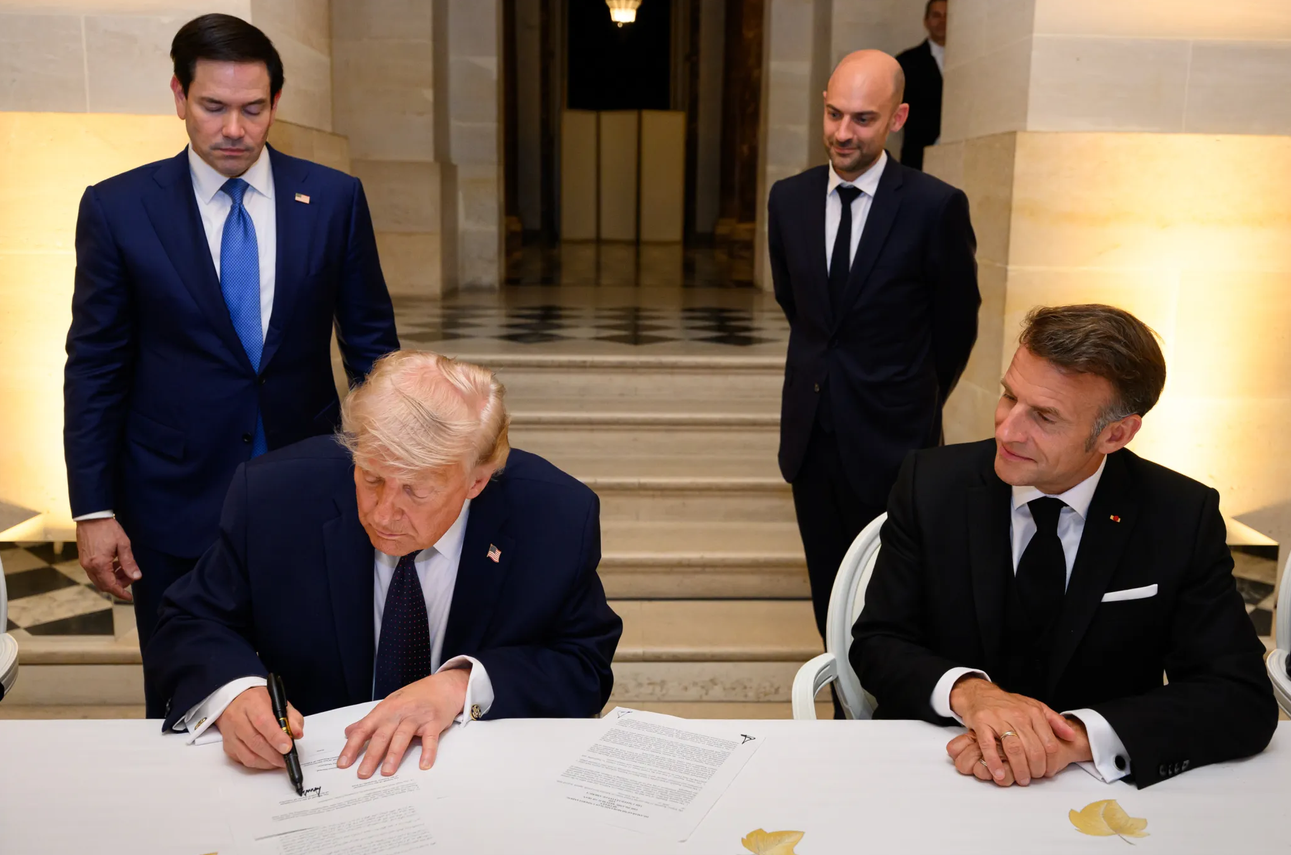
U.S. President Donald Trump signs a Memorandum of Understanding between Iran and the United States at the Palace of Versailles, France on June 17, 2026. / WHITE HOUSE PHOTO
Throughout three election campaigns, and now 1.5 administrations, U.S. President Donald Trump has had something like a magical hold on what some observers have called the “entertainment wing” of the Republican Party.
That is, the constellation of legislators, commentators and influencers who, like sock puppets, on whom Trump could reliably count to preach from his appointed talking points on any topic, at any time.
Judging by the sock puppet rebellion that occurred among Republicans this week in response to the President’s Memorandum of Understanding (MOU) with Iran, Trump’s spell has been broken, at least temporarily, and, depending on the outcome of November’s mid-terms, perhaps permanently.
A non-release release of an ‘agreement to agree’
The first sign of trouble for the president was the administration’s reluctance to actually post the MOU on either the White House or State Department websites. Instead, what we have seen is administration officials either reading out the contents of the 14-point MOU over the phone or otherwise distributing PDFs to journalists. [It still hadn't been posted at the time this Means & Ways newsletter was published.] This is shambolic, even by Trump administration standards.
The second sign of trouble was the fact that it is an MOU rather than an actual agreement. Anyone who has worked in government knows that MOU’s are agreements to reach an agreement. They set a framework of shared understandings that hopefully shape subsequent negotiations. To put it another way, an MOU and about $4 will get you a coffee at Starbucks.
Then there is the substance, such as it is. True, there is a joint commitment to unblock the Strait of Hormuz. But the Strait of Hormuz was blocked in the first place by Iran in response to the American-Israeli attacks. So this is actually a measure to undo the damage done to the global and U.S. economies that Trump is complicit in by launching the assault.
That the president and his team have invested so much in trumpeting this accomplishment is, itself, a concession that the rather bold ambition of ending Iran’s nuclear weapons program has been supplanted by the rather more parochial imperative of getting U.S. gas prices down ahead of the coming mid-terms.
As for the curtailing of Iran’s nuclear program itself — the initial objective that was vaunted as the jets and missiles flew — that particular can has now been kicked down a 60-day road of new negotiations.
Looking bad compared to Obama
Perhaps most galling of all to the Republican sock puppets is the huge amount of cash — in the area of $300 billion — that the U.S. and unnamed partners commit to post-conflict Iranian reconstruction. Combined with other pledges to lift economic sanctions on the export of Iranian oil in return for Iran's ending its nuclear weapons program, the MOU has the flavour of a whole bunch of economic carrots being offered, now that the military sticks have not succeeded.
One of Trump's rationales for withdrawing from former president Barack Obama’s Joint Comprehensive Plan of Action to restrain Iran’s nuclear program included the simultaneous unfreezing of $1.7 billion of Iranian funds held in U.S. and other banks, a sum that Trump repudiated as a “bribe” or “ransom” in return for a bad deal. But the financial incentives for Iran contained in the MOU dwarf anything contained in the Obama plan. What’s more, they came in return for an actual formal agreement, not an agreement to agree.
The rebellion
So, not even Trump’s singular talent for projecting a reality distortion field that supporters could cling to as justification for any of his actions, however outrageous, could sustain the MOU, hence, the rebellion.
Chairman of the Senate Intelligence Committee Senator Tom Cotton, referring to the MOU’s financial incentives, said: “That’s a lot of money and we know that this terrorist revolutionary regime is not going to spend that money on day care or on hospitals. They’re going to use it to rebuild their drone stockpiles, their missiles, to fund Hamas and fund Hezbollah.”
Chairman of the Senate Armed Services Committee, Senator Roger Wicker, said the $1.7 billion that the Obama administration sent to Iran in 2015 was “a pittance by comparison.” He added in a statement that “I … oppose the U.S. lifting any sanctions on Iran, or unfreezing Iranian funds, in exchange for Iran’s mere agreement to negotiate for another 60 days. The Iranian regime has not renounced its ultimate goal — ‘Death to America, Death to Israel.’ The regime will invest every penny it receives to further that aim.”
Republican Senator Bill Cassidy called it “the worst foreign policy blunder in decades.”
Some in the Republican commentariat have been equally withering.
Newsmax host Rob Schmitt said, “On paper, it looks pretty bad. … Mostly just a list of all the goodies for the Iranian terror regime.”
Ben Shapiro, a founder of the Daily Wire said: “This MOU appears to be ... a disaster.”
Mark Levin of Fox News said, “These 10 points are an absolute disaster.”
Tucker Carlson of The Tucker Carlson show said: “This is a pretty humiliating loss for the United States. … This is, by the way, the reason that you wouldn't want to start this war in the first place, because it could only end as it has ended.”
Lame duck?
Of course, the fact that the sock puppets are now abandoning the President may have as much to do with the steadily more dismal assessment that voters have registered in the polls with his handling of the U.S. economy, as with the paltry results to date from the assault on Iran.
The MOU for Republicans may simply have marked a point of no return for the President as a political asset for the party heading towards November. However, the causal connection between the attack on Iran and politically lethal spikes in gas prices is impossible to deny.
So far in his second term, the President has squandered all of his hitherto potent political capital as an economic manager in a self-indulgent pursuit of what can only be called trifles. These include redecorating the Oval Office in gold leaf, embarking on a new White House ballroom which, by some estimates, will cost $600 million, and trying to create a $1.6 billion fund to compensate rioters convicted of assaulting police and storming Congress on January 6, 2021.
In the context of the enduring economic pain being felt by Americans from post-COVID inflation, a pain that at least in part fueled Trump’s re-election in 2024, the attack on Iran is disconnected from their day-to-day pocket book struggles.
Whatever the case may be, when even the sock puppets start rebelling, Trump may just be getting his first taste of the lame duck torpor that may define the rest of his presidency.