‘We have to take the world as it is,’ Carney says in China as he seeks to prepare Canada for a new international trading order
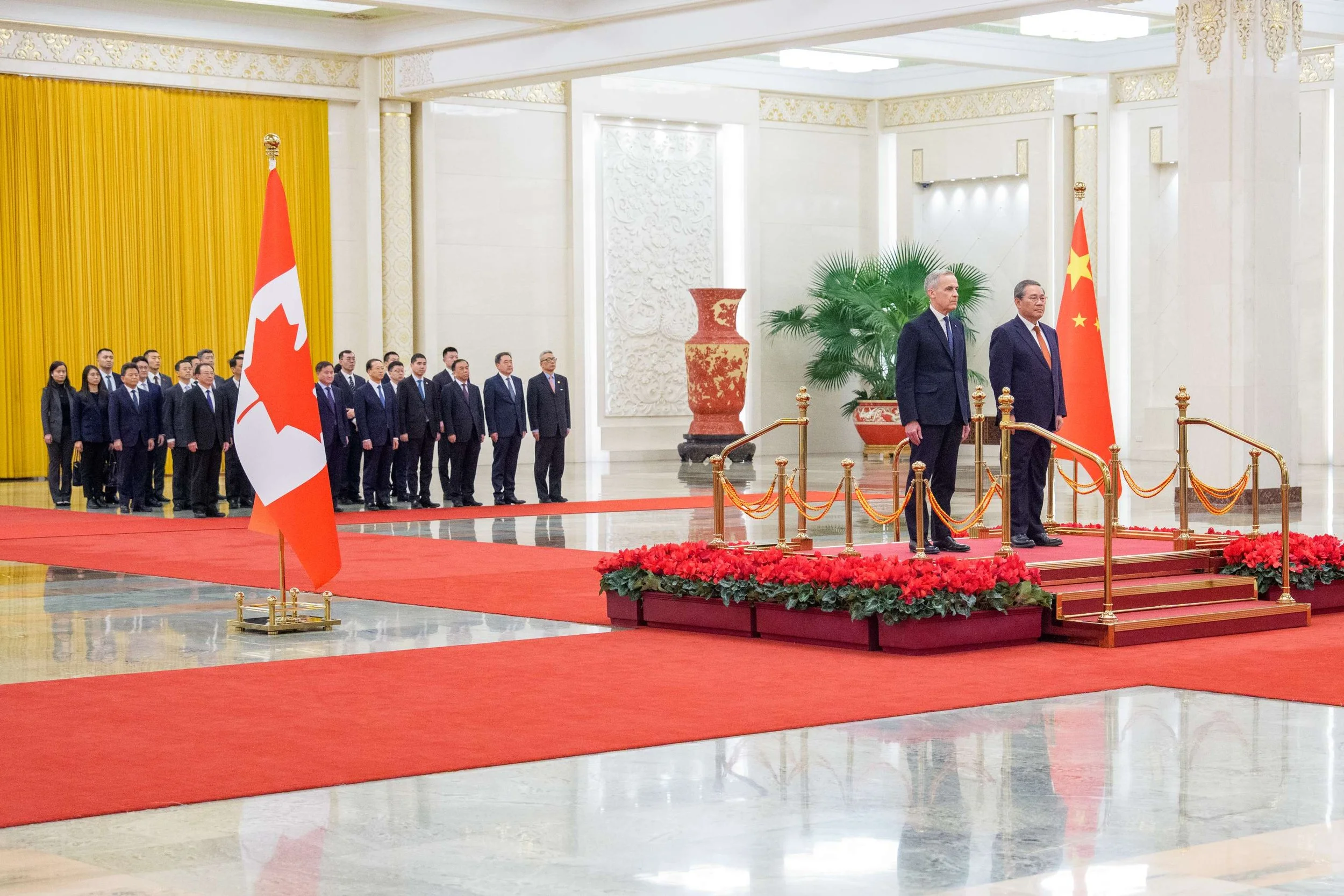
Prime Minister Mark Carney was in China from Jan. 13 to 17 to meet with President Xi Jinping. The two countries signed a trade deal for Canada to let in more Chinese electric vehicles at a lower tariff rate for access to China’s canola market. / TWITTER PHOTO
Aside from the immediate impact on Canadian farmers of Prime Minister Mark Carney’s canola-for-EVs deal in Beijing, the rapprochement with China revealed this week is largely symbolic.
China only buys about 5% of Canadian exports–compared to 70 per cent going to the U.S. — and it is obvious that trade with the Chinese will not grow fast enough to change that dynamic anytime soon. Business dealings with China are notoriously difficult and subject to problems such as copyright infringement, and moving closer to Beijing raises clear security risks at a time when China is a chief perpetuator of political interference in this country.
But Carney says a limited renewal of Ottawa’s troubled relations with China, the world’s second largest economy, is essential at a moment when Canada’s economic lifeline to the U.S. is no longer assured. “We take the world as it is, not as we wish it to be,” he said grimly as he explained the deal worked out with President Xi Jinping.
In an example of the kind of gutsy statesmanship that hasn’t been seen in Ottawa for some time, Carney is playing a long game with the goal over time of creating a stronger, more independent Canadian economy for a changing world trade environment.
He said Friday that Canada has to shift its approach now that the postwar multilateral system of rules-based trade as evidenced in the World Trade Organization has eroded. This post-war system has of course been undermined by U.S. President Donald Trump’s destructive disregard for global alliances and cooperative trade relations.
Looking beyond that, Carney envisions a system in which international trade agreements will be replaced by coalitions of countries that develop “subsets” of alliances such as regional and country-to-country pacts.
Implicit in this strategic thinking is that Canadians would be wise to have very limited expectations for ongoing business relations with the U.S., particularly when it comes to the three-country review this year of the Canada-U.S.-Mexico (CUSMA) free-trade pact.
Canadian tariffs on Chinese EVs were imposed in alignment with the U.S., so by modifying that measure Carney is taking a chance that Trump will accept it as part of the West’s efforts to avoid all-out trade conflicts with Beijing. If it goes the other way, the Ottawa-Beijing rapprochement may give the president another reason to undercut CUSMA.
Be that as it may, Trump has been decidedly negative in recent comments about CUSMA, and Carney appears to be convinced that Canada’s economic future now hinges on other alliances. He has been travelling the world for months to drum up trade and investment and situate this country as an important partner in commercial agreements intended to overcome U.S. impediments to trade. The prime minister noted tellingly on Friday that China is now more predictable as a trade partner than Trump’s America.
Although Canada and China are just beginning to seek improvements in their fraught bilateral dealings, the federal government believes there is potential for more engagement with China in areas such as energy, construction with wood, farm products and tourism.
All in all, Carney is embracing an historic change for Canada and it will be years before it provides the economic wherewithal of the trade relationship Canadians have enjoyed with their American neighbours for 75 years. The prime minister is also fanning the embers of internal division among Canadians with a deal in China that can be seen as saving western farmers at the expense of Ontario auto workers.
But Carney, weary of trying to repair trade relations with a U.S. president whose diplomatic and economic inclinations appear more extreme every day, clearly sees diversifying interests away from America as the best bad choice for Canadians.