The CUSMA exemption: Canada’s economic make-or-break for 2026
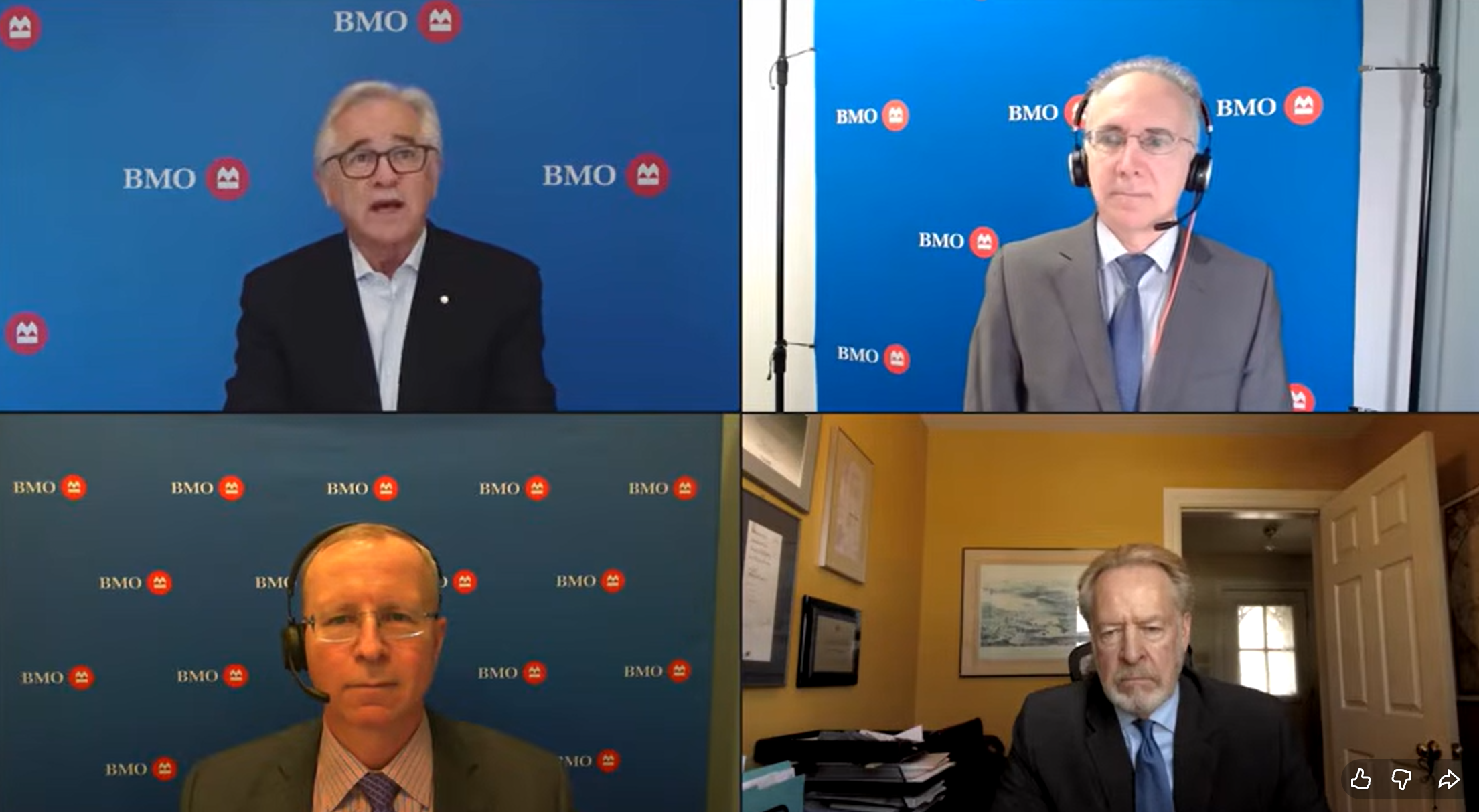
Brian Tobin, Vice Chair, BMO Financial Group, moderated an online event featuring Sal Guatieri, Director and Senior Economist at BMO; François Trahan, Chief Investment Strategist for BMO Capital Markets and Steve Verheul, Canada’s former chief trade negotiator on the global trade outlook. ‘The compliance exemption for Canada is everything,’ says Guatieri. / SCREENSHOT
As businesses and investors confront a volatile mix of trade policy uncertainty, geopolitical conflict and energy market swings, economists and trade experts say the outlook for the rest of 2026 will depend most notably on U.S. tariff decisions and oil prices.
“The single most important element is whether or not the U.S. maintains the exemption we have under the CUSMA,” says Steve Verheul, Canada’s former chief trade negotiator, pointing to a provision that currently exempts the vast majority of Canadian exports. “If the U.S. removes that exemption, then we’re in a whole different world.”
Verheul spoke at a virtual event hosted by BMO, called Global Trade Outlook: Tariff Risks and Energy Shock. The discussion was moderated by Brian Tobin, Vice Chair, BMO Financial Group and also featured Sal Guatieri, Director and Senior Economist at BMO and François Trahan, Chief Investment Strategist for BMO Capital Markets.
Tobin said there are two issues affecting global trade and markets: the Feb. 20 decision by the U.S. Supreme Court to invalidate key emergency tariffs; and renewed volatility in global energy markets tied to the conflict in the Middle East, specifically the war between the United States, Israel, and Iran. “These two together have increased uncertainty around trade policy, energy supply and near-term market conditions.”
In the near term, Washington is relying on Section 122 of the U.S. Trade Act of 1974, which allows tariffs of up to 15% but only for a limited duration and without country-specific targeting. Longer term, the administration is turning to Section 301 investigations into “unfair trade practices” and Section 232 national security probes — both of which take time to implement and face legal and political hurdles.
‘A lot of uncertainty’ ahead
The result, Verheul said, is a more uncertain and less predictable trade environment. He called the Supreme Court ruling “a serious blow” to the Trump administration's tariff policy. “Overall the approaches they have in front of them now are nowhere near as flexible as what they had under the former regime. And we're going to see a lot of uncertainty going forward.”
For Canada, the continuation of CUSMA-related exemptions is central to economic stability, Guatieri said.
“The compliance exemption for Canada is everything,” he said. “It really could determine whether the economy continues to grow even modestly, or possibly slip into a modest downturn.”
Guatieri emphasized that while a return to pre-ruling tariff levels — around 16% effective rates — would be manageable, a more aggressive escalation could have far-reaching consequences.
“Going well beyond that rate… would mark a pretty serious escalation that could materially slow the U.S. economy and global economies,” he said.
Tobin asked panellists whether Prime Minister Mark Carney’s attempts to diversify trade and open up new markets is making a difference.
“I think overall it is making an impact, and I think it’s the right direction that we should be following,” Verheul said. However, he cautioned that diversification has been concentrated in natural resources rather than manufacturing, which “is the soft spot for us.”
Look for growing tension with U.S. priorities
He also warned of growing tension with U.S. priorities including common tariffs on strategic products and common approaches to investment screening and export controls, which raises questions about how Canada can balance diversification with maintaining U.S. market access.
Trahan agreed with the strategy but highlighted its long-term nature. “It’s the right reflex, but I think it’s going to take time before we see the fruits of this effort,” he said.
Guatieri added: “Like most economists, I’m a fan of free trade and I think the more deals we can sign with as many countries as possible, the better.”
Beyond trade policy, energy markets have become volatile following the weeks-long closure of the Strait of Hormuz, affecting economic forecasting.
“The price of oil — where oil is able to stabilize — the level at which it stabilizes will tell us a lot about the outlook,” said Trahan.
Oil price swings—driven by conflict involving the United States, Israel and Iran—have already led economists to revise both growth and inflation forecasts. Earlier in the discussion, Guatieri noted that higher oil prices had pushed inflation projections above 3% while trimming growth expectations in both Canada and the United States.
Markets are showing surprising resilience
Despite the uncertainty, markets have shown surprising resilience, something Trahan attributed to a mix of stimulus, structural factors and sectoral dynamics. “Investors are confused, which is not surprising. Every time you face something you haven’t experienced before, it's kind of a scary time. You have to acknowledge that there's a lot of ‘unknown unknowns’ as Dick Cheney used to say. We all have to accept that things can change with a simple tweet.”
Trahan said there’s “stimulus in the pipeline, both monetary and fiscal” that will provide a buffer, and since Canada is an oil-producing country, its stock market has performed better than non oil-producing peers. “It's been in those countries that are dependent on energy imports that we've seen the biggest drawdowns, so the KOSPI in South Korea, the Nikkei in Japan, those are countries that are more vulnerable, certainly than the U.S. or Canada are, and so that's been initially at least the biggest source of volatility.”
Meanwhile, the combination of tariffs and energy shocks is complicating the job of central banks, which must balance competing pressures on growth and inflation, Guatieri said. “It’s probably apt to think of tariff and energy price increases as shocks to both demand and supply,” Guatieri said. “That’s a pretty tricky mix for central banks to handle.”
In Canada, the Bank of Canada is expected to remain on hold. “We see no moves for the foreseeable future,” he said, citing fragile growth and persistent uncertainty.
Canada is in a good trade position with the U.S. despite more advanced talks between the U.S. and Mexico, Verheul said. “The U.S. has been already conducting a lot of these discussions. They're fairly well advanced with Mexico, not so advanced with Canada, but in many ways, time is on our side because the pressures on the U.S. are only going to increase over time. Their whole approach on tariffs is not providing the kinds of benefits they thought it would provide.”
Verheul noted the U.S. attempts to reshore jobs haven't materialized, with manufacturing jobs down and an increased trade deficit. “It's really a question of Canada being prepared to wait this out a bit,” he said, adding that Canada is not only a leader in oil and gas, but also aluminum, potash, propane, helium and more where the country plays a central role in the economy.
“All of these commodities are seeing rapidly increased prices because of the conflict, and we'll see what kind of disruption that has going forward,” he said.
Uncertainty over what the world will look like in the coming months and what trade policy the U.S. will ultimately pursue is leading investors to “sit on their hands,” he said.
“We're going to see increasingly that there will be further pressure to try to get to places where we have more stability, more predictability, and that's positive for Canada, because that's what we're looking for and that's where we want to be positioned with respect to the review of the existing agreement between Canada, the U.S. and Mexico. So I don't think it's necessarily a bad issue from the Canadian perspective, but we just have to be patient.”