Carney, rejecting piecemeal approach, stresses urgency of Vancouver Port expansion
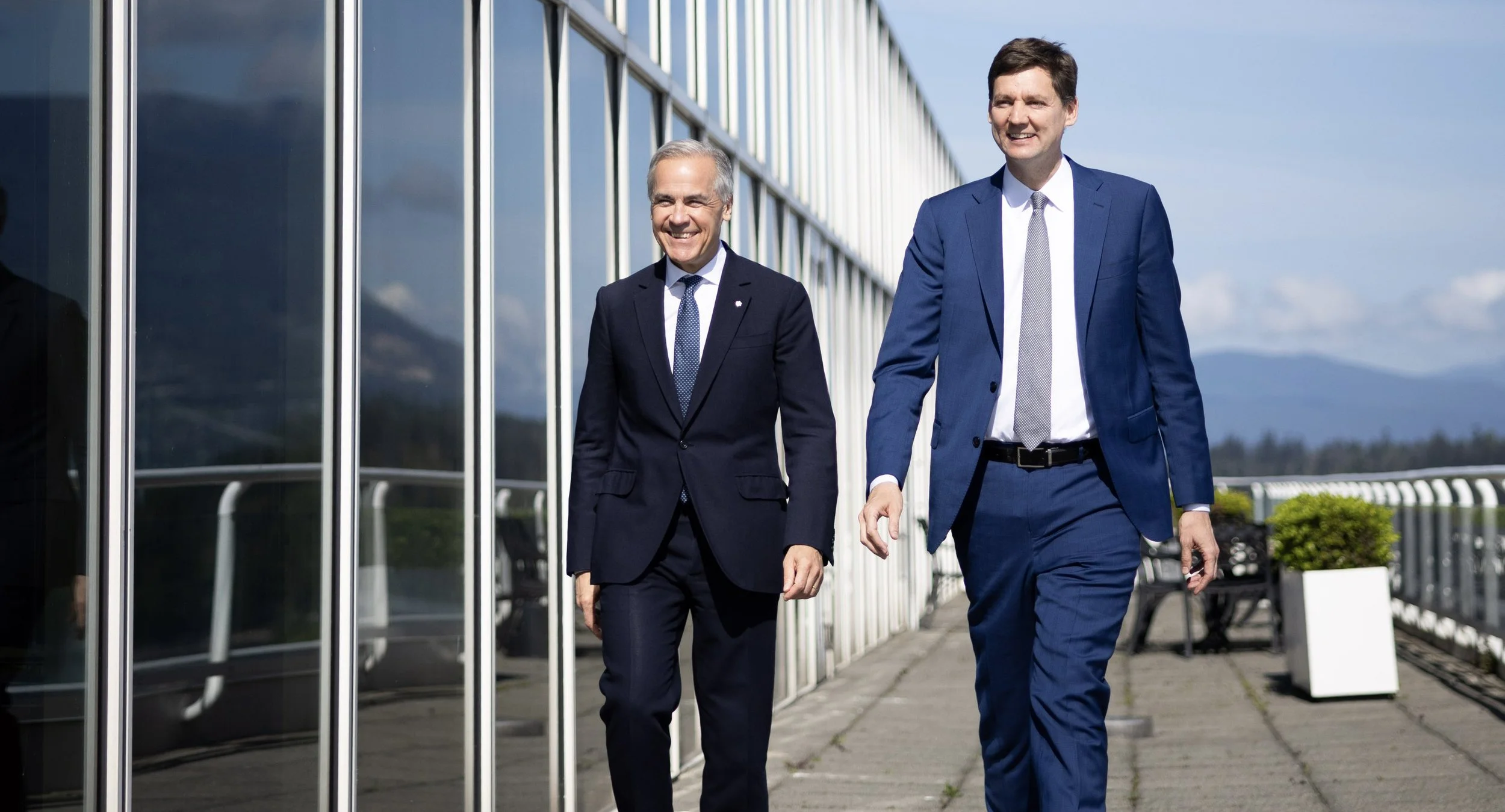
‘We’re going to build infrastructure faster – sustainably and responsibly – to drive the clean energy transition and create more opportunity and prosperity for British Columbians and all Canadians,’ says Prime Minister Mark Carney, pictured with British Columbia Premier David Eby. / TWITTER PHOTO
Coordinated and accelerated investment to expand the Port of Vancouver and its supporting trade corridors is essential to expanding global trade, says Prime Minister Mark Carney.
“We're going to run out of capacity at Port of Vancouver over the course of the next, well, less than a decade in effect,” he told the Greater Vancouver Board of Trade on May 20. “We would like to run out of capacity sooner than that, because we would like to be growing our exports faster than that, which means we need to act now.”
He described B.C. as Canada’s gateway to global markets and referenced the federal goal to double non‑U.S. exports — more than $300 billion in new trade — by leveraging the province’s international connections and its role in unlocking critical minerals and clean technology.
Carney said an integrated approach is needed “because the worst thing to do is to do this piecemeal” and risk not having a better waterfront, greater productivity, protecting habitat and building First Nations partnerships.
“We can do all that if we do it all together with a sense of urgency that the moment demands, because if we don't do this, to be clear, it is going to be very hard for us to become materially more independent, more resilient as a country.”
He said that expanding market access abroad must move in tandem with that infrastructure push. “This year we're moving forward with major trade agreements with India, ASEAN, Mercosur, Thailand and the Philippines,” he said. “And our trade partners, current commercial partners, Korea and Japan would like to buy more energy.”
Carney also noted that Canada has a strategic opportunity as a low‑risk, low‑cost and low‑carbon energy supplier, with B.C. leading in renewable power, LNG and critical minerals. Canada will need to double its electricity capacity over the next 25 years, he said, adding that “electrification underpins everything,” and pointed to new federal incentives for transmission, investment tax credits and support for Indigenous equity participation in major projects.
Affordability and housing were also referenced, with Carney pointing to measures such as the Build Canada Homes initiative and expanded retrofit supports for households. He cited federal modelling showing that “seven in 10 Canadians will pay less for their energy by 2050.”
Carney also spoke about ongoing regulatory reforms aimed at speeding up federal major‑project approvals, saying Ottawa is pursuing “one‑stop shop” legislation and closer coordination with provinces such as B.C.
His remarks came days after signing an energy agreement with Alberta, raising the effective carbon price six and a half times by 2040 — a deal B.C. Premier David Eby has said would give Alberta an unfair advantage.
As a part of the agreement, Carney said any future pipeline proposal would only advance if several prerequisites are met, beginning with “the building of Pathways, renamed the Oil Sands Alliance,” which he described as “the world's largest carbon capture utilization and storage project.”
B.C. ‘backs’ Canada, time for Canada to return the favour, says Eby
On Tuesday, Eby said Ottawa must show “at least as much enthusiasm” for B.C.’s projects as it has for Alberta’s, arguing the agreement risks leaving B.C. behind. He said British Columbia “backs Canada,” and now needs the federal government to “back British Columbia” in return.
Carney sounded an upbeat note after a closed-door meeting with Eby in which the two leaders began negotiations on economy-building projects in the province.
“Premier Eby and I met in Vancouver today to outline how a new agreement will focus our governments’ work to deliver major projects and real results for this province,” Carney said on social media after Wednesday’s discussion.
“We’re going to build infrastructure faster – sustainably and responsibly – to drive the clean energy transition and create more opportunity and prosperity for British Columbians and all Canadians,” the prime minister said. “We get more done when we work together, and that’s how we will build a strong economy for all.”
Eby, who has been critical of the Liberal government’s approach to infrastructure projects in the western region, did not comment immediately after his discussion with Carney.
The B.C. premier sharply criticized Carney last week over Ottawa’s deal with Alberta Premier Danielle Smith intended to fast-track plans for construction of an oil pipeline from her province to the B.C. coast.
Complaining that energy projects in B.C. were not being prioritized equally by Ottawa, Eby said Alberta should not be rewarded for political “bad behaviour” and “separatist premiers” should not get special treatment by the federal government.
Eby has also complained that B.C. has ready-to-go energy projects that Ottawa can support financially while Smith’s proposed pipeline to a B.C. port has no private sector proponent and no preferred pipeline route. The premier has also said his province is opposed to any moderation on the tanker ban on the northwest B.C. coast.
Carney provided a glimpse into his determination to get projects like a new pipeline moving quickly. He said Ottawa wants to adjust to peoples’ needs, but the federal government is looking for positive results.
“Look, we’re the federal government,” he told the Vancouver business audience. “It’s a big country. There’s lots of things going on. Life’s about time management. But if things get stalled here, we’re going to be spending more time elsewhere in the country because we need to move forward. We need to invest at scale in the country.”
He said one‑third of the 22 nation‑building projects currently being fast‑tracked are in B.C., calling it “a testament to the leadership of the premier” and to the province’s “energy and innovation.” Carney said the goal is to apply shared principles of partnership and sustainability to existing and future projects “in a way that makes us stronger, makes the province and the country more sustainable, and makes us more independent.”
“We’re building B.C. strong, so we can build Canada strong for all,” he said.