Liberals secure a majority government with three by-election wins

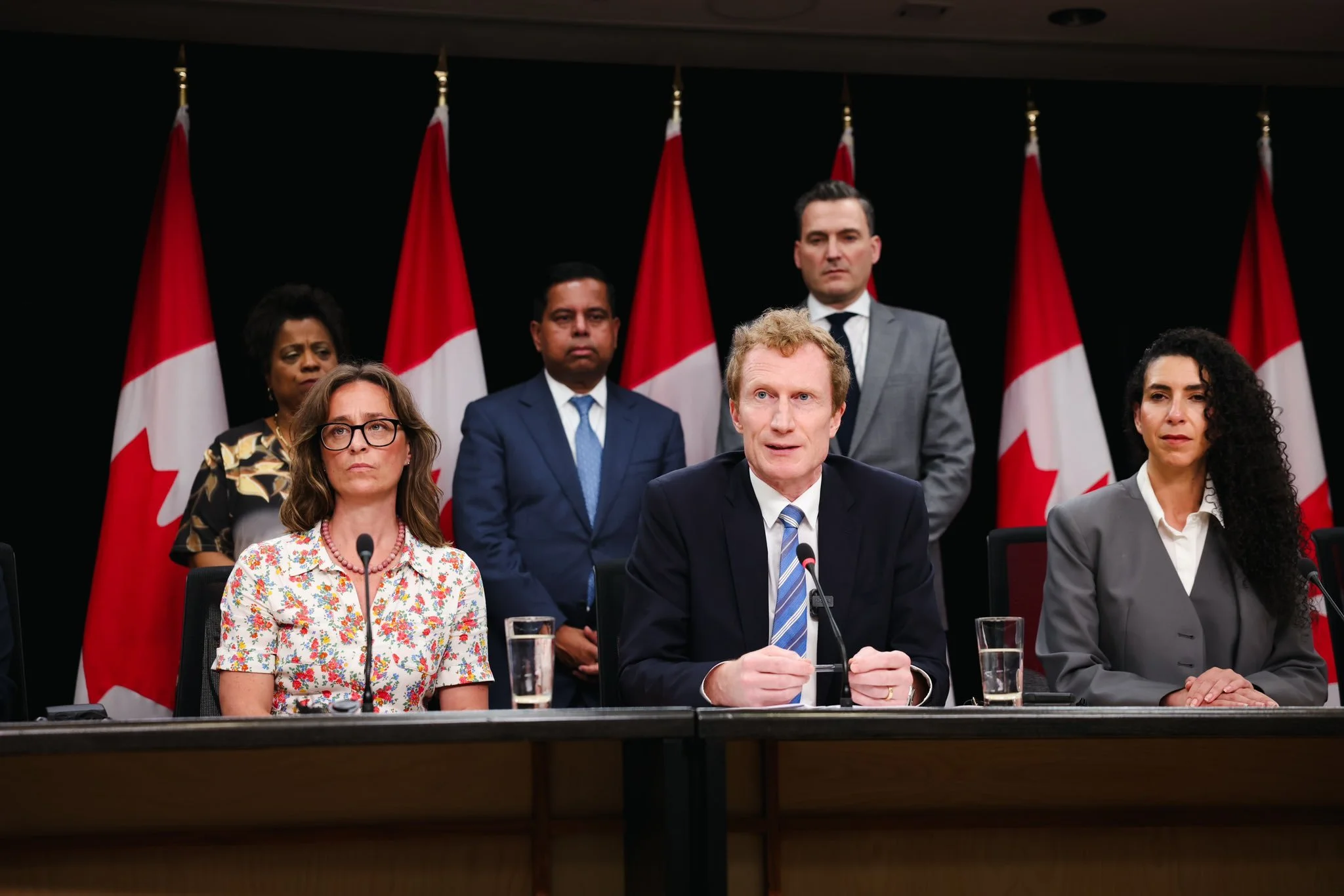
Prime Minister Mark Carney pictured with Liberal MPs Tatiana Auguste, Doly Begum and Danielle Martin. / TWITTER PHOTO
The Liberals have won a majority government with the election of Danielle Martin in University-Rosedale, Ont., Doly Begum in Scarborough Southwest, Ont., and Tatiana Auguste in Terrebonne, Que.
Martin, a family physician, ran in former Finance Minister Chrystia Freeland’s riding, which became vacant when she resigned to advise Ukrainian President Volodymyr Zelenskyy.
“Our public health care system, despite its many challenges, is one of the great moral achievements of our country. At the same time, it is also one of our country's greatest economic engines and values in the same breath,” Martin said her in her victory speech. “That is what the word progressive means to me, a commitment to equitable and decent public services and a commitment to a fair and growing economy. That is the Canada I want to help build.”
Martin received 64.4% of the vote. NDP candidate Serena Purdy came in second place with 18.9 per cent of the vote, followed by Conservative Don Hodgson.
Begum, the former Ontario NDP deputy leader, ran in the riding that was vacated by Bill Blair, who left Parliament to become Canada’s high commissioner to the U.K.
She served in the same provincial riding from 2018 to 2026.
“As Mark Carney, our prime minister says, ‘Hope is not a plan and nostalgia is not a strategy.’ So, what does that mean? That means we cannot stand still. We have to do the hard work of building a country where opportunity is real, where dignity is protected, and where every single person has a fair chance to succeed,” she said during her victory speech. “I will always fight so that families can get ahead and not just get by. I will stand up for workers and small businesses, who are the backbone of our economy. I will advocate for better transit and infrastructure. … We are given a task, a responsibility to come together to fight for this country.”
Begum won with 69.9% of the vote. Conservative candidate Diana Filipova came in second place with 18.4 per cent of the vote, followed by NDP candidate Fatima Shaban.
The night’s most closely watched contest unfolded in Terrebonne, where former Bloc Québécois MP Nathalie Sinclair-Desgagné sought to reclaim the seat lost last year by a single vote to Liberal Tatiana Auguste. The Supreme Court overturned that result, triggering a rematch in a riding the Bloc has dominated for decades. Auguste’s win signals growing Liberal momentum in Quebec.
Auguste won the seat with 48.4% of the vote, or 731 votes, followed by Sinclair-Desgagné, who received 46.8% of the vote. Voter turnout was at 50.76%.
“For me, the difference in this campaign was that people know me now. I was their MP for nine months and they know what kind of person I am and how I work,” Auguste said.
With a majority government for the first time in seven years, the Liberals now have the ability to advance their agenda with a confident long-term outlook.
Derek Holt, Vice President and Head of Capital Markets Economics at Scotiabank, said the outcome “could lend supportive stability to the Canadian dollar and domestic markets while emboldening the Carney administration to more aggressively pursue fiscal, regulatory, investment and trade policies without having to depend upon the fragmented opposition.”
The government will be expected to act, now, he said, in a note prior to the byelections. “Time to bone up on additional features within their ‘Canada Strong’ partyplatform into last April’s election. The time for delays or excuses will have passed and with it the expectations will rise across multiple policy arenas,” he said. “Once a majority is set, the machinations toward a Spring fiscal update are likely to be set in higher gear with a combination of targeted stimulus and updated fiscal position likely.”
The Liberals now hold 173 seats, with the third byelection in the riding of Terrebonne, Que., still undeclared.
In recent months, the Liberals have gained five new MPs to the government benches, four Conservatives and one NDP MP, who crossed the floor.
In response to the election results, Conservative Leader Pierre Poilievre said the majority government was a result of “backroom deals” with MPs “who betrayed the people who voted for them.”
He added: “While the Prime Minister spent the year on this cynical power grab, he has doubled the deficit, and given Canada the worst grocery prices and housing costs in the G7. … We will continue to fight for people to afford homes, food and fuel. We will continue to fight for safety in our streets. We will continue to fight for our resource workers and soldiers. I will continue to lead that fight every day and in every way in Parliament, across the country and in the next election.”
According to the latest Nanos Research polling, the Liberals hold a 13-point lead and Mark Carney is the preferred prime minister, however views on the economy are worsening. “The economic picture is darkening fast: concern over jobs and the economy has risen nearly five points in a month, inflation worry is up and anxieties about Trump and America has dropped to the third most important national issue,” says Nik Nanos, Chief Data Scientist.
The Liberals currently hold 45.3% support, followed by the Conservatives at 32%, the NDP at 12.2%, the Bloc at 5.4% and the Green Party at 3.5%.
Editor’s note: The story was updated on April 14 to include results from Terrebonne and preliminary vote result numbers from University-Rosedale and Scarborough Southwest.
Now that the Liberals have a majority government, what does it mean for the economy, businesses and Canadians?
Join us on April 20 to hear from Hon. Lisa Raitt, Vice Chair, Office of the CEO, CIBC; Nik Nanos CM, ICD.D, Chief Data Scientist, Nanos Research and Marci Surkes, Chief Strategy Officer and Managing Director, Compass Rose who will break it all down.