Priming the trade war pump
Canada’s economy is expected to avoid a recession despite the latest U.S. tariff escalation, but the trade dispute is putting renewed pressure on growth, inflation and businesses. The bigger risk, economists say, is further escalation.
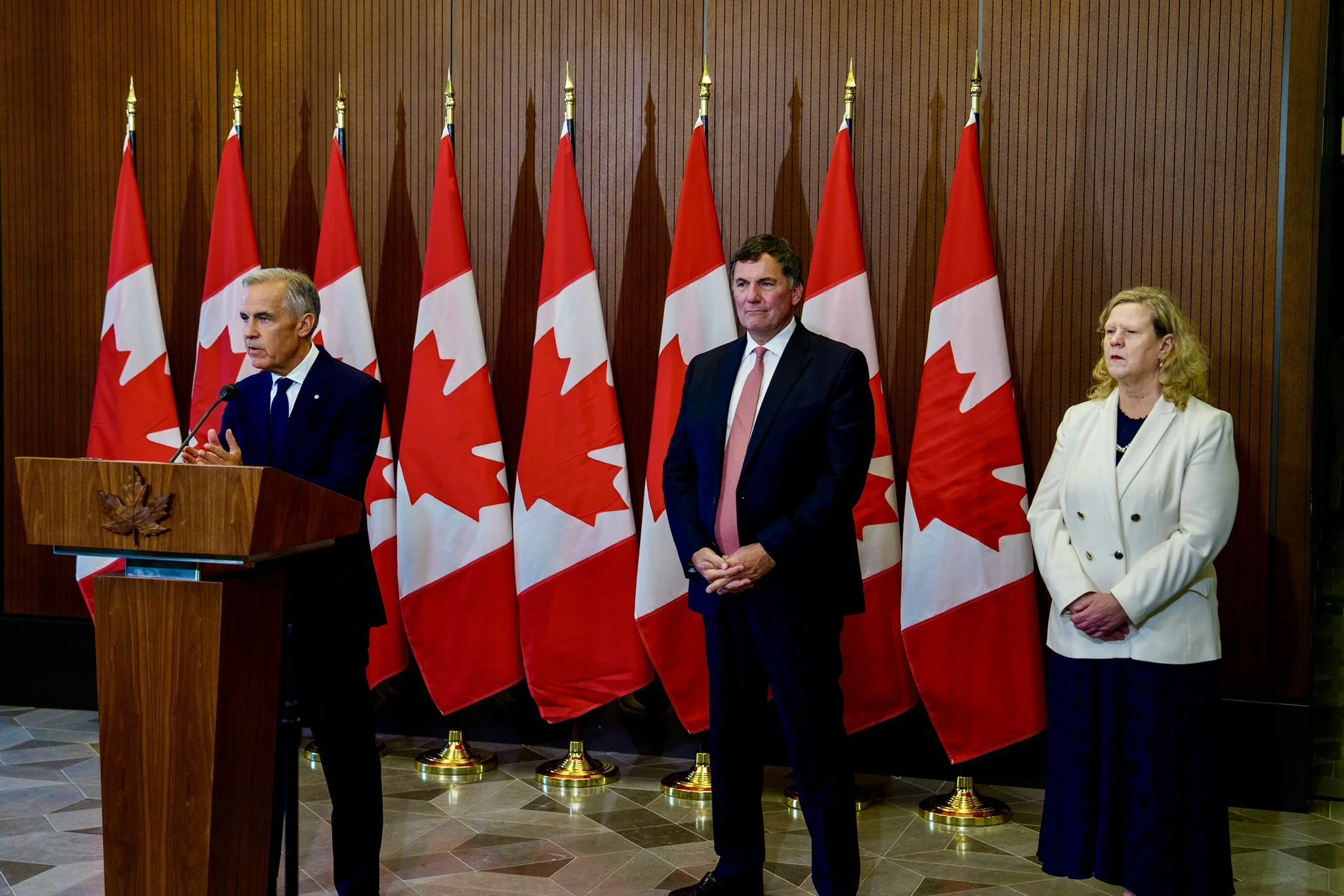
‘Team Canada is strong and united. We’ll continue supporting Canadian workers and businesses, building our strength at home and diversifying our partnerships abroad,’ says Canada-U.S. Trade Minister Dominic LeBlanc, centre, pictured with Prime Minister Mark Carney and chief trade negotiator Janice Charette. / TWITTER PHOTO
Canada’s economy is facing greater risks as trade tensions with the U.S. intensify, but the latest tariffs are not yet large enough to change the country’s overall growth outlook, according to an RBC economic analysis.
Canada remains on track for modest growth in the near term, though recent trade measures have weakened the momentum that was beginning to build. RBC’s base case remains cautiously optimistic, and the bank says the bigger concern for policy-makers and business leaders is what comes next. The main risks are “largely tied to the potential of further escalation in the U.S.-Canada trade war rather than current measures.”
The report follows the expiration of an Aug. 19 trade deadline without a deal, which ushered in 50% U.S. tariffs on $28 billion of Canadian goods.
Minutes before the negotiations broke down, the U.S. proposed “uneconomic” and “unfair” terms, Prime Minister Mark Carney told reporters Aug. 22.
“In short, they asked too much, and they offered too little,” said Carney. “More fundamentally, the cumulative effect of U.S. demands revealed the limits of their commitment to a true economic partnership.”
Carney pointed to U.S. demands on autos, the French language and discoverability of Canadian content on online streaming platforms, and limits on Canada’s independent trade agreements as unacceptable conditions.
When pressed on whether Canada was in a trade war, Carney said: “Well, yes. That's obvious.” He criticized the U.S. for violating existing trade agreements like CUSMA, adding that sometimes America’s signature is “written in pencil.”
In response, Ottawa unveiled matching countertariffs of up to 15, 25 or 50% on $27.6 billion worth of U.S. imports starting Sept. 8. The levies target sectors including steel, aluminum, appliances, agriculture, pulp and paper and electronics.
Finance Minister François-Philippe Champagne said Canada was responding to U.S. actions in a “proportionate, targeted, and strategic way,” pledging $12.5 billion worth of programs and investments to tariff-affected businesses and Canadians.
Support measures include:
$7.5 billion in enhanced business support, featuring grants and interest-free loans for small businesses, and industry loans of between $250,000 and $5 million not repayable until after the end of the current Trump administration.
$1.5 billion for the Regional Tariff Response Initiative to support small and medium-sized enterprises adapt, diversify and build greater trade resilience.
$3.5 billion over four years in worker support, including extended EI measures, longer benefits for long-tenured workers and expanded work-sharing and training supports.
The government is also urging retailers and consumers to promote and buy Canadian products, suggesting that it would push for measures enabling consumers to more easily identify Canadian products.
The RBC report estimates the direct impact on the overall Canadian economy is relatively small. The U.S. tariffs affect about 5% of Canadian exports to the United States, representing about 0.4% of Canadian GDP and jobs.
Desjardins estimates the measures could reduce Canadian real GDP growth to 0.6% in 2026 and 1.7% in 2027. Unemployment could reach 7% by year-end, compared with 6.4% in July, while inflation next year could be 0.2 to 0.3 percentage points higher than otherwise expected. The report does not forecast a recession.
“These initiatives address immediate liquidity pressures and could help prevent otherwise viable businesses from closing because of cash shortages,” Desjardins said, noting that “governments are preparing for a more persistent shock.”
The trade dispute is creating another challenge for policy-makers: keeping inflation under control.
Latest measures shouldn’t have a major impact on inflation
Canadian counter-tariffs will make it more difficult for inflation to return to the Bank of Canada’s 2% target on a sustained basis. However, the RBC report says the latest measures are unlikely to have a major effect on overall inflation unless the trade conflict gets significantly worse.
There is some evidence that tariff-related price increases can reverse quickly. The report notes that price increases caused by Canadian counter-tariffs in 2025 were promptly reversed after those tariffs were removed.
RBC expects the latest measures to have a “significant, but partial and ultimately, a temporary pass through to consumer prices in Canada.” RBC also expects the Bank of Canada to keep interest rates unchanged for the rest of 2026.
U.S. politicians offered sharply divided reactions as Trump continued to attack Canada on social media. U.S. Trade Representative Jamieson Greer told Fox News Canada didn’t want “the best deal” on steel, autos and lumber and that no new talks are planned.
Meanwhile, in retaliation to Canada’s retaliation, Trump signed an executive order on Thursday asserting that the U.S. will rename Lake Ontario as “Lake America.”
In response, Carney said, “We know that America is changing. Their trading relationships, their foreign policies, their national monuments, their hydronyms. Canadians also know that naming reality means calling it Lake Ontario – then, now and always.”
Editor’s note: This story was updated on Aug. 31 to correct the total funding support from $21.5 billion to $12.5 billion due to a typing error.