The Carney formula: Equal parts patriotism and pragmatism
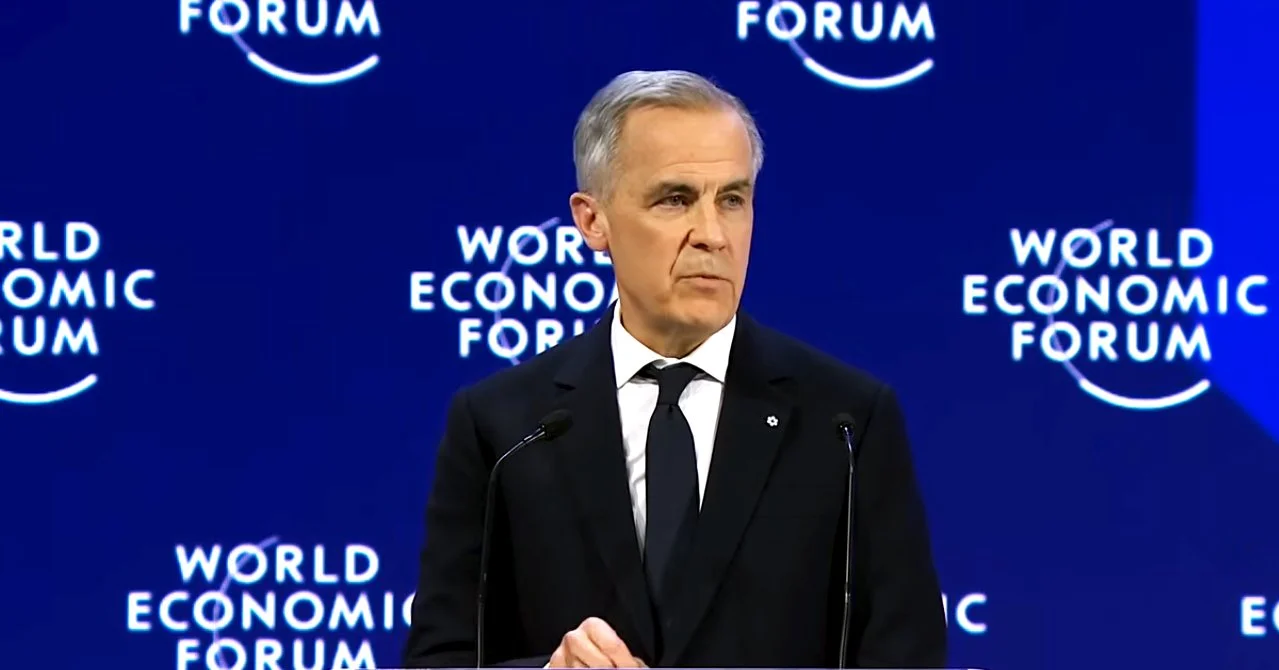
Prime Minister Mark Carney has been cautious and measured in his approach to the trade war, writes Ken Polk. He understands that there are very real economic stakes in our relationship with the U.S. / SCREENSHOT
Once upon a time, in a tongue-in-cheek bid to define Canadian identity, the flagship CBC Radio morning show, Morningside, held a contest asking listeners to finish the sentence: “As Canadian as…” The winning entry was: “As Canadian as possible under the circumstances.”
I have always thought this is as perfect a statement of “Canadiana” as perhaps there ever will be: reticent, cautious and self-deprecating. As much as I enjoy a rousing chorus of O Canada, hockey, or maple syrup, the Morningside winner has defined what it means to be Canadian in terms that feel right in my bones.
Canada and the U.S. — It’s always complicated
The “circumstances” in question are obviously the consequences, good and bad, of the magnetic pull of the United States — geographically, economically, culturally and politically.
Our economies are integrated to the extent that over a trillion dollars in two-way trade flowed in 2025. But the U.S. market is far more important to us than ours is to America. Our corporate and personal tax rates are benchmarked against those in the U.S.. The persistent lag in our productivity growth compared to the U.S. has been bemoaned by a generation of economists and Canadian business leaders. Our trade strategy has been premised on America’s global leadership.
We are also engulfed by American culture. The television and movies we watch, the music we listen to, the books we read and the podcasts we subscribe to are primarily American. We obsess over American celebrity culture. Our social media channels are American-built and owned. Our fashion trends are defined in New York and Los Angeles.
We follow what's going on in Washington more than what’s happening in Ottawa. To be recognized as a success at home, our best Canadian talent knows that they first have to make it big south of the border.
Not surprisingly, then, Canada has a complicated attitude toward the Americans: a combination of inferiority and superiority complexes depending on the circumstances.
We are exquisitely insecure about being overlooked or ignored. I had a professional taste of it just after 9/11. I was awakened early one morning by my PMO boss, who called to ask whether I thought it was a problem that President George W. Bush had not mentioned Canada in his speech to Congress the previous evening, which, in part, thanked those countries that had supported the United States after the attack.
Knowing that Canada had literally saved the lives of thousands of Americans stranded in the air on Sept. 11 when U.S. airspace was suddenly closed, I thought it odd. But I also thought we shouldn't make a big deal about it. But the media went into full-throated panic mode, whether angry at the mission or worrying that it suggested a poor relationship between prime minister Jean Chrétien and the president, or that we had committed some offense at that terrible hour.
The flip side of this inferiority complex is the collective sense of superiority we express about things we do differently and think we do better than they do: i.e., health care, gun control, or our social safety net. Chrétien’s decision not to join Bush’s 2003 invasion of Iraq has come to be viewed as a recent crowning moment of Canadian independence.
All of these conflicting cross-currents are why the concept of being as “Canadian as possible under the circumstances” appeals to me.
And then came Trump
President Donald Trump’s second-term attack on the Canadian economy and sovereignty has been stark and shocking. Even so, our response has been typically Canadian: careful, balanced and cautious, adapting as needed to changing circumstances while safeguarding our long-term interests and sovereignty identity. Balancing patriotic rhetoric with clear-eyed pragmatism.
On one level, Trump has made this easy to do. To most Canadians, Trump comes across as a cartoonish, sneering, bombastic clown. His insistence that America’s trading partners “bend the knee” created a ready Canadian audience for the “Elbows Up” rhetoric that carried Prime Minister Mark Carney to victory in 2025.
Even so, the Prime Minister has been cautious and measured in his approach. He understands that there are very real economic stakes in our relationship with the U.S.
He has taken high-profile steps to strike a note of Canadian independence, most notably with his now-famous speech at the World Economic Forum. A planned speech to the European Parliament next month will no doubt be another signal moment.
Carney has adopted a course of economic diversification, which has shown some initial progress. He has done well with the knowledge that, as never before, the U.S. is no longer the only game in town. There are other strong, like-minded countries with markets in need that Canada has to sell to.
He has taken significant steps to start building what he calls “one Canadian economy,” in which homegrown Canadian industries will be able to build and sell ever more of what Canadians buy.
But the Prime Minister also knows that it will take time to redirect our trade flows and supply chains away from the United States. The rupture of trade negotiations last week came only after months of painstaking negotiations, during which the Prime Minister steadfastly refused to publicly editorialize on progress or problems.
The break only came after he seemed to conclude that, whatever the substance of an agreement, Trump would never be satisfied and would keep coming back for more and more.
Some of the media analysis of what is known about the concessions Canada had already made at the time of the breakdown has wondered why we stayed at the table as long as we did. To be sure, the Prime Minister wanted a deal. But he also seemed intent on ensuring that, should a rupture occur, he could plausibly blame it on Trump.
In other words, he matched Trump's will to make Canada “bend the knee” with his own will to engineer Trump into the role of unprincipled, unreliable shakedown artist. Trump, being Trump, made that relatively easy.
In his speech to Canadians laying out reasons for recalling his negotiating team from Washington, Carney was firm but also matter-of-fact: “They asked too much and offered too little.” This is in contrast to Trump, who has been at his bullying worst, calling us “clowns,” bizarrely signing an executive order to change the name of Lake Ontario, and saying, “It’s time to teach Canada you can’t do this anymore.”
Who knows what comes next
What comes next for Canada depends on our tolerance for economic pain, notwithstanding dollar-for-dollar tariff retaliation and support for affected industries and workers.
Some think that the chorus of U.S. business opposition to the trade war will force Trump to back down. Others hope that the shellacking that the Republicans are on course to take in the coming mid-term elections will force Trump back to the table. Don’t hold your breath. Trump would rather have needles stuck in his eyes than bend the knee to anyone. And he has never had much use for Congress.
We’ll see. But this trade war may be a long haul. It will be a drag on the economy, costing jobs and investment, unless and until the Prime Minister’s “Canada Strong” vision becomes a reality.
Come what may, we will continue to chart a sober, patriotic, pragmatic course: We will remain as Canadian as possible under the circumstances.