Of Super Bowls, the Buffalo Bills, and Pierre Poilievre
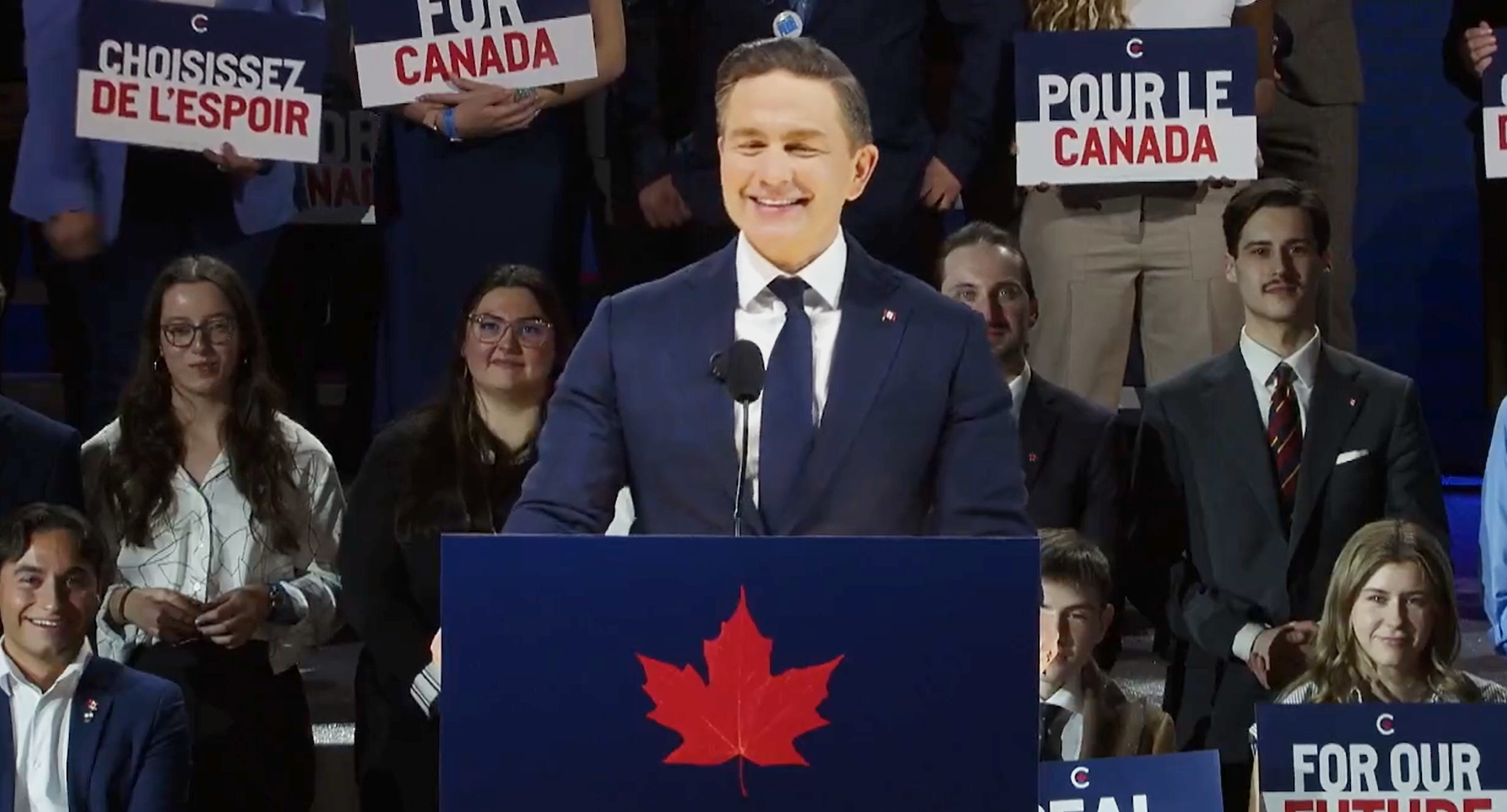
Conservative Leader Pierre Poilievre, pictured at the CPC convention, where he received an approval rating of 87.4%. / SCREENSHOT
It’s Super Bowl weekend. And while it may seem odd for non-football fans, the star-crossed history of the NFL’s Buffalo Bills in the Super Bowl may hold a cautionary tale for Pierre Poilievre and the Conservative Party as they plan for the next federal election: the political Super Bowl for obsessives, like me.
The Buffalo Bills appeared in four consecutive Super Bowls in the 1990s. This was an awesome team, an offensive and defensive powerhouse, head and shoulders above almost every team they faced. Sadly for the Bills and their fans, the only team they could not beat during this terrific run was the one they faced in the Super Bowl. So this run of football excellence has gone into NFL lore as a monument to futility.
Worse, it was not just that they lost four times; it was the way they lost that was so dispiriting. They lost their first Super Bowl by just one point, a true heartbreaker. They not only kept losing, but they were also crushed in every other game. So, in the end, the best Super Bowl memory left to Buffalo fans is that first heartbreaking loss.
Poilievre: The song remains the same
Which brings us to Opposition Leader Pierre Poilievre.
The 87.4% vote for Poilievre at last week’s leadership review was very impressive. For those, like your humble correspondent, who speculated about the possibility of so-called Red Tories or Premier Doug Ford damaging Poilievre enough to spark an overthrow, well, I suppose you could say we were, in this case, the Buffalo Bills of Conservative punditry.
The result demonstrated to anyone out there who does not like Poilievre’s style of politics that the Conservative base likes it a very great deal. Indeed, despite the defection of two MPs to the Liberal Party since the election — each citing the leader’s style as a reason for defecting — the party membership doubled down on Poilievre.
Poilievre, in turn, doubled down on the formula he has applied since becoming Conservative Leader in 2022. His focus is on the economy and affordability. His pitch is still aimed at what he calls the “forgotten Canadians” — especially young Canadians — who work hard, play by the rules, pay their taxes and scrimp and save to build a better life but feel shut out by the dead weight of the federal government. Affordability remains his watchword, with pledges to cut the price on everything from food, gas and clothes to homes. He still wants to axe the carbon tax and force through oil and gas pipelines. He still plans to slash deficits and fire bureaucrats. He will be tough on criminals and big on defence.
It is, in short, the same pitch that saw him get within 20 seats of becoming Prime Minister of Canada last April.
Not surprisingly, there was no mention of President Donald Trump in his speech. Here, too, Poilievre and his team have decided, as they did during the spring campaign, that Trump is a kind of “kryptonite” for Poilievre and a kind of political steroid for the Liberals. Poilievre’s Trump stand-in is his Canadian Sovereignty Act, which, in sum, gathers together a host of anti-Liberal 2025 policy pledges into a manifesto of Canadian nationalism and patriotism.
Can Poilievre win on the replay?
What really allowed Poilievre to dominate Canadian federal politics — until he didn't — was his identification of inflation and affordability as Canadians' primary post-pandemic concerns, planting his political flag there well ahead of the Liberals or the NDP. He lost an election he seemed destined to win. Nevertheless, he seems to be anticipating Prime Minister Carney’s failure to solve these problems as the key to victory the next time around. Rather than identifying the coming policy wave, as he did so well on inflation, Poilievre seems content to wait for Canadians to catch the old policy wave back to him. He needs only to stand still.
No doubt, unintentionally, he actually identified in his speech the political dilemma that he faces in trying to win on the replay: “It’s funny to watch the Liberal rhetoric. First, they said, ‘Conservatives have no policies. It’s just slogans.’ Then they said, ‘Conservative policies are very scary.’ And then they said, ‘We agree with all the Conservative policies.’ The best part of being Conservatives is that eventually everyone admits that we were right all along.”
This is a fairly direct admission by Poilievre that the Carney Liberals have moved to occupy economic policy terrain that had been ceded to Poilievre almost by default by the Justin Trudeau Liberals. If nothing else, the Prime Minister has made it clear his government will fight like heck for this terrain. So, the economic contrast that powered so much of Poilievre's rise in the polls is gone, or at the very least much less stark.
Only avid fans remember who loses a Super Bowl
Which brings us back to the cautionary tale of the Buffalo Bills. They came so close to winning the first time around. They ran back to the same strategy year after year, certain that victory was just a matter of time. Only to fail each time.
This is the heartbreaking outcome that Poilievre seems ready to risk by appearing to be standing pat. Apart from what seems to be a warmed-over policy set and message, there is the fact that Trump is not going anywhere, at least until 2028. Then there is the demonstrated fact that Poilievre’s style and substance has made him a human get-out-the-vote machine for the Liberals among progressive voters.
All of this suggests that Poilievre will have to do much more than stand pat if he seriously plans on finally winning the Canadian political Super Bowl. Otherwise, he and his party may have to content themselves, like Buffalo Bills fans, with having come so close that one time.