How much progress can Canada make at transforming the auto sector?
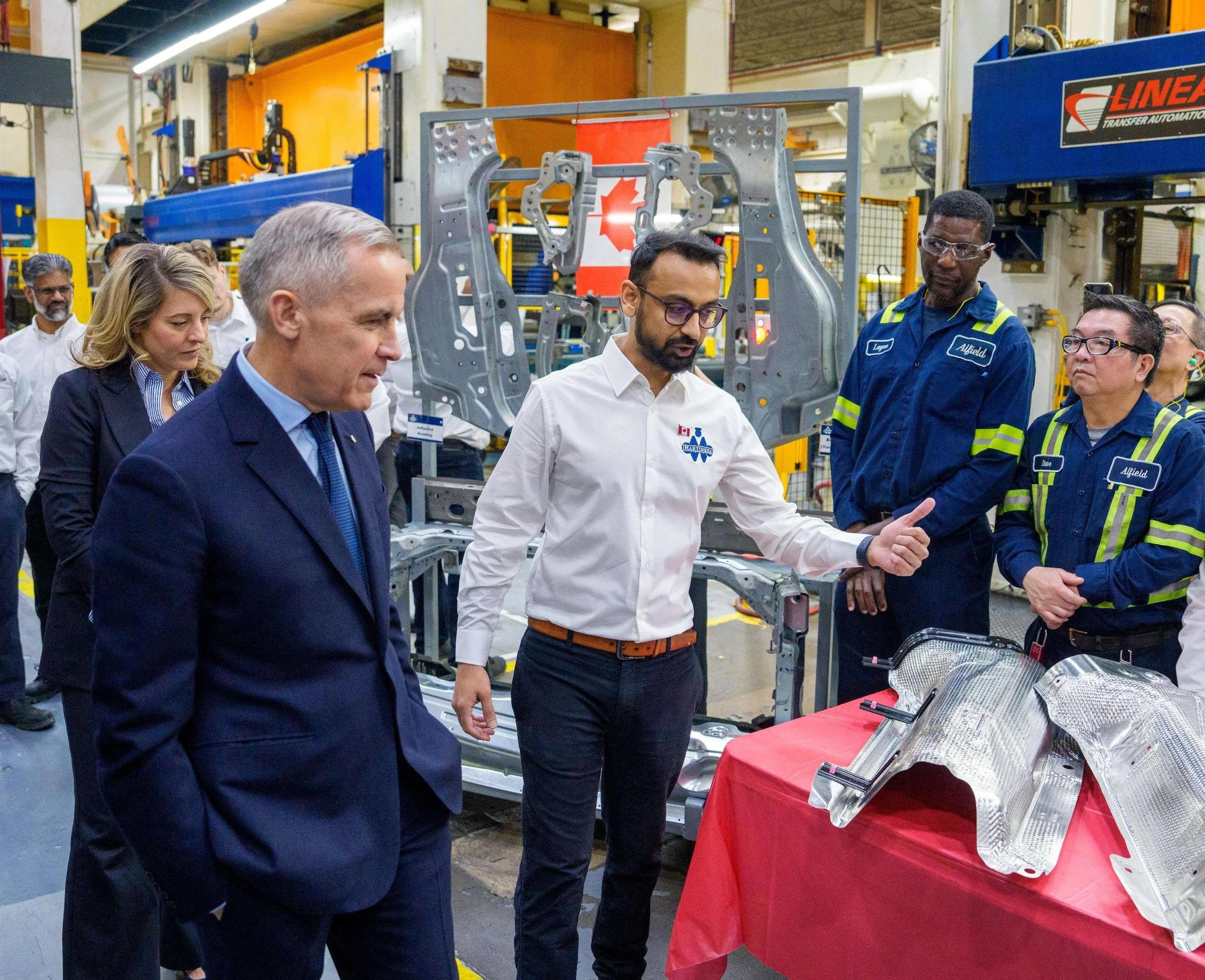
Prime Minister Mark Carney visited an auto parts manufacturing facility in Vaughan, Ont. / TWITTER PHOTO
Treading the path carved out in Davos, Prime Minister Mark Carney moved to relieve Canada’s auto industry from its traditional reliance on the U.S. market and further encourage development of a world-class electrical vehicle sector.
As with his widely-lauded speech at the World Economic Forum in Switzerland, where Carney said middle powers must build a new trading economy in response to the U.S.’s destructive protectionism, the prime minister’s proposed go-it-alone auto strategy will be examined closely in Washington.
Noting that Canada’s goal of preserving free-trade in autos and parts with the U.S. is not shared by the Trump administration, the prime minister reconfigured the federal government’s plan for sustaining the sector in the face of today’s U.S.-driven trade crisis while prioritizing EV production for the post-carbon future.
Federal guidelines on the Canadian industry’s future production of low-emission vehicles were tweaked in accordance with automakers’ requests. And the Liberal government set out a $6-billion-plus package of EV consumer rebates, business assistance, support for new charging infrastructure and measures to incentivize the world’s auto companies to build vehicles in Canada.
The goal is to “make our industry world leading regardless of the outcome” of this year’s review of the Canada-U.S.-Mexico (CUSMA) free-trade deal, Carney said. “This is what a confident country does.”
Thursday’s announcement was welcomed by Ontario Premier Doug Ford and automakers. But the strategy, admittedly a planned rear guard action to respond to the possible collapse at President Donald Trump’s hands of CUSMA-aligned auto trade, is a complex amalgam of measures meant to make the best of an unpromising situation.
Is Canada ready for generational transformation?
It formulates a response to the need to remake Canada’s vehicle production architecture and take full advantage of opportunities arising from our auto-making expertise, exceptionally skilled workforce and government investments in battery innovation. But Carney’s new multi-pronged, aspirational strategy is giving rise to questions about how much progress Canada is actually likely to make in this proposed generational transformation of one of the country’s key economic sectors.
First and foremost is whether Canadians can be convinced to buy EVs in sufficient numbers. Consumer incentives may help, but buyers aren’t going to move away from internal combustion engines on the needed scale until electric vehicles become a lot more affordable and charging stations become a lot more plentiful. The feds earmarked $1.5 billion for charging infrastructure but the task is formidable. By one estimate, charging stations will need to increase to about 250,000 in 10 years from the current 34,000 ports.
The other major question is whether foreign automakers, who have in the past mostly put plants in this country to access the U.S. market, will respond to Ottawa’s measures meant to convince them to invest more in production here. Otherwise, the Liberals’ vision of creating a domestically self-sufficient sector with a future-oriented focus on selling EVs around the world will prove overly ambitious.
To have any chance of success, the new policy will in the short term at least have to reverse the drift away from EV production commitments caused by the drop in consumer demand for non-gas car options, which continued alarmingly Friday as Stellantis took a $26-billion (U.S.) writedown as it reversed its EV strategy.