Indigenous ownership key to building major projects in the North: Northwest Territories Premier Simpson

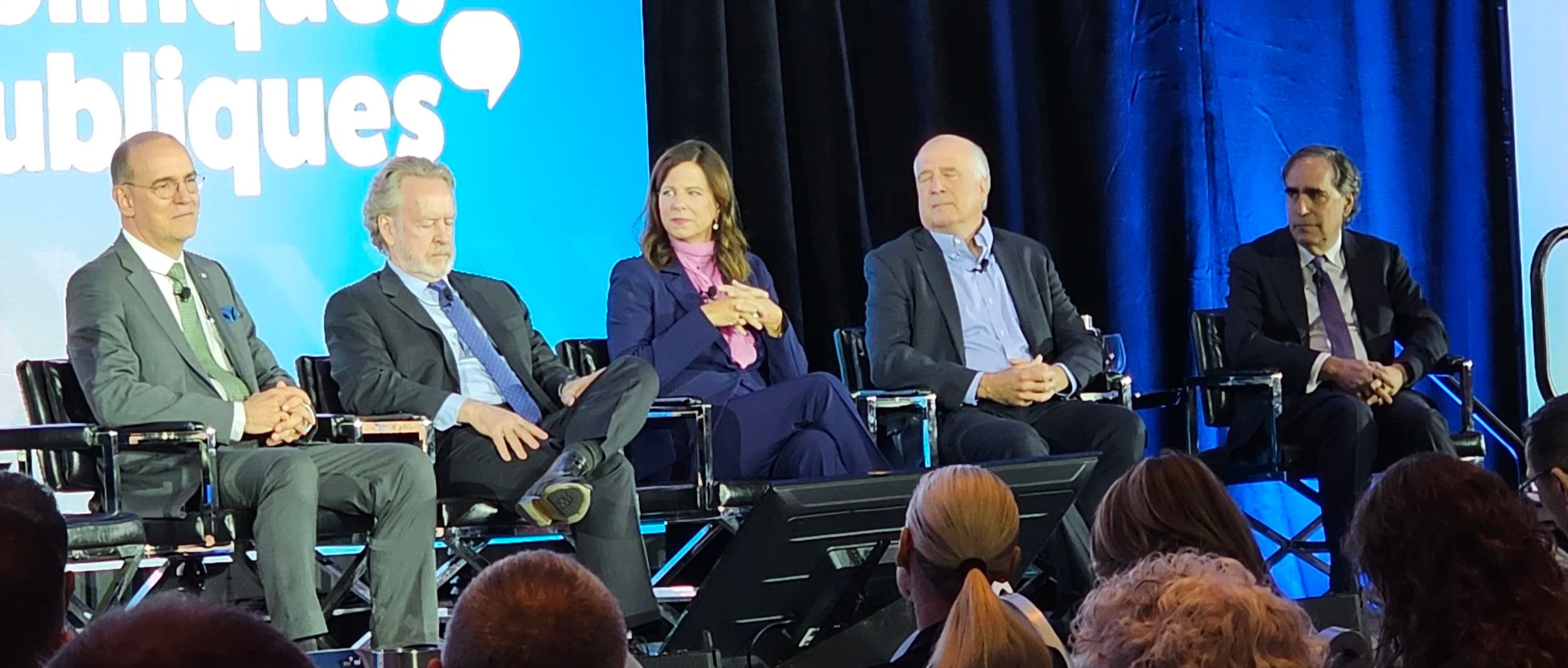
Moderator JP Gladu, Principal of Mokwateh; Sean Boyd, Chair of the Board, Agnico Eagle; Anne-Raphaëlle Audouin, Chief Executive Officer of Nukik Corporation; Erin O’Toole, former Conservative Party leader; and Northwest Territories Premier R.J. Simpson spoke about Indigenous participation in major projects on a panel at the Public Policy Forum Growth Summit. / MEANS & WAYS PHOTO
TORONTO – Without Indigenous ownership and participation in major northern projects, they won’t get built, says Northwest Territories Premier R.J. Simpson.
Bringing Indigenous people and communities in is why these projects are moving forward, Simpson said May 7 at the Public Policy Forum Growth Summit in Toronto. “Otherwise, people are willing to lay down in the road and make sure these projects don't happen.”
Simpson pointed to the Mackenzie Valley Highway as an example of how Indigenous-led advocacy can work. “The Indigenous governments from up and down that route have all come together, and we've jointly advocated to the federal government for this project, and we've been very clear to the federal government that this needs to be done on our terms as the owners, which means there needs to be robust Indigenous involvement.”
Simpson, speaking on a panel about Arctic investment, contrasted that vision against recent history, citing the Giant Mine remediation project as a missed opportunity for economic reconciliation. The mine operated for decades, releasing 200,000 tons of arsenic trioxide dust into the environment and affecting communities that relied on the land. When the remediation contract went to American-based multinational Parsons rather than to a local Indigenous development corporation, it illustrated precisely the problem the North is trying to move past.
It’s ‘not complex’ to have the necessary conversations
“It's not complex on how to bring people in,” Simpson said. “It just takes time to understand the situation, have those conversations and create the current processes that are responsive to that.”
The panel also featured Sean Boyd, Chair of the Board at Agnico Eagle, Anne-Raphaëlle Audouin, Nukik Corporation CEO and former Conservative Party of Canada Leader Erin O'Toole. The panel was moderated by JP Gladu, Principal of Mokwateh, an Indigenous-owned consulting firm.
Audouin, whose corporation is 100% Inuit-owned, described a territory that covers 20% of Canada's landmass but remains almost entirely cut off from national infrastructure.
“There is no road, there's no bridge, there's no transmission line connecting the rest of the country,” Audouin said. The consequence is total dependence on imported energy and foreign-controlled communications. “One hundred per cent of all of our energy needs are met by diesel — schools, businesses, hospitals, industry, everybody relies on diesel.” Most years, 100% of all petroleum products come from outside Canada, mostly the U.S., she said.
The digital situation is equally precarious. “Our telecommunication is low-orbiting satellites that mostly relies on Starlink, owned by you know who in you know where,” she said, referring to Elon Musk in the U.S. “Simply put, Nunavut has no energy security and has no digital sovereignty.”
Audouin argued that Inuit ownership of major projects emerged not from a desire for profit, but from necessity. “The Inuit didn't start on that ownership cycle for bigger projects because they were hoping for financial gains,” she said. “They really looked at it as ‘We are not thriving here, and we are not going to be able to thrive as a society if we continue to rely on others.’”
She said the Inuit took the lead on projects to fill a “gap in the governance” caused by the federal government’s failure to lead. “You cannot have true self-determination until you have that economic autonomy.”
For Inuit, economic sovereignty is matter of survival
In March 2025, Nunik and the Nunavut Government jointly identified four major infrastructure priorities as part of a sovereignty strategy. The corporation's flagship project — a $1.2 billion initiative to bring domestic hydropower and domestic fibre optic connectivity to the territory — illustrates what Inuit-led development can look like. “You just wouldn't have a project without Inuit pushing forward for that initiative,” she said.
O’Toole, a long-time advocate for northern development, said the political signals from Ottawa are now more promising than they have been in years, pointing to Prime Minister Mark Carney's early decision to visit Iqaluit — not a southern swing riding — as one of his first domestic stops after taking office.
He noted that decisions about the north cannot be made without consultation and partnerships with Indigenous communities and governments. “You have to show up and build those partnerships,” he said.
O'Toole said major announcements like the Grays Bay Port and Road Project signal the beginning of a long-term infrastructure renaissance — but he warned that private capital will not follow without firm government commitment. “Until the government can commit a set of funds to a major project, you're not going to get the private sector coming in. There's interest, but they have to see that the government is there with their share, with their official upfront investment.”
He also emphasized that the current moment must translate into sustained, non-partisan action. Drawing on the experience of projects announced under the Harper government that only came to fruition years later, he cautioned that long timelines demand long-term vision. “If you don't have a long-term vision, you're never going to succeed. Let's make sure, as the Premier said, this is more than just a moment.”
Boyd, whose mining company has operated in the North for nearly 20 years, said collaboration and long-term commitment is essential. “We're about to embark as a country on something that's almost unprecedented in terms of the scope, the scale, and the timeline that we need to get it done,” Boyd said.
He acknowledged his own company's early stumbles. “When we first went to Baker Lake, our view was: we're visitors. Let's try to understand what we bring to the table.” Within two years, the company had incurred a billion dollars in losses. “We overestimated our ability to develop,” he said. “But we didn't leave.”
Stay-and-build versus extract-and-depart
That decision to stay is what separates companies that build lasting relationships from those that extract and depart, he said.
He identified the lack of skilled labour as a critical barrier to building in the north, noting that roughly 300 students graduate high school annually in some northern communities, many without exposure to the trades needed for major infrastructure development. Tying northern development to a national immigration strategy for specific skills will be important, he said.
Boyd called on Canadian companies with northern experience to stop waiting on government and start sharing knowledge. “All big public companies in Canada that have experience with big infrastructure and experience in the North have to be at the table, transferring their knowledge and experience, because the government needs our help — territorial governments, the federal government, and communities.”
He said it is urgent to start now. “It's not perfect, and this will not be perfect. There are going to be mistakes made going forward. But we can't wait until everything is wrapped in a bow before we can start,” he said. “We just need to get started.”