Canada needs to seize the opportunity in front of us, say trade experts
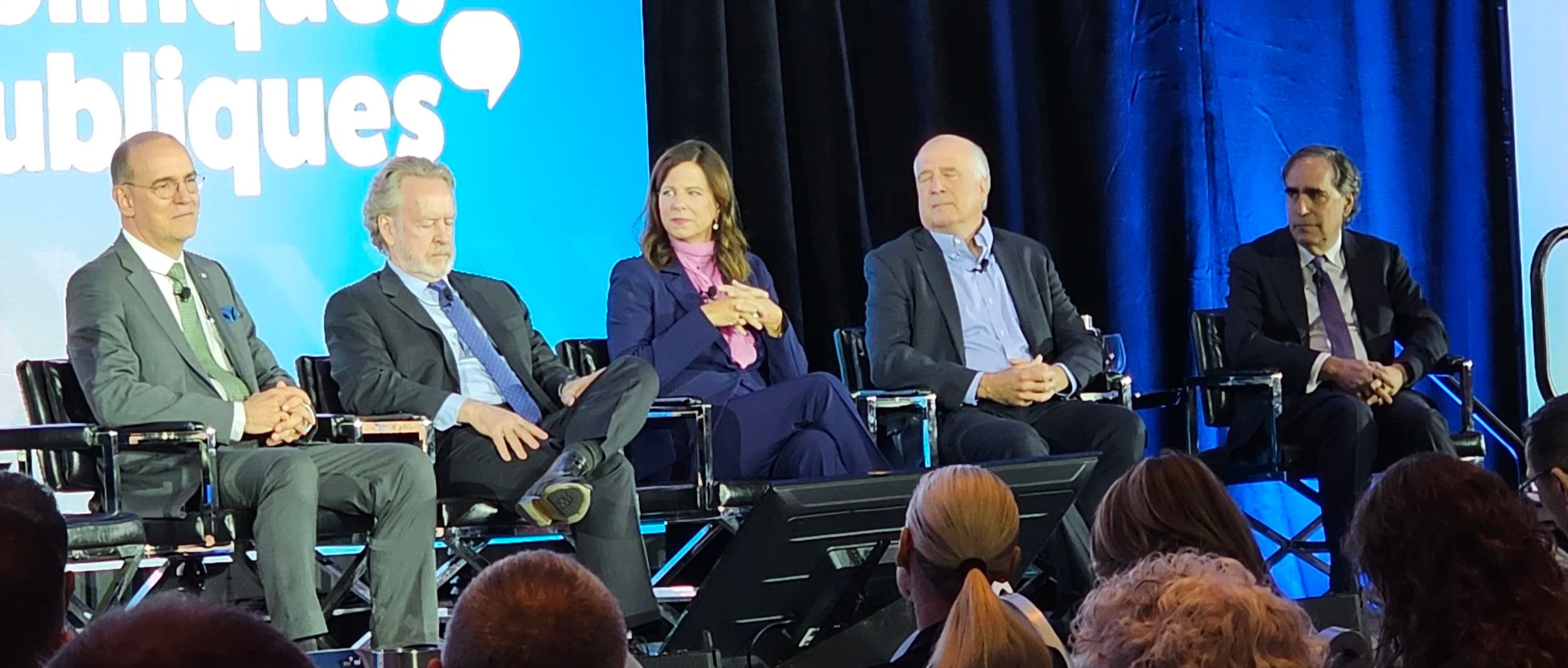
Vivian Abdelmessih, EDC Board Chair, moderated a panel discussion about Canada’s trade future with Michael McAdoo, Partner and Director, Global Trade & Investment, Boston Consulting Group; Steve Verheul, former Chief Trade Negotiator for Canada; Louise Blais, Quebec’s representative for the renewal of CUSMA and continental trade; Robert Greenhill, Chair, Global Canada; and Avery Shenfeld, CIBC chief economist at the Public Policy Growth Summit. / MEANS & WAYS PHOTO
TORONTO – Canada must pursue a U.S. trade deal as its primary objective while simultaneously building on diversifying trade of the assets that cannot be relocated south of the border, according to a panel of senior business and trade experts.
"We do have to be still focused on Plan A, which is getting a deal with the U.S. that's the best we can," CIBC Chief Economist Avery Shenfeld told the Public Policy Forum Growth Summit attendees.
With roughly 75% of Canadian exports destined for the U.S., he argued that even significant diversification wins would be difficult to feel at the macro level.
At the same time, Shenfeld pointed to the parts of the Canadian economy best positioned to grow globally — particularly natural resources.
"We have to be realistic that what we do have that can't be moved to Tennessee is we have resources in the ground," he said. With the Americans having refrained from tariffing Canadian oil and natural gas, and global demand intensifying amid Middle East instability, Shenfeld argued that energy exports represent Canada's strongest hand internationally.
Shenfeld was speaking on a panel moderated by Vivian Abdelmessih, EDC Board Chair, about Canada’s trade future. The panel also featured Michael McAdoo, Partner and Director, Global Trade & Investment, Boston Consulting Group; Steve Verheul, former Chief Trade Negotiator for Canada; Louise Blais, Quebec’s representative for the renewal of CUSMA and continental trade and Robert Greenhill, Chair, Global Canada.
Blais said that while Canada is doing the right things and there is a lot of change in the global trade environment, it doesn't mean that "fundamentals aren't still there. Those fundamentals are map and geography, and those cannot change. Not even the president of the United States can actually change those things."
She said it's essential that while we should be seizing the moment to grow Canada's economy, we can't forget that the growth is anchored in North America and its value chains.
"That's not a bad thing. This is a strength in my view, and I think we should reinforce it," she said.
Robert Greenhill, chair of Global Canada, argued that the current global disruption represents the best opportunity in three decades for internationally minded Canadian companies. Supply chains are being restructured worldwide, he said, and Canada is well positioned to fill new roles. He called for an "export team Canada" of top CEOs working in concert with government, and urged companies to build dedicated, multi-year pipelines for international market development — much as Bombardier did with a separate international group that pursued markets outside Western Europe and North America for five years.
"The mindset has to be not 'we have to do this as a response to a threat from the United States,' but as an opportunity to be seized," Greenhill said.
Verheul, who led Canada's negotiating team on the original CUSMA agreement, said he doesn't expect anything to come from the current review. "At least in the foreseeable future," he said, saying both Canada and the U.S. are seeking significantly different concessions. "Those discussions are going to continue to be in a space where there's not a good match at the negotiating table," he said.
He noted that existing CUSMA exemptions have taken some heat out of the situation, reducing urgency for a quick resolution. "We can't entice them to an end game. We have to see where the U.S. is going to be when they want, on their own — probably as a result of domestic pressure — to try to get to some kind of end game."
McAdoo said that despite considerable rhetoric, new manufacturing investment in the United States has not materialized in any meaningful way.
"No one that I know is putting down new capital in the U.S.," he said. "Because they have to take this to the board — it's a $500 million minimum ticket, usually in the many billions to do a new factory — and the first question the board asks is, what's your assumption around tariffs?"
McAdoo described work his firm did for a U.S.-headquartered medical technology company with operations in the EU and the U.S. After analyzing 800 individual products, the conclusion was that only if tariffs hit 18% or higher would it make sense to shift production to the U.S. Below that threshold, companies have three other options: squeeze suppliers, improve efficiency, or pass costs to consumers. "Every company has this tipping point," he said, "and if you don't know what the tariff is, how do you know what the tipping point is?"
Blais said there is a notable shift in sentiment in Washington.
"How we felt, they now feel it — and Democrats feel it," Blais said of American allies who have watched Canada's response to U.S. trade pressure with growing concern. "They are urging us to send different signals to show that we're interested in solving the problem."
Blais warned that delay is deepening the diplomatic divide. "The longer we go not responding that we are listening to them and we understand how they feel, the deeper the rut is going to be, and the harder it's going to be to come back."
On the domestic front, she sounded an alarm about the cascading impact of tariffs and countermeasures on Canadian manufacturers. Companies in Quebec and elsewhere that had done everything right — automating, restructuring, modernizing — are being sideswiped by Chinese goods diverted from the U.S. market. "It is absolutely becoming a minefield to operate pretty much any business in Canada today," she said. "Companies are going bankrupt as we speak, and those companies will be gone forever."
Asked for the single most important action Canada should take, panelists converged on a common theme: speed.
“I think we're doing a lot of the right things, so I'd say the one thing that we're maybe not doing is speeding it up as much as we can," Shenfeld said.
Verheul called for sustained urgency across all fronts. "I think the one thing that we do need to do is continue to approach all this with a sense of urgency. Because really, we have to get all things done all at once. And we need to do it quickly, whether it's infrastructure, whether it's getting resources to places where we can sell them, whether it's getting businesses ready to export to other markets," he said.
Blais flagged electricity supply as a critical and underappreciated constraint on Canada's future competitiveness. "We've got to make sure we don't have a blackout in Canada," she said, warning that growing electrification demands are straining capacity.
Greenhill urged for a renewed focus on attracting and retaining top global talent. "Coming back to the war for talent, we need to make sure that while we're dealing with overall numbers, we continue to improve our ability to attract and retain and attract back the best and the brightest. And that's not an issue of numbers, as much as quality and capability. And for people who have those service jobs that are doing them elsewhere, we should make it very easy for them to come here with their jobs," he said.
McAdoo agreed, saying Canada needs to move where the puck is going. "I think we have to look at where the future is going to be. And the good news is that's actually positive for Canada, right?" he said. "Yes, we have the resource base. But I don't think you want to turn into Australia which is so dependent on that and so dependent on one customer by the name of China. But a bunch of the things that require the knowledge and skills around artificial intelligence and industrial automation, you know, key sectors of the future, we have the technology. We have the people, we have the brains to do it, and that's where I'd be focusing."