Life sciences strategy in development: Joly

Industry Minister Mélanie Joly, pictured with former Treasury Board Secretary Graham Flack. / MEANS & WAYS PHOTO
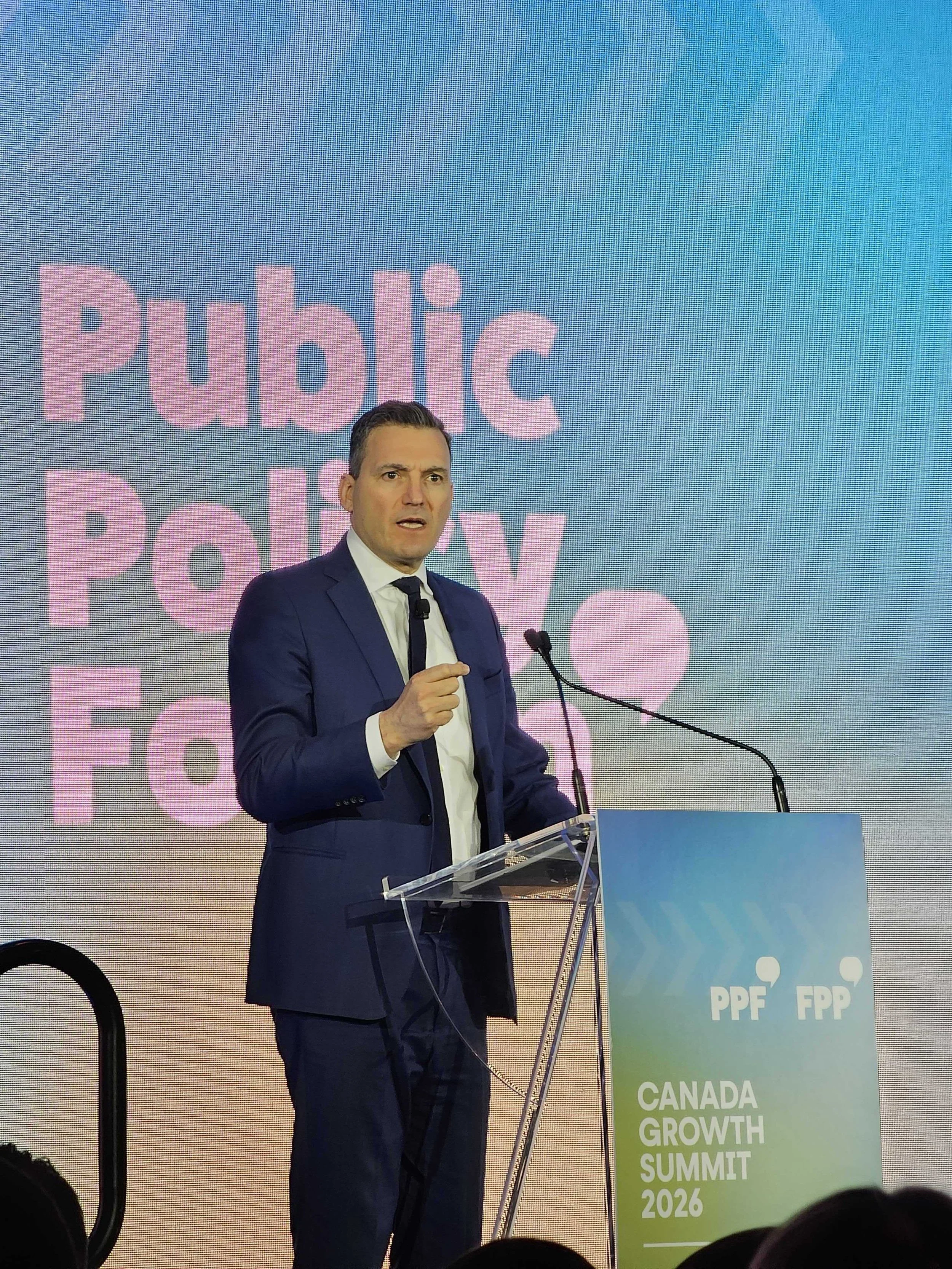
TORONTO – Industry Minister Mélanie Joly, who spoke at the Public Policy Forum Growth Summit, confirmed that a dedicated life sciences strategy is underway, developed jointly with the Minister of Health. “We've created a working group to be able to address the issues of commercialization of research, but also at a time where the U.S. is offering a lot of incentives to our pharma companies and life science sector companies,” she said during a Q&A with former Treasury Board Secretary Graham Flack, adding that the strategy aims to grow pharmaceutical spin-offs from universities and strengthen Canada's generics sector.
“We need to be able to build back that sector even more,” she said. “It's not only a question of being able to have sovereign capabilities. It's more than that — it's actually being able to do spin-offs from our universities and grow some real pharma companies.”
In the wide-ranging conversation, Joly addressed the country's long-standing productivity gap, arguing that the economic disruption brought on by the trade war has forced a fundamental rethink. “Businesses cannot take for granted what they did even two years ago,” she said. “And so they have to start taking risks even more, and they have to become more productive.”
Joly pointed to several federal tools: a productivity super-deduction introduced in the last budget, the Strategic Response Fund, and a new sovereign wealth fund in development designed to catalyze private capital. Canada's current standing as the second-highest GDP growth in the G7 and highest per capita foreign direct investment is evidence the approach is gaining traction, she said, while acknowledging the structural challenge remains real.
On the auto file, she said her strategy involves deepening relationships with Japanese automakers already established in Canada, attracting German and Korean investment, and pursuing joint ventures with Chinese companies to ensure Canada is not left behind on electrification.
“Electrification is where the rest of the world is going,” she said, warning against North America becoming “the last market jurisdiction in the world where we're adopting these new technologies.” She pointed to progress with Siemens announcing its AI and battery R&D centre will be located in Canada, joining Volkswagen battery plants in St. Thomas and Windsor.
“It's more than just markets and spreadsheets — it's fundamentally fighting for people's livelihoods and communities,” she said.
On the defence industrial strategy, Joly outlined targets that signal an aggressive expansion of domestic capacity: 125,000 jobs to be created, defence exports to rise 50%, sector revenues to grow 240%, and the share of Canadian Armed Forces procurement going to Canadian companies to climb from 42% to 70%.
The governing framework, she said, is a “build, partner, buy” strategy — prioritizing domestic capacity first, then alliances with trusted partners such as the Saab-Bombardier Global Eye project, and purchasing from abroad only when no other option exists. The submarine procurement — with bids from TKMS and Naval Group both in play — was cited as a current example where industrial benefits to Canada will weigh heavily in the final decision.
Closing the session, Joly framed Canada's response to global protectionism not as a bilateral U.S.-Canada problem, but as an opportunity to build coordinated industrial alignment among like-minded middle powers, as Prime Minister Mark Carney noted in his Davos speech.
“It's not the U.S., it’s not China — it's the middle powers together,” she said.