Canada’s AI strategy will be pro-worker, sovereign and serve people, says Solomon
Vivian Abdelmessih, EDC Board Chair, moderated a panel discussion about Canada’s trade future with Michael McAdoo, Partner and Director, Global Trade & Investment, Boston Consulting Group; Steve Verheul, former Chief Trade Negotiator for Canada; Louise Blais, Quebec’s representative for the renewal of CUSMA and continental trade; Robert Greenhill, Chair, Global Canada; and Avery Shenfeld, CIBC chief economist at the Public Policy Growth Summit. / MEANS & WAYS PHOTO
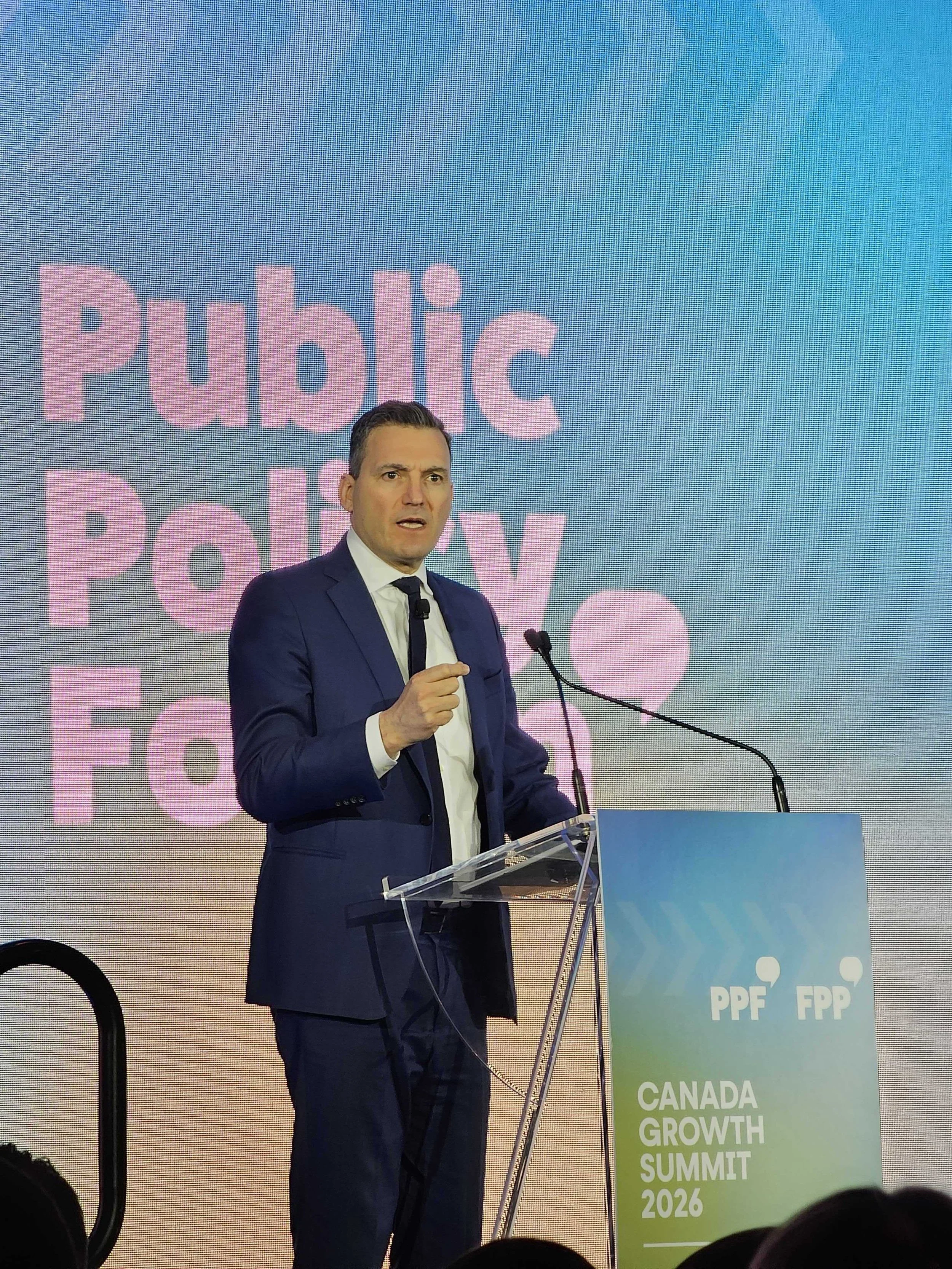
TORONTO – The government’s long-awaited AI strategy is still “coming soon,” but AI Minister Evan Solomon says it will be pragmatic and anchored in six pillars that focus on the technology serving humans, not the other way around.
“This file is growing and changing faster than any other file in the government,” Solomon said at the Public Policy Forum Growth Summit on May 7. “Our AI strategy is about... pro-worker, reliable sovereign AI for all, AI to serve people not for people to serve AI. AI for Canadian innovation. AI for Canadian jobs.”
He said that the majority of people fall in two camps when it comes to AI – those that think it will solve everything and those that fear it and think it will take their jobs. He said the government is not on either side. “We are a pragmatic government that is going to build,” he said, noting the delay in releasing a strategy reflects the pace of change in the sector rather than indecision.
Solomon said that the government is setting up an advisory group with labour leaders to ensure workers’ voices are represented in the strategy.
“This matters, we are going to get it right. I recognize there's enthusiasm, but let me also say we have not waited. The strategy will come very shortly. I'm not going to put a hard date on it.”
Solomon opened up his speech by saying that when the government started working on the AI file, it was a vertical policy, but now it has become horizontal as well. “It's not a tech file anymore,” he said. “It's a productivity file, it's an economic file. It's a public service file, it's a workforce file. It's a trust file, it's a sovereignty file.”
He reiterated the strategy’s six pillars that were announced in the recent Spring Economic Update. He said each would be accompanied by specific action items, goals and metrics:
Protecting Canadians and safeguarding democracy: Including updated privacy legislation, action on deepfakes and synthetic content, algorithmic transparency for automated decision-making, and protecting data of children.
Empowering Canadians with skills: Building AI literacy across the broader workforce, not just technical specialists.
Powering AI adoption for shared prosperity: “We have the lowest adoption rates in the OECD — 12 and a half per cent,” he said, saying government procurement will play a key demand-side role, with the new Office of Government Transformation set to modernize how federal ministries buy AI tools.
Building a sovereign Canadian AI foundation: Anchored by a $1-billion investment in a national public AI supercomputer, described as the single largest investment in public AI compute infrastructure in Canadian history. Applications close June 1.
Scaling Canadian AI champions: Reforming capital pathways and procurement pipelines so Canadian companies can scale domestically before being acquired abroad. “We plant the seed here with our great researchers, we water it, we grow it — someone else harvests it. We're stopping that,” Solomon said.
Building trusted partnerships and global alliances: Including the Sovereign Tech Alliance launched with Germany in February, which has already yielded a major transatlantic partnership between Canadian AI firm Cohere and Germany's Aleph Alpha.
Solomon also spoke about the gap between frontier AI development and real-world uptake in small- and medium-sized enterprises, which represent roughly 95% of Canadian businesses. Solomon pointed to the Compute Access Fund — launched to help SMEs access computing power — as an early indicator of demand: 1,400 to 1,500 applications arrived within a week of its opening, far exceeding projections.
“AI will not transform our economy on a macroeconomic level with a handful of frontier companies building powerful models,” he said. “It will only transform our economy when the tech is adopted and used to increase productivity.”