Feds want to double electricity grid by 2050: Carney
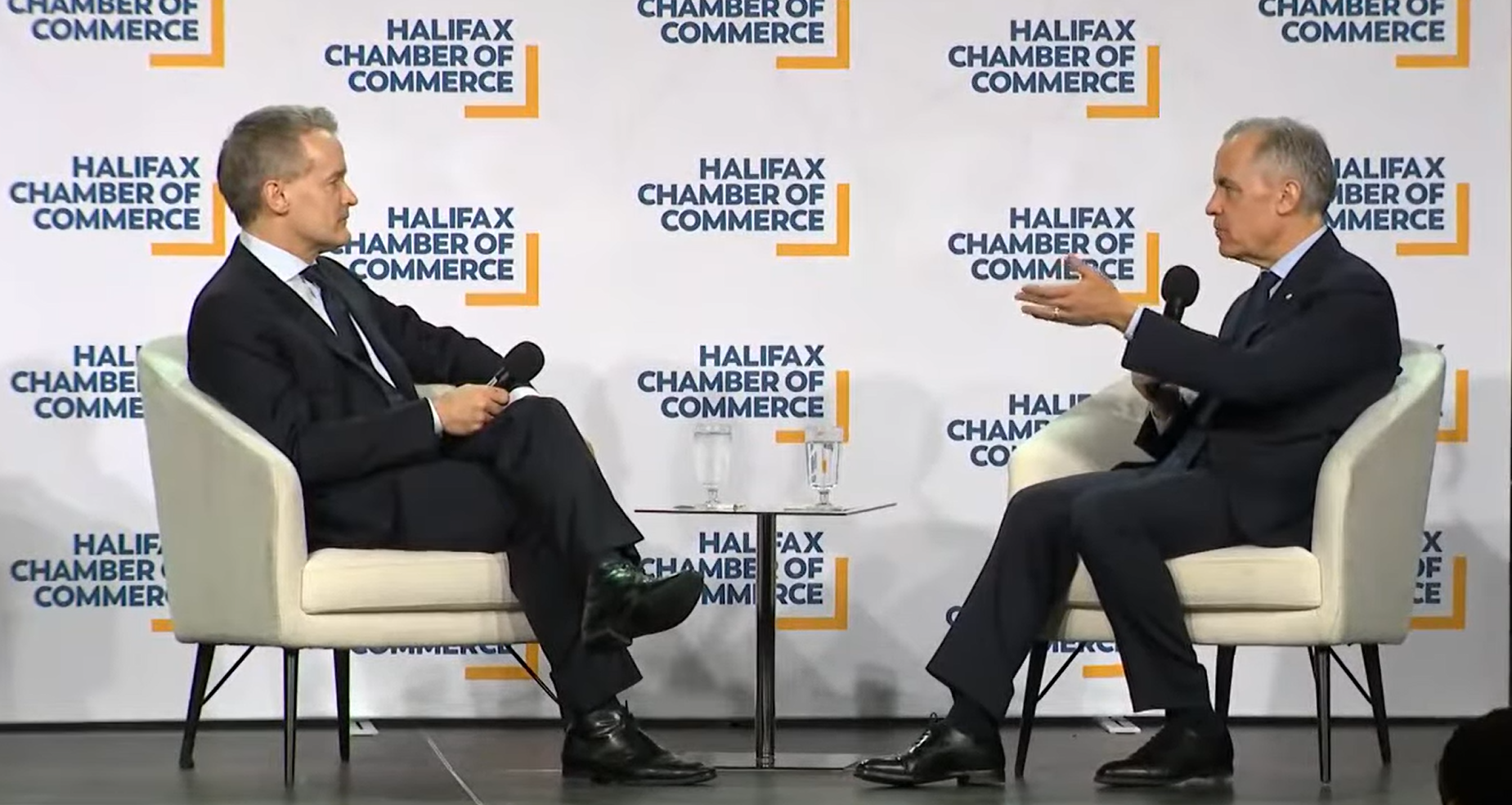
Prime Minister Mark Carney, right, pictured with former Liberal Minister Seamus O’Regan at a Halifax Chamber of Commerce event. / SCREENSHOT
The federal government will be releasing a new electricity strategy next week, Prime Minister Carney announced Friday.
“We will publish a strategy on electricity to double our network by 2050 while building a stronger and more sustainable economy,” Carney said during a keynote speech at the Halifax Chamber of Commerce.
The strategy will help “double the electricity grid in this country, largely with clean power, hydro, nuclear and renewables.”
During a fireside chat with former Liberal Natural Resources minister Seamus O’Regan following the speech, Carney said the government’s goal is to “catalyze things to move more rapidly.”
“There's lots of opportunity. So the way we make that happen? Yes, bring new industry here, data centres. Yes, make bills cheaper. … But in order to do that effectively, we need better inner ties with Quebec, with other parts of Canada. And it can be much more efficient,” he said. “It takes a coordinating role. It takes ambition, coordination, and yes, sometimes it takes some money, and the federal government can help play that role with the provinces.”
Carney focused his address on Ottawa’s commitment to making Canada a leader in defence, economic growth, and global trade. He noted Canada has already met NATO’s two per cent defence spending target, five years earlier than expected. This achievement was driven by more than $60 billion in new commitments over the past 10 months.
In its 2025 annual report, NATO Secretary General Mark Rutte confirmed that Canada has met the spending target for the first time since 1990.
“For the past 10 months, we have moved at unprecedented speed and scale–working across over a dozen federal departments and agencies to spend more than $63 billion, the largest year-over-year increase to Canada’s defence spending in generations,” Carney commented. “Over the next decade, Canada will unleash half a trillion dollars in defence investment–from submarines and aircraft to drones, sensors, and radar systems. In October, we launched the Defence Investment Agency to overhaul and streamline Canada’s defence procurement so the Canadian Armed Forces have the world-class equipment they need.”
“And last month, we announced Canada’s first-ever Defence Industrial Strategy — a bold plan to get our Armed Forces what they need, when they need it; scale Canadian defence companies; and put hundreds of billions of dollars to work in the strategic sectors of our economy.”
The defence strategy channels over half a trillion dollars of public and private investment into a range of areas, including ships, planes, AI, cyberspace and critical minerals.
He pointed to Nova Scotia’s increasing role in the sector: earlier this week at CFB Halifax, he announced that the province will receive $2 billion for new defence infrastructure and property investments. “But we're doing more, and it has broader implications, modernizing critical infrastructure, building new facilities to support the next generation of fleets, expanding training and operational capacity.”
Carney indicated that the national shipbuilding strategy and new maintenance facilities are models for building Canadian capacity and creating high-paying careers.
On economic growth, Carney highlighted broad-based tax cuts and a “productivity super-deduction.” This is a 100 per cent tax write-off for investments in manufacturing, R&D and clean energy. He said new investment tax credits have dropped Canada’s marginal effective tax rate for business investment to just 13 per cent.
He pointed to the new Major Projects Office as a way to accelerate nation-building infrastructure. Currently, $120 billion in projects are on the books. These include the McKenzie Valley Highway and the WindWest offshore wind project, which Carney said could eventually supply a quarter of Canada’s electricity needs.
On housing, Carney highlighted Build Canada Homes, using factory-built technologies to halve construction times and cut costs by 20 percent, with over 9,000 units fast-tracked.
On trade, Carney described a strategy to double non-U.S. exports, targeting $300 billion in new trade. He noted that, as part of this effort, 20 new partnerships were forged in the past year. He also highlighted a new agreement with China to open $7 billion in markets for Canadian agri-food producers. Meanwhile, negotiations continue with India, ASEAN, and Mercosur.
On immigration, he said the government is reducing temporary resident admissions and returning population growth to sustainable levels. He also highlighted a $60 billion expenditure review to cut day-to-day government spending while protecting key services, such as child care, dental care, and pharmacare.
Carney told O’Regan that the government is trying to “connect the dots” on Canadian priorities – such as affordability, defence or national unity – which can be realized by working with the private sector as well as the provinces.
“It's all about catalyzing, setting out the clear [tasks], taking some of the risk off,” he said.
On the Defence Investment Agency, Carney highlighted that the big procurement decisions had to be given back to taxpayers to “ensure that we get the industrial benefits as much as possible.”
He also highlighted the need to ensure the benefits of major projects reach as many Canadians as possible, not just through a stronger economy but “more broadly.”