Carney’s polling may be sugar high, not a lasting one
The Liberals have a majority government with strong polling behind Prime Minister Mark Carney, but the economic and political environment is still uncertain as businesses look for action on investment, infrastructure and trade, say experts.
While Mark Carney is riding high when it comes to the leadership front, public sentiment on the economy has weakened, said Nik Nanos, chief data scientist at Nanos Research. “You can see that people are increasingly worried about jobs and the economy as their top national issue of concern, followed by inflation and healthcare. I'm not convinced that it's going to be as steady and stable as some people think. It'll be more steady. It’ll be more stable. But steady and stable — nope.”
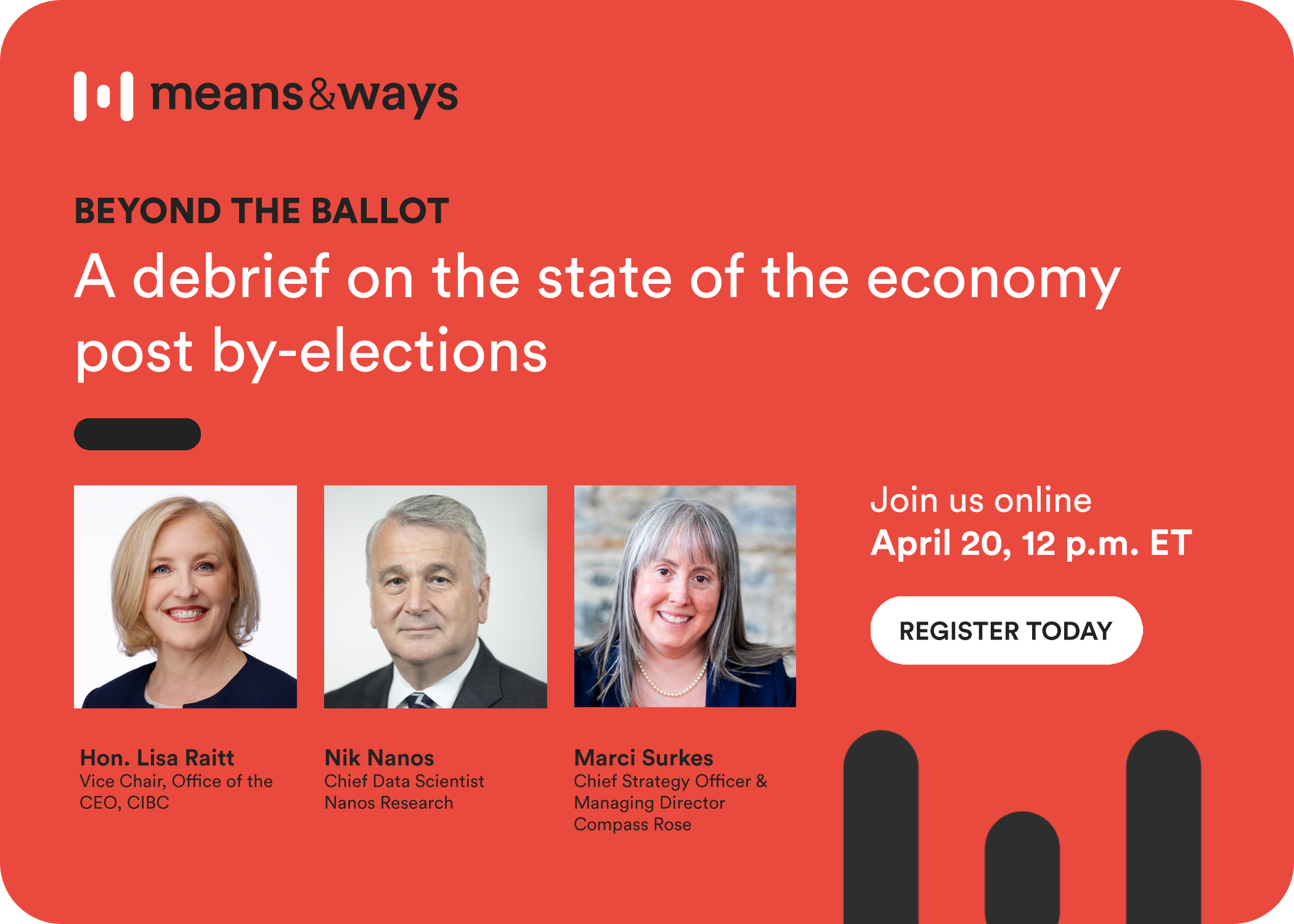
Nanos was speaking on a panel, Beyond the Ballot, with Lisa Raitt, CIBC Vice-Chair, Office of the CEO and Marci Surkes, Managing Director of Compass Rose, moderated by Lucy van Oldenbarneveld and hosted by Means & Ways.

‘It takes more than a different Prime Minister to change the growth trajectory of the country,’ says Chief Data Scientist Nik Nanos. / SCREENSHOT
Nanos said economic dissatisfaction hasn’t yet translated into declining support for the government, in part because many Canadians blame U.S. President Donald Trump for trade uncertainty, the rise in gas prices and the knock on effects on food costs. “Usually these issues are good for the opposition party and bad for the government. But in this particular case, there's an external party — that person's name is Donald Trump — that people are more likely to blame for this.”
Raitt said businesses are now focused on execution and expecting the government to take action on previous announcements. Now that there’s a majority, the government has the ability to quickly move on its priorities, including following up promises made to the business community, such as getting shovels in the ground on major projects. “‘Well here we are, and now we expect you to deliver Mr. Carney and we're looking to see what you're going to be able to do because you can't hide behind the issue that the Conservatives or the NDP, the Bloc or the Greens are causing problems in Parliament.’”
Canada’s capital flight
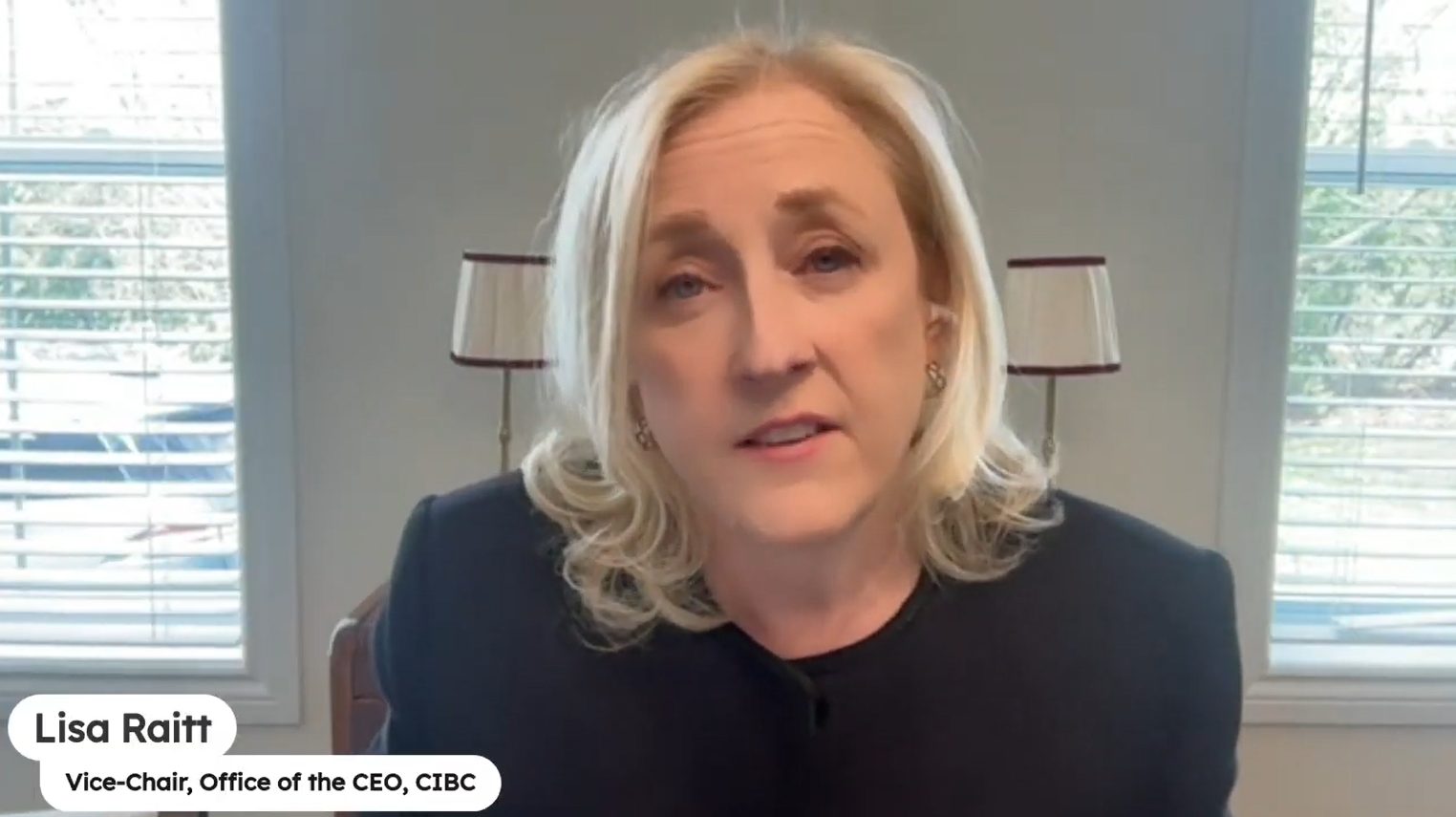
Lisa Raitt, CIBC Vice-Chair, Office of the CEO, says businesses are now focused on execution and expecting the government to take action on previous announcements. / SCREENSHOT
One key issue that needs to be addressed is the trend of capital moving outside Canada because firms see stronger returns elsewhere. Outbound financial flows to the U.S. are on track to reach approximately $255 billion by year-end, equivalent to about 8% of Canada’s GDP, making Canada a net lender to the U.S. for the ninth straight year, according to analysis by Maria Solovieva, an economist at Toronto-Dominion Bank. Still, this is below peaks seen in 2021 and 2023, she said.
The government needs to make it more attractive for businesses to invest in Canada rather than elsewhere, Raitt said.
“The problem with capital fleeing Canada is the reinvestment of capital in this country is important in order to have growth and growth is important to have an economy that's going to be supporting all of the things that we love and care for especially those support systems that we have in place,” said Raitt. “The more difficult it becomes for the government to maintain those systems, it's going to be more difficult for people and their quality of life.”
Since businesses are naturally driven to expand, the burden falls on governments with stagnant investment climates to re-evaluate their strategies to identify the specific barriers — whether they be high taxes or burdensome regulations — that are currently diverting global capital toward the United States instead of their own economies, Raitt said.
Surkes, a former Liberal adviser, said the majority mandate gives the government time to pursue medium-term policy goals. Given the geopolitical landscape, while there may not be stability, “there is actually some certainty” now with a majority government, and this allows the Liberals to focus on economic reforms, infrastructure and affordability measures within their control.
“There is now a window to get things done,” said Surkes. “I do believe the government is pretty zeroed in on this point and is doing what they can to effectively re-engineer more than a decade or at least a decade of policy sets that did not appear that Canada was open for business or investment. And that's not going to happen overnight.”
She said the government is making the right signals to the business community, especially around investments in infrastructure.
“They are actively working with the business community in a way that had not happened in the last number of years,” she said. “They’re looking at streamlining projects, reducing red tape, all of these different initiatives — these are all good positive signals from government to business.”
The government needs to get into ‘delivery mode’
At the same time, however, the government is not necessarily moving quickly enough. “The government does need to get into delivery mode. The business community needs to see how serious the government is, in terms of where it is placing its investment, how quickly it's prepared to actually eliminate duplicative regulatory burdens, how these new trade partnerships are actually going to work in practice.”
Surkes said the Carney government’s priority around diversifying exports from the U.S. is “hugely ambitious” but “the proof is in the pudding.”
“Right now it looks good but there isn't enough there on the back end for business leaders to be clear in terms of how they want to take decisions and where they want to invest their money, so that's really the shift that needs to come now.”
She pointed to the various strategies that have been promised by the government — the Defence Industrial Strategy, the AI strategy, an electrification strategy. “Strategies only matter if you actually get the work done at the end of the day,” she said. “This is the year for the Carney government to demonstrate its chops and to execute on the strategic vision it has laid out.”
Panellists offered differing views on whether a majority government can change Canada’s slow-growth outlook.
Real GDP increased only by 0.5% in the third quarter of 2025. Canada’s GDP per capita has underperformed most of its G7 peers since 2010. Meanwhile, non-residential private-sector investment as a share of nominal GDP has dropped to its lowest level since the 1950s. The poverty rate has rebounded to 10.9%, and the average poverty gap widened to 33% in 2023, up from 30.4 in 2021. And, given the trade uncertainty and the U.S.-Iran war, Deloitte has downgraded Canada’s economic growth projection from 1.7% to 1.2%.
We’re ‘not quite there’ on reducing internal trade barriers
Raitt said governments can support growth through policy measures, though results may take time. She said one of the clearest opportunities would be reducing internal trade barriers between provinces. “I don't think we're quite there. I don't think we're even beginning to get there in terms of having true ability to trade across the nation,” she said.
Nanos said a new government alone would not be enough to materially improve Canada’s economic performance. “It takes more than a different Prime Minister to change the growth trajectory of the country.” He agreed that a long-term strategy is needed, but said investors still lack certainty.
“We need to have some sort of certainty and alignment that Canada is a good place to invest, not just in the short-term, but in the long-term,” he said. “And we don't know that yet because we have a weak majority.”
Nanos said large companies often make decisions on much longer timelines than governments. “When a lot of these major enterprises are making big bets and big investments in Canada, they're looking at a 10-, 15-, 20-year horizon,” he said.
He also drew a distinction between publicly funded infrastructure and projects that require private capital. The large infrastructure and energy projects also require “the private sector to put money on the table,” Nanos said. “I'm not sure we've really seen that in a big way.”
He said some investors may still be waiting to determine whether the current policy environment is stable. “They're waiting to see, you know, how long will this last? Is this the new normal?”
Surkes said the relationship between government investment and private-sector participation remains a chicken-and-egg scenario. “Everyone's waiting to see who is going to be first mover in terms of these major initiatives,” she said, adding businesses often plan over longer horizons than governments can realistically guarantee.
People are ‘getting jazzed’ about the defence sector
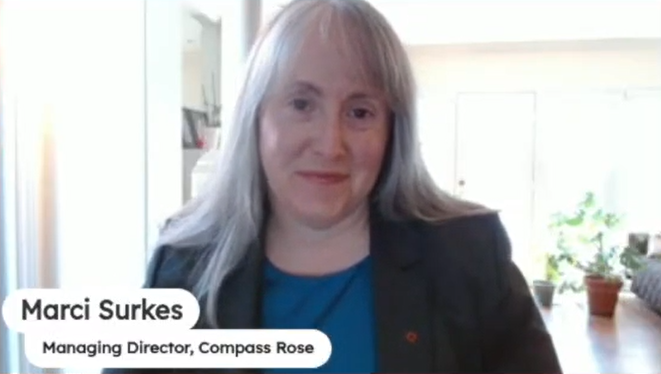
Given the geopolitical landscape, while there may not be stability, “there is actually some certainty” now with a majority government, says Compass Rose managing director Marci Surkes. / SCREENSHOT
Surkes pointed to the defence sector as an area where momentum appears to be building more quickly than in other areas. “The Defence Industrial Strategy … is really getting people jazzed in the private sector and mobilized in a way that we've not seen,” she said.
She added that new demand from government buyers could generate broader economic benefits.
“I actually think we could see some real progress in the next 12 months, in terms of spurring new industrial benefits and spin-offs for the country,” Surkes said.
Raitt agreed, saying financial institutions are already responding.
“Every bank on Bay Street is coming up with their own white paper on how to be able to serve their clients who are in the space now and how to help people who want to get into the space,” she said. “The message has really resonated.”
One key variable is the Alberta separation referendum, expected this fall.
Nanos said “100%” it is affecting the economy and businesses psychologically because of the unstable investment environment. He said most pollsters agree the appetite for Alberta leaving is at around 30% of the populace. “It's not enough to win, but the thing is that this is another thing that delays at a time that we need urgent action, urgent investment and need to urgently move forward. This puts a bit of a wet blanket on that appetite at least from the perspective of potential investors. They're going to wait to see what happens, even if they think that the referendum will fail, they're still going to wait. Waiting is not good for us because there's a big sense of urgency to move forward.”
Raitt agreed, saying that the issue keeps her up at night. “It's based on emotion and you can never, ever predict where emotion's going to go. So I would say that, as we deal with this topic, we take it very seriously and we instead of saying, ‘Well, you can't do this,’ or saying, ‘Oh, you won't do this,’ I think we really have to get it in our minds of going in another direction and saying, ‘Please don't do this.’ Because having that vote itself, I think is going to be problematic given perhaps the malicious intent of a Trump administration recognizing an independent Alberta if they just get close enough. You know, how much is enough in order to recognize that separate state? So I think it causes a whole bunch of problems and we have to have eyes wide open on it.”