‘Go time’ for Canada: Coalition for a Better Future demands policy execution

Carolyn Wilkins, External Member of Bank of England’s Financial Policy Committee; Lisa Raitt, co-chair, Coalition for a Better Future; Anne McLellan, co-chair, Coalition for a Better Future; and Michael Serapio, CPAC PrimeTime Politics host, pictured at the Coalition For a Better Future’s Scorecard Reporting Event March 26. / COALITION FOR A BETTER FUTURE PHOTO
It’s time to execute on the public policies and investments that will help Canada’s economy grow, says the Coalition for a Better Future.
“I'd like to think that things are getting better and that one day we're going to wake up and everything is going to be fine, but we're not there yet,” Lisa Raitt, CFBF co-chair, said at the March 26 launch of the 2026 Scorecard Report. “The numbers don't lie. We're beginning to see the impacts in decisions being made in businesses across the country, and that worries me.”
The Scorecard measures how Canada is doing on 21 economic indicators. The report, entitled Time to Execute: Canada’s Crucible Moment, shows that “the fragility of our economic growth is no longer a theoretical concern; it is a reality felt by households at the grocery store and the gas pump.”
Real GDP increased only by 0.5% in the third quarter of 2025. Canada’s GDP per capita was $60,165 in the same time period. Growth of GDP per capita in Canada has underperformed most of its G7 peers since 2010. Meanwhile, non-residential private-sector investment as a share of nominal GDP has dropped to its lowest level since the 1950s. The poverty rate has rebounded to 10.9%, and the average poverty gap widened to 33% in 2023, up from 30.4 in 2021.
“We have a trough we've got to come out of and the numbers that we see here are beginning to really crystallize how deep that trough is,” Raitt said on an opening panel with Coalition co-chair Anne McLellan and Carolyn Wilkins, external member of the Bank of England’s Financial Policy Committee and Senior Research Scholar at Princeton. “And that's why we came up with the phrase, which is, It is time to execute. It's go time.”
McLellan spoke about the lack of “Canadian champions” — large Canadian companies competing globally — as a “really serious structural problem for the Canadian economy.”
“Why do Canadian champions matter?” she said. “They carry the country's brand around the world. They create that buzz in relation to innovation and risk-taking and a place where you want to come and think about investing and working and living. In fact, we don't have that many Canadian champions … in relation to the U.S., but also France, the U.K., Germany, Japan.”
McLellan said Canada is good at startups, but many don’t stay and build in Canada. The Coalition’s report notes that a “lack of ‘exit’ scaling often results in promising firms being acquired by foreign competitors before they can become global champions. Today, the number of Canadian-grown global champions stands at 20 — including Royal Bank, Shopify, and Agnico Eagle — but this is still well shy of the national target of 40. While Canada ranks 17th in the Global Innovation Index — its ‘knowledge creation’ is among the best in the world — it continues to fail in the deployment and commercialization of that knowledge.”
Claudio Rojas, CEO of the National Angel Capital Organization, said the challenge is that Canada’s innovation system is not designed to take risks. He said Canada has exceptional talent and deep pools of capital but risk aversion is perpetuated at all levels of society.
A risk-reward economy
“The innovation economy is a risk-reward economy. It's very, very different than the industries of the past. So it's important that at the policy level, we're designing policies that allow for an appropriate level of risk for the reward that we're looking for,” he said on a panel discussion about the workforce of the future with Stephen Lucas, CEO, Mitacs and former deputy minister of Health Canada; Victoria Mancinelli, director of public relations, communications, marketing and strategic partnerships at LiUNA! Canada and moderated by CPAC PrimeTime Politics host Michael Serapio.
“One of the policy recommendations that we're making is a $500 million matching fund for the early stage and the risk profile,” he said, adding that the concept has already been proven with later stages of the venture capital ecosystem.
“We've seen exceptional growth. But for the venture capital ecosystem to succeed, you need to be enabling the entrepreneurs, the young people in this room, with the capital that they need to build the companies that grow into the venture capital portfolios. At a policy level, it's not just about mobilizing the $500 million so that when an entrepreneur raises a million dollars there's another million dollars of public capital and then they can focus on building their company as opposed to becoming professional fundraisers, but it's also so that that capital has a risk profile that understands the power law, which is that you can't predict the great companies of our lifetime in advance.”
If Canada wants global champions, the government needs to create the conditions for entrepreneurs to thrive here, Rojas said. “They will prove to us the impossible, and so if you create the right conditions, the power law will be unleashed. And we just haven't done that yet.”
For Wilkins, a Coalition advisory council member and a former Senior Deputy Governor of the Bank of Canada, the fact that GDP per capita has “flatlined” for years is worrisome. She said that although it’s stabilized, it’s still “not great” relative to other countries. Noting that business investment has been the lowest in years as well, Wilkins said “The top line isn’t very good. We've been seeing that for years.”
The Coalition characterized this in the report as a “crisis.”
We have turned the corner into critical territory
“The link between Canada’s productivity crisis and its investment crisis is now absolute. For years, the Coalition has warned that our economic foundation was thinning; in 2026, we have turned the corner into critical territory,” the report says. “Canadian workers receive approximately 55 cents of new capital investment for every $1 received by their U.S. counterparts. The gap is even wider in the “tools” of the future: We receive only 41 cents on the dollar for machinery and equipment (M&E) and a dismal 32 cents for intellectual property (IP) products like software and R&D.”
The problem, the report says, is homemade. “Over the past decade, Canada has seen massive investment shifts away from productive exports toward domestic-facing, low-productivity sectors like residential construction.”
Wilkins also noted that it’s “insane” that as an advanced economy, Canada has a poverty rate as high as it does. This indicates that although the economy is growing very slightly, it’s not “finding its way into the economy to raise living standards the way that we would hope for enough people,” she said.
“But you could see why. Because if you've got business investment at its lowest level since the 1950s, you're not growing companies, you're not keeping them in Canada. If you see GDP per capita only kind of pitifully growing, there's nothing to distribute, and you see food prices up by 25%, 27% in the last five years, where you're going to say that every dollar that you earn is going to get you less of the basic things that you need. I didn't even mention housing. So I think this is a problem. And that problem, to me, can only sustainably be solved by executing, getting things done to build the capacity for our economy to create companies and jobs that go with it and communities across the country. Not just in big cities, but in rural areas that play to our strengths, so you can build strong communities. I think that's the only way out of this.”
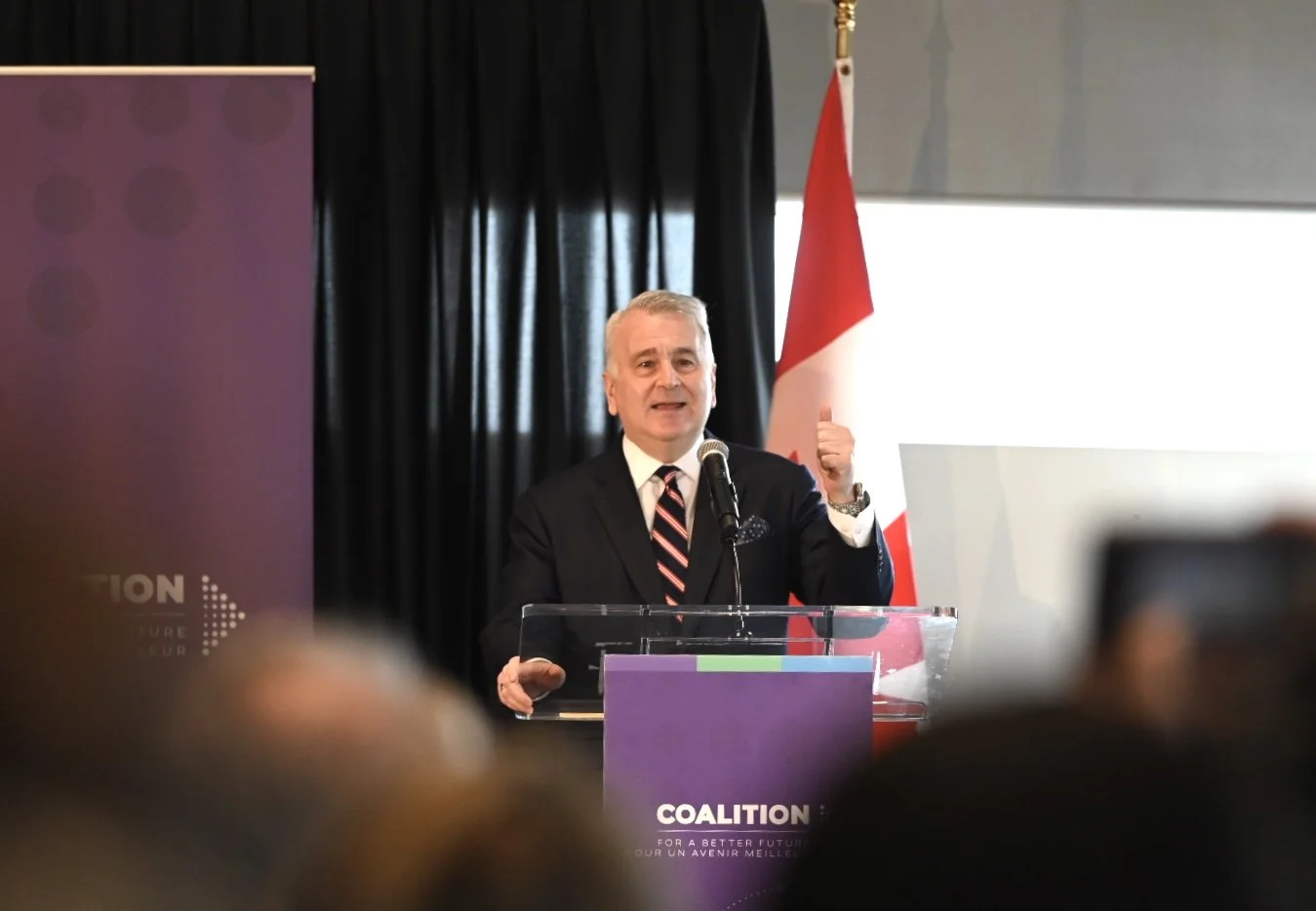
Chief Data Scientist Nik Nanos, Nanos Research. / COALITION FOR A BETTER FUTURE PHOTO
Nik Nanos, Chief Data Scientist at Nanos Research, spoke about new data at the event. He said that when asked whether Canada was moving in the right direction on the economy, there has been a 20 to 30 point increase in positive responses. He noted, however, that it doesn’t necessarily mean Canadians are satisfied. Instead, he said, they want to see the details.
“We kind of like what we're hearing, but we need to see, you know, what actually transpires in terms of the real impact on economic growth and investment in innovation,” Nanos told the audience. “That's the good news, at least in terms of the tracking, that there is a brighter view on where we are on some of these measures compared to the past.”
When digging deeper, however, he said that AI disruption is a key issue on Canadians’ minds. “It's been really significant in the last 12 to 24 months, and I think it is quite striking that eight out of every 10 Canadians rate the importance of learning new skills as urgent, not something that's nice to have, not something that you know is planned, but that there is a certain level of urgency.”
When it comes to climate change, Canadians said the country is moving in the wrong direction. Only 35% of Canadians say the government is moving in the right direction, Nanos said. “For average Canadians, they see some things related to innovation and economic growth, but they're wondering how that fits within our environmental aspirations.”
The Coalition Scorecard Event also featured a keynote discussion between Serapio and Buckley Belanger, Secretary of State (Rural Development); remarks from Liberal MP and House of Commons Finance committee chair Karina Gould; and remarks from Conservative MP Greg McLean who also chairs the Conservative Economic Growth Council. Another panel discussion took place focusing on “unlocking Canada's potential” featuring Justine Hendricks, President and CEO, Farm Credit Canada; Jeff Nankivell, President and CEO, Asia Pacific Foundation of Canada; Kristan Straub, President and CEO, Canada Indigenous Loan Guarantee Corporation and Marie-Eve Sylvestre, President and Vice-Chancellor of the University of Ottawa.