The 1970s revisited: Stagflation may be back
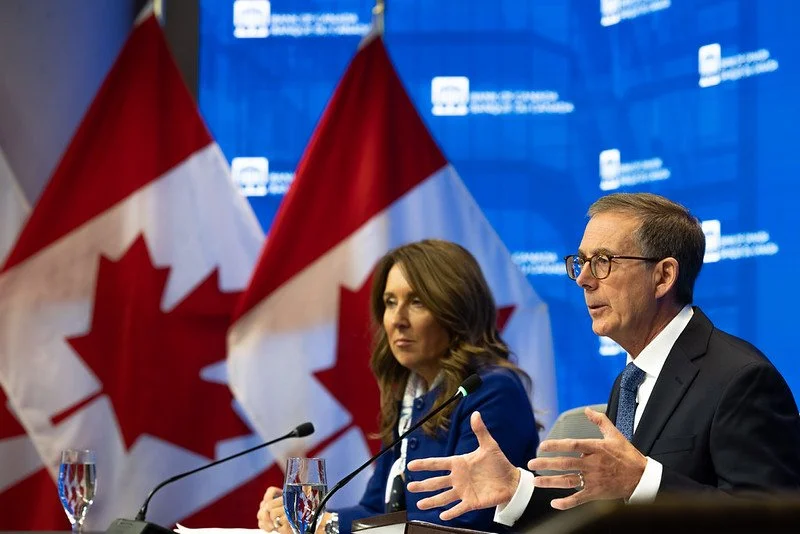
Bank of Canada Governor Tiff Macklem, pictured with Senior Deputy Governor Carolyn Rogers, September 2025. / BANK OF CANADA PHOTO
The Bank of Canada, which is working with data that can’t keep up with the quickly-evolving impact of the current energy shock, is almost universally expected to hold steady in its interest-rate setting next week.
But it will be interesting to see how Governor Tiff Macklem appraises the economic damage and risks from the continuing conflict in the Middle East.
The concern is that Canada could be headed for a period of stagflation — high inflation, high unemployment and low economic growth — a rare and painful condition that’s difficult for central banks to fix. In Canada, the last prolonged bout of stagflation occurred between 1973 and 1982.
Macklem has said the BoC’s decision-makers are inclined to look through the upsurge in headline inflation witnessed in Canada last month. Driven by energy costs, the Consumer Price Index increased 2.4% year over year in March, up sharply from 1.8% in February, according to Statistics Canada.
Gasoline prices jumped 5.9% from a year earlier and shot up 21.2% since February, the largest monthly hike on record.
But, separating out the gasoline price spike caused by the blockage of Strait of Hormuz tanker traffic, March inflation came in close to the central bank’s 2-per cent target.
This reflected the sputtering state of the economy after a year of destructive trade initiatives imposed by U.S. President Donald Trump.
Macklem doesn’t want to be too early … or too late
In comments to the media last Friday, Macklem spelled out the dilemma faced by the BoC, which has held its key overnight interest rate at 2.25% since December.
“We don’t want to jump too early and raise interest rates and lower growth, particularly when growth is already weak,” Macklem said. “On the other hand, you don’t want to be late and let inflation get a hold and become entrenched.”
Analysts of all stripes have been clinging to moderate forecasts in hopes that the Middle East conflict would be resolved fairly quickly. But as of Friday, the outlook for a permanent peace arrangement there remained very iffy. And the continuing fighting and oil blockade seem likely to have a much more potent effect on prices than was evident last month, with the impact certain to spread throughout the economic realm — from farm costs to food to shipping and transport.
Inflation in the U.S. jumped to 3.3% in March, and the Inflation Nowcasting project at the Federal Reserve Bank of Cleveland has it running at a higher 3.56% so far in April. Here, BMO Chief Economist Doug Porter said this week that Canada’s CPI could hit 3%in April.
But slack in the Canadian economy may temper the extent of the impact of upcoming cost-of-living increases. Uncertainty arising from the U.S. trade war has already hurt the economy through weak business Investment. And the jousting between Ottawa and Washington around the upcoming review of the Canada-U.S.-Mexico agreement is not going to reassure business of an early return to normal trade relations with the Americans.
Rosenberg sees a red light on any further tightening
Noting that the Iran conflict has introduced “another layer of uncertainty” to Canada’s economic prospects, Deloitte Canada recently trimmed its 2026 GDP forecast to 1.2%, down from its 1.5% prediction three months ago.
David Rosenberg, president of Rosenberg Research & Associates Inc., said in a note after the latest CPI release that the economy is suffering from an output gap and a weak labour market that hasn’t produced any net full-time positions since mid-2025, the Financial Post reported.
“The light is green for the Bank of Canada to resume its easing cycle once the U.S.-Iran war finally does end, and a red light has now been established for any policy tightening, which the bond market had recently and we believe mistakenly started to price in weeks ago,” Rosenberg said.
Commenting on StatsCan’s CPI report, BMO’s Porter said: “Our considered view is that if it were not for the conflict with Iran, the discussion would currently be revolving around the strong possibility of BoC rate cuts, not hikes. This report reinforces that opinion.”
Nonetheless, the prevailing opinion is that Macklem will stick with the BoC’s current rate setting for the bulk of 2026. Add it all up, and this is a recipe for stagflation, which is something Canada has dodged for nearly a half-century.