CUSMA review: Charette seeks a ‘lasting deal, not a fast one’

Canada’s Chief Trade Negotiator Janice Charette, pictured with Canadian Chamber of Commerce CEO Candace Laing at the Future of Business Summit. / CANADIAN CHAMBER OF COMMERCE PHOTO
Canada is unlikely to have a comprehensive resolution to its tariff dispute with the United States by July 1, the date that triggers a formal review of CUSMA, but negotiations are progressing and the underlying trade framework remains strong, says Janice Charette, Chief Trade Negotiator to the United States.
“There's a lot of focus on July 1st, which is kind of a checkpoint. It's not a cliff,” Charette said Tuesday at the Canadian Chamber of Commerce’s Future of Business Summit in Ottawa. “It's not determinative of the future of our trading relationship. The USMCA, the trading agreement does remain in place.”
The priority is a lasting deal, not a fast one, she said. “I don't think we should expect — and Jameson Greer said this — that necessarily we’re going to have everything resolved with a bow, ready to go by July the first. It's really important to focus on getting a comprehensive solution. Not necessarily a fast solution, not quick, not rushed, doing it right.” She added that Canada is proactively engaged with the U.S. and Mexico, addressing issues as they arise.
Recent consultations confirm the CUSMA — the Canada-United States-Mexico Agreement — is solid, effective and doesn’t require fundamental renegotiation or structural changes, said Charette. The three countries “all have issues that we want to look at. And if there's a consensus for us to make changes, we can do that. I do anticipate that there will be a combination of trilateral conversations, Canada, U.S. and Mexico, looking at some of the parts of the agreement.”
Maybe not the biggest fan, but still the biggest customer
Canadians buy more goods from the U.S. than the 2.8 billion people in Japan, the U.K. and China, making us the U.S.’s biggest customer, according to Charette. In addition, the North American market has a combined GDP of $42 trillion, and Canada’s foreign direct investment in the U.S. is double the amount the U.S. invests in Canada. Additionally, $3.6 billion in goods cross the border every day, and bilateral trade has grown 27% since the agreement was signed.
Despite the current tensions, Canada's trading position relative to other U.S. partners remains favourable, she said. “We do actually have the very best trade deal of any of the major U.S. trading partners. Eighty five per cent of our trade is going tariff-free into the United States. We continue to enjoy the lowest average effective tariff rate of any of the major trading partners of the United States.”
In addition to protecting the trade framework, Charette said her mandate is to address the removal of tariffs on steel, autos, aluminum and “resolution of the long-running challenges we've had with respect to the softwood lumber and other subsectors. This is costing our companies billions of dollars, and I see that when I talk to these CEOs. I see how challenging it is for them to maintain employment, to maintain their order books, to maintain confidence.”
Carney addresses the nation via YouTube video
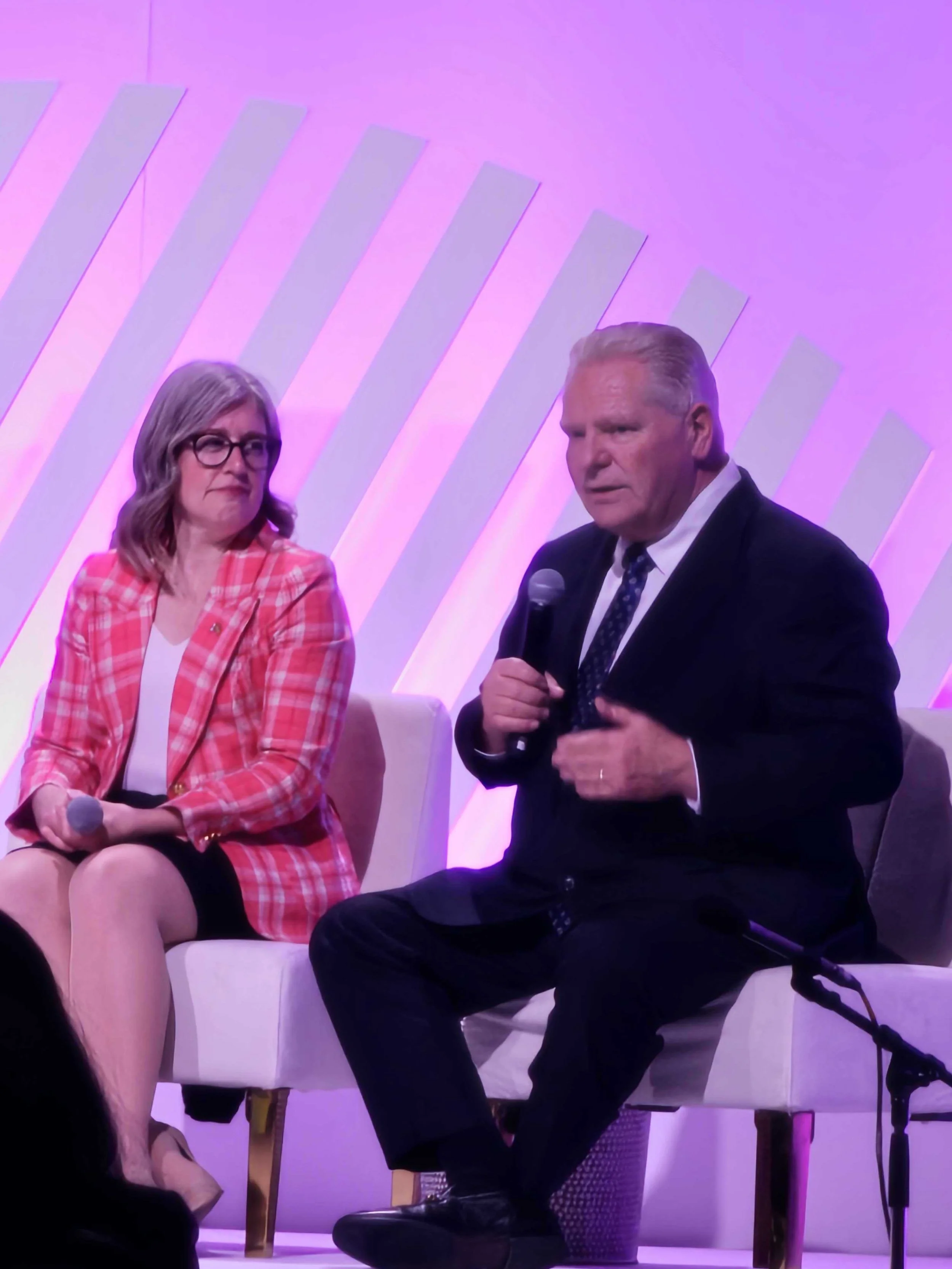
New Brunswick Premier Susan Holt, pictured with Ontario Premier Doug Ford. ‘There are so many things we don't need President Trump to do,’ Ford said at the Canadian Chamber of Commerce’s Future of Business Summit on April 20. / MEANS & WAYS PHOTO
Meanwhile, in an April 19 video to Canadians called Forward Guidance, Prime Minister Mark Carney reiterated the “rupture” in the Canada-U.S. relationship. “Many of our former strengths, based on our close ties to America, have become our weaknesses, weaknesses that we must correct. Workers in our industries most affected by U.S. tariffs in autos and steel, in lumber are under threat. Businesses are holding back investments restrained by the pall of uncertainty that's hanging over all of us.”
On a separate panel at the business summit, Ontario Premier Doug Ford, New Brunswick Premier Susan Holt, P.E.I. Premier Rob Lantz and Northwest Territories Premier R.J. Simpson were asked whether they agree with Carney’s assessment.
Ford said he did. “The Prime Minister is saying we have to diversify our trade and not be so reliant on the U.S. I'll just speak for Ontario. … There are so many things we don't need President Trump to do. … Yes, we're the U.S.'s number one customer. They're our number one customer as well and I always differentiate between the great American people that love Canadians vs President Trump. I tell our American friends, we don't see eye to eye with President Trump. Protectionism doesn't work anywhere in the world, and we have to move forward with the CUSMA or USMCA and get a deal done.”
Holt also said the characterization was fair. “When you have one customer that's responsible for the vast majority of your business — and in New Brunswick's case, it's 92% of our exports that go to the U.S. — that's a vulnerability. It makes you more of a price taker than a price setter. And that's why businesses look to diversify their customers.”
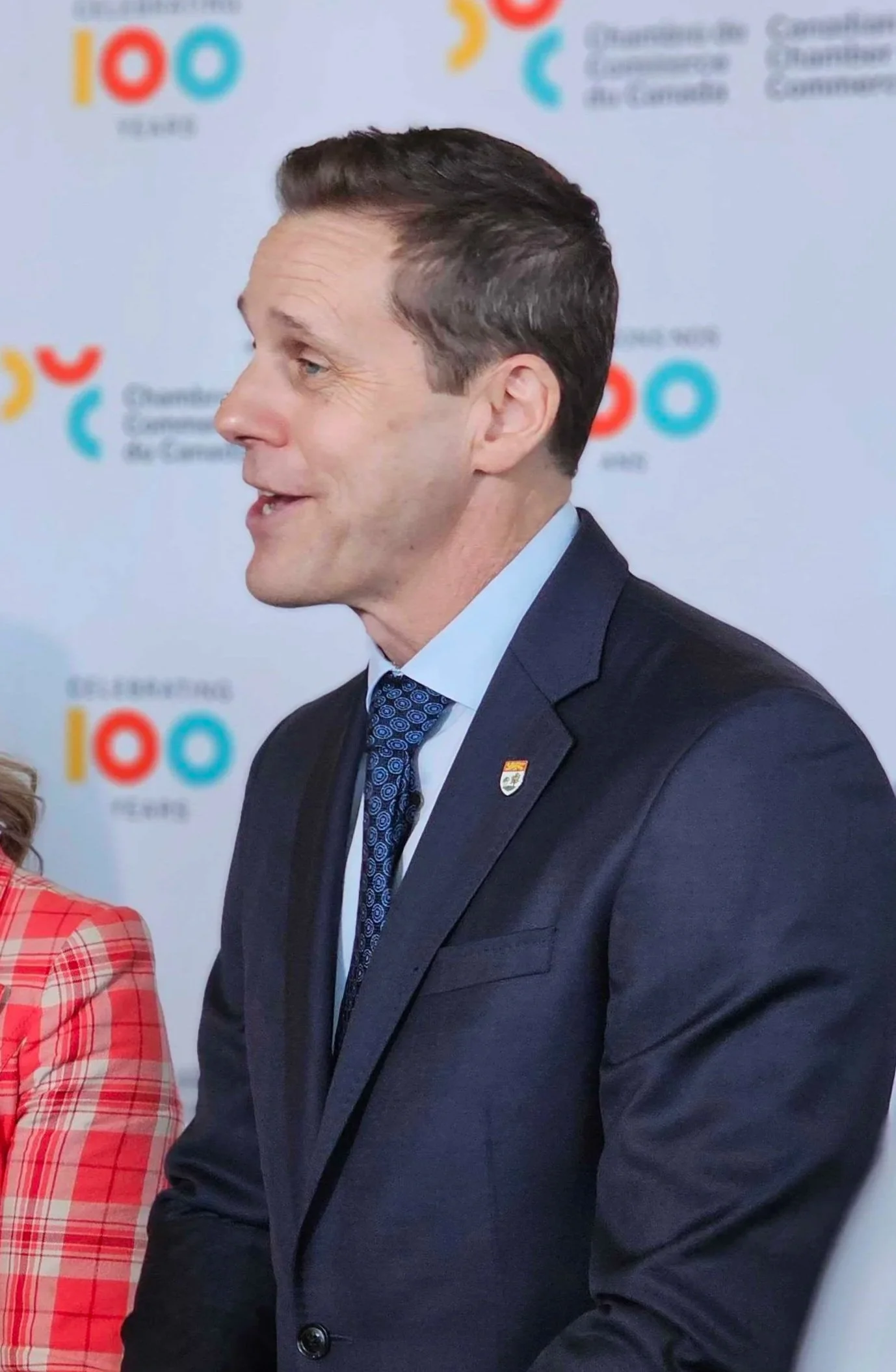
Prince Edward Island Premier Rob Lantz, pictured speaking to media at the Future of Business Summit. / MEANS & WAYS PHOTO
Our relationship with the U.S. will outlast Trump
Lantz said he would have used different language. “Weakness is not the way I would put it. Vulnerability might be a better word.” He argued the underlying relationship with the U.S. remains strong. “The Trump era will end. I still see a long, prosperous future ahead with our relationship with the United States.”
Simpson agreed it was a weakness. “Just look at the position that we're in right now. We are really under the gun with CUSMA. But I think that Canada has what it needs to become more self-sufficient, and we're always going to have a strong relationship with the United States — geography and relationship dictate that — but we don't need a dependent relationship.”
Bob Rae, former Permanent Representative to the United Nations, said on a separate panel he’s positive about our prospects. “I'm extremely optimistic about the moment that we're in.”
Canada is not in a unique position but is in a good position because there’s a “more united, effective leadership and a greater degree of national consensus about what needs to be done than we've seen in a very, very long time,” said Rae.
He added, however, “Mind the gap. That gap is, are we doing what we're saying? And how does this match up in every instance?”
The Canada-U.S. relationship will remain despite the current economic situation, he said, rejecting the idea that Canada is moving away from its southern neighbour.
A whole lot of new markets
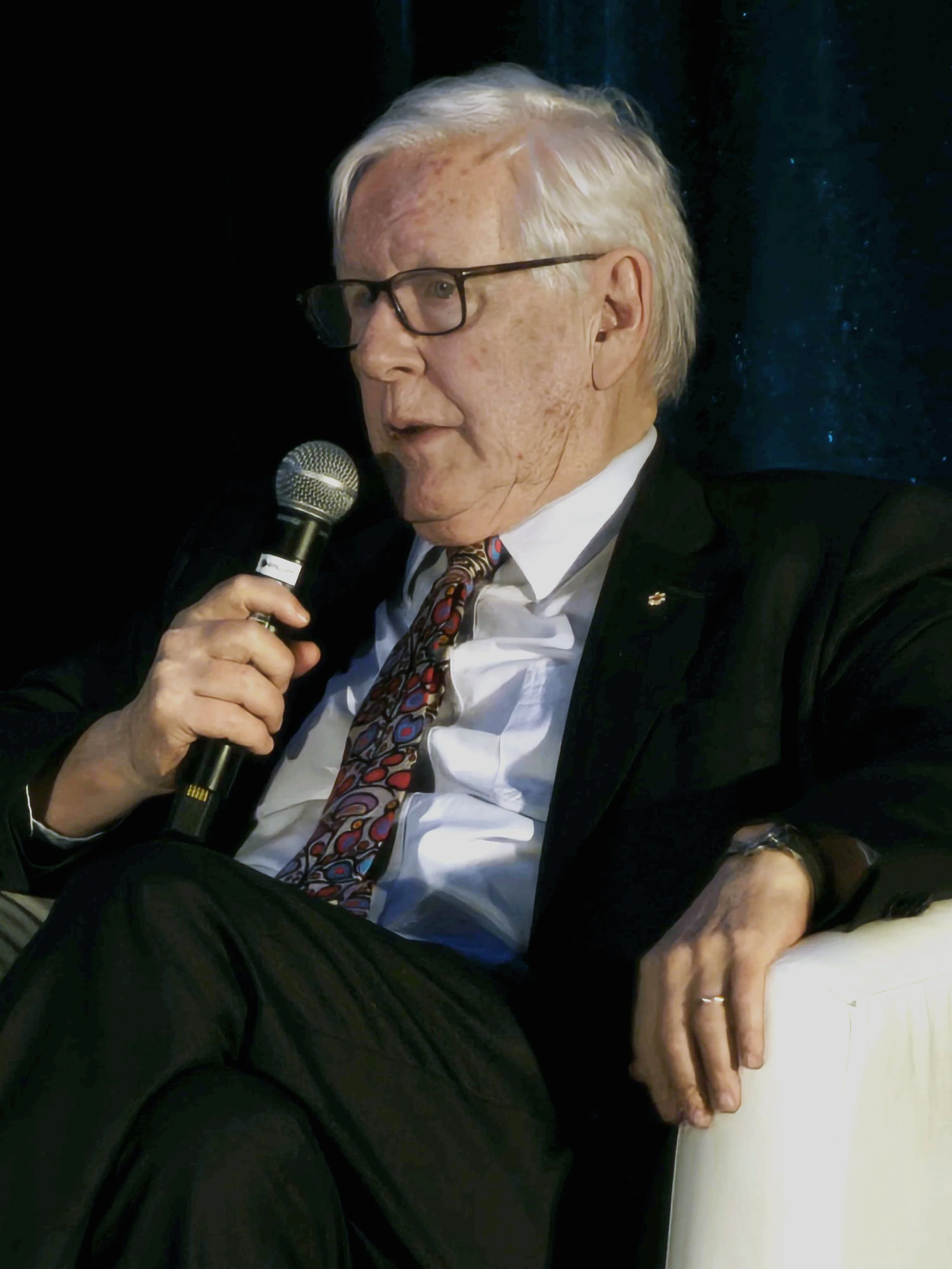
‘I'm extremely optimistic about the moment that we're in,’ says former UN Ambassador Bob Rae, speaking at the Future of Business Summit. / MEANS & WAYS PHOTO
When asked by moderator Matina Stevis-Gridneff, Canada Bureau Chief of The New York Times, “Should Canada really be turning its back on the U.S.?” Rae responded: “Nobody's turning their backs. That's not happening.”
Rae also said it’s up to businesses to also take action, because it’s not governments that do the trading. “The protectionist drive is there and I don't think it's going to disappear overnight but nobody's walking away from the U.S. All we're saying is, there are a whole lot of new markets out there and there's an enormous amount of potential, and it's only going to happen in business.”
Ford encouraged businesses not to pull back on American trade while diversifying. “Go after the 51 countries that we have free trade agreements with. Still continue to work with the U.S. Continue growing your company,” he said.
His broader economic message was directed at businesses weighing investment decisions. “Put money into people's pockets. They're going to go out and do things they might otherwise not do. Put money into companies' pockets and — I know this personally — they're going to invest, number one, in their people, into the infrastructure, into technology, and into new equipment.”
All four premiers identified the removal of internal trade barriers as a priority for strengthening Canada’s economy, though they differed on which barriers were most pressing.
Holt singled out trucking. “The barriers on trucking and transportation affect so many other sectors who are trying to move their goods, but find that they have to switch drivers at this border, and then switch first aid kits at this border, and then chain trucks together at the next one. It adds time and it adds cost, both to the customer and to the client,” she said.
Waiting months for authorization for work that needs to be done today
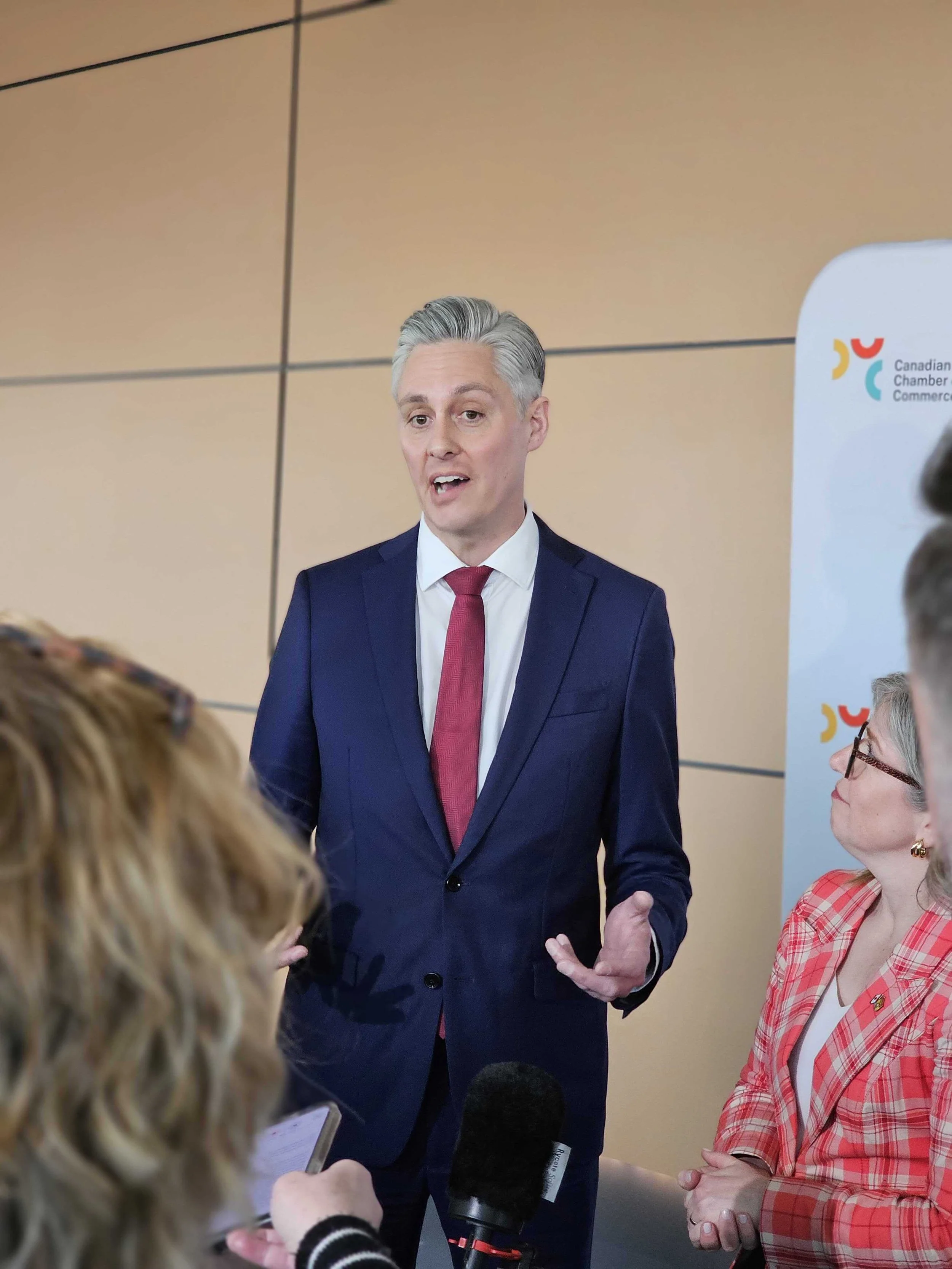
‘I think that Canada has what it needs to become more self-sufficient, and we're always going to have a strong relationship with the United States,’ Northwest Territories Premier R.J. Simpson says. / MEANS & WAYS PHOTO
Simpson pointed to labour mobility as equally urgent. “Labour mobility is huge, especially for us in the territory, where we rely so much on southern workers. In terms of healthcare and any type of skilled labour, that's an area where it really slows everything down when you're waiting weeks or months to get authorization to bring someone in to do work that needs to be done today.”
Holt said New Brunswick addressed the labour mobility issue unilaterally, without waiting for a national agreement. “We passed a new labour mobility act that said we would recognize anybody who had a Canadian credential in our province and give them the ability to work the next day, because we didn't need that to be reciprocal. Any Canadian credential is good in New Brunswick — come and help us fill the labour gaps that we have,” she said.
On interprovincial trade, Ford called on premiers to convert existing memoranda of understanding into binding agreements. “Either you're in or you're out. We're opening up the largest market in the country,” he said.
That same push for action echoed Charette's description of where Canada-U.S. negotiations stand.
Charette acknowledged Canada has already taken significant steps in an effort to advance the negotiations, including measures that carried real financial costs. For example, she said, walking back the Digital Services Tax cost the government millions of dollars in refunds and the loss of billions going forward. She said this was a “big concession” along with the removal of retaliatory tariffs.
Progress in the pocket
“The progress is coming. So far it’s being pocketed. And I think it’ll be important for us to see some mutuality in terms of the negotiating process.”
On how a final agreement might be structured, Charette offered insight into discussions between Canadian and American negotiators.
“My counterpart in the U.S. described this to me as kind of like a snap-on Lego bilateral piece to the underlying framework agreement,” she said, suggesting a deal could combine trilateral elements of the existing agreement with bilateral components addressing each country's specific concerns.
She also pushed back on the suggestion that negotiations with Mexico are significantly further along than those with Canada, arguing the two situations are not comparable. “It's partly pace. The other thing is, as I said, we’re in a negotiating process. So you're not going to hear a lot of public bouquets necessarily thrown our way.”
Charette was explicit that Canada will not negotiate publicly. “I can assure you that we are absolutely constructively engaged. We have been for months and we will continue to be.”
She called on Canadian business leaders to leverage their relationships with American counterparts to make the case for the agreement's mutual benefits.
“The most persuasive, the most influential voices that are going to affect decision makers and influencers in the United States are the leaders in the U.S. business community, in labour organizations, the leaders of American farmers, American workers,” she said. “I need Canadian businesses to reach out to your clients, reach out to your partners in the United States, and don't just take for granted that the [CUSMA] is an agreement that's mutually supportive, that's in the interests of the United States. Help me make that case.”
She added: “We're their number one customer. So let's use the power of the customer. We are so much stronger together.”