Carney, Smith announce pipeline plan to be built by federally-owned Trans Mountain Corp.
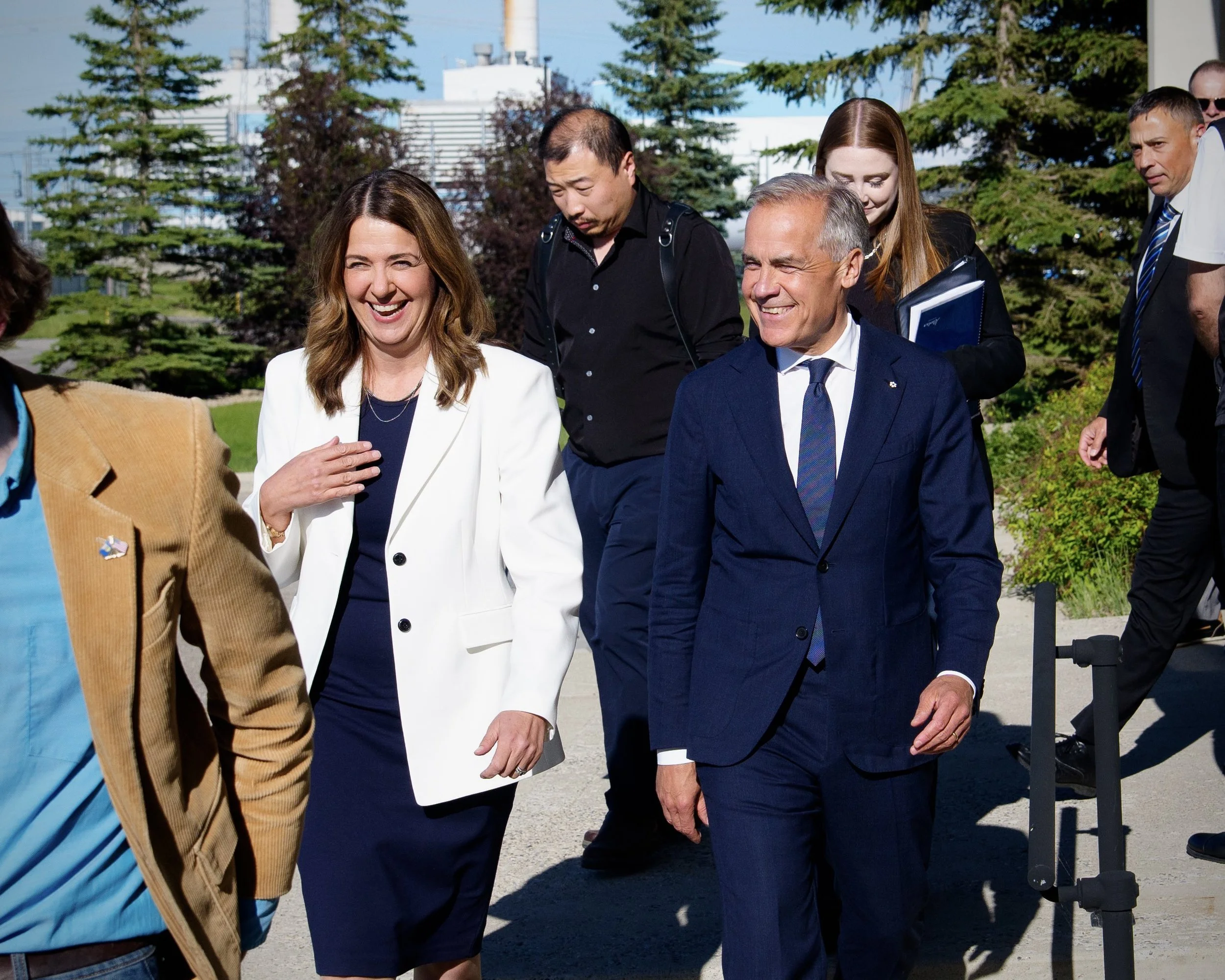
Alberta Premier Danielle Smith pictured with Prime Minister Mark Carney. ‘Canada faces a real opportunity to become an energy superpower. We are not waiting. We are building our strength at home and diversifying our partnerships abroad,’ Carney wrote on social media. / TWITTER PHOTO
Prime Minister Mark Carney and Alberta Premier Danielle Smith announced a proposal for a new oil pipeline from Alberta to a southern British Columbia port, to be funded jointly by the federal and Alberta governments and built by the federally owned Trans Mountain Corp.
Carney said the project will be immediately referred to the federal Major Projects Office for possible fast-track approval, with Canada and Alberta serving as equal partners and Indigenous communities offered a meaningful ownership stake.
The proposed one-million-barrel-per-day pipeline would largely follow the existing Trans Mountain corridor, is estimated to cost between $35.2 billion and $43.7 billion, and could begin construction in 2027 with completion targeted for 2034.
Carney defended the expected public investment, saying it should be viewed as an investment rather than an expense because the existing Trans Mountain pipeline has proven profitable.
Smith said the southern B.C. route is more practical than her earlier proposal for a northern B.C. pipeline, which faced strong opposition, while Calgary-based Pembina Pipeline Corp. has agreed to participate with a 10% ownership stake.
The two leaders argued the project is needed to expand Canada's oil exports to Asia and strengthen its role as a reliable energy supplier amid global instability, although Indigenous consultations and securing sufficient industry commitments remain significant challenges.
Earlier in the day, Carney and British Columbia Premier David Eby signed a Canada-British Columbia Cooperative Prosperity Agreement that includes about $20 billion for infrastructure, forestry, mining and trade projects and is intended to unlock more than $150 billion in investment.
Under the agreement, the federal tanker ban on B.C.'s North Coast will remain in place, while Eby said his government would not challenge a new pipeline in court but would instead ensure its constitutional obligations, including consultation with Indigenous communities, are met.
Meanwhile, in a new ‘Forward Guidance’ video, Carney said Canada must expand conventional oil and gas production while accelerating electrification and nuclear power development to strengthen the economy and energy security. He said the Trans Mountain expansion gives Canada direct access to Asian markets, reducing reliance on the U.S. and improving prices for Canadian oil. Carney said Canada will continue producing and exporting oil and gas in environmentally sustainable ways, despite acknowledging emissions will be higher in the near term than previously projected.
“Our emissions will be higher in the next few years than they were projected to be under the previous government’s plan,” Carney said, but argued the earlier approach was not viable in today’s geopolitical environment and would have restrained growth. “We must change our plan to get there. We can't afford to restrain the growth of an important part of our energy mix – oil and gas – to meet a short-term goal.”
Carney also pledged to double Canada's electricity grid, connect provincial systems, streamline approvals, and expand nuclear energy to lower long-term costs and improve competitiveness, describing the strategy as a nation-building effort to boost affordability, exports, and energy resilience.
In a social media post, former environment and climate change minister Steven Guilbeault, who resigned his seat over the government's energy plans, said there were three takeaways from the announcement. The first, he said, was that having a pipeline in B.C. take a southern route was “less bad news” and will “mean less environmental impacts and less opposition from Indigenous nations.”
He said, however, that after including a private-sector proponent for Alberta's pipeline MOU, taxpayers will be on the hook for it and that the clean electricity regulations “will be, if not abolished, seriously weakened” even though renewables are now less expensive.
“All of this is happening as we are seeing heatwaves hitting numerous corners of the globe and northern Quebec is seeing four times the number of forest fires we would normally have at this time of the year,” he said.