U.S. creates continuing uncertainty for business as Trump declines to extend CUSMA
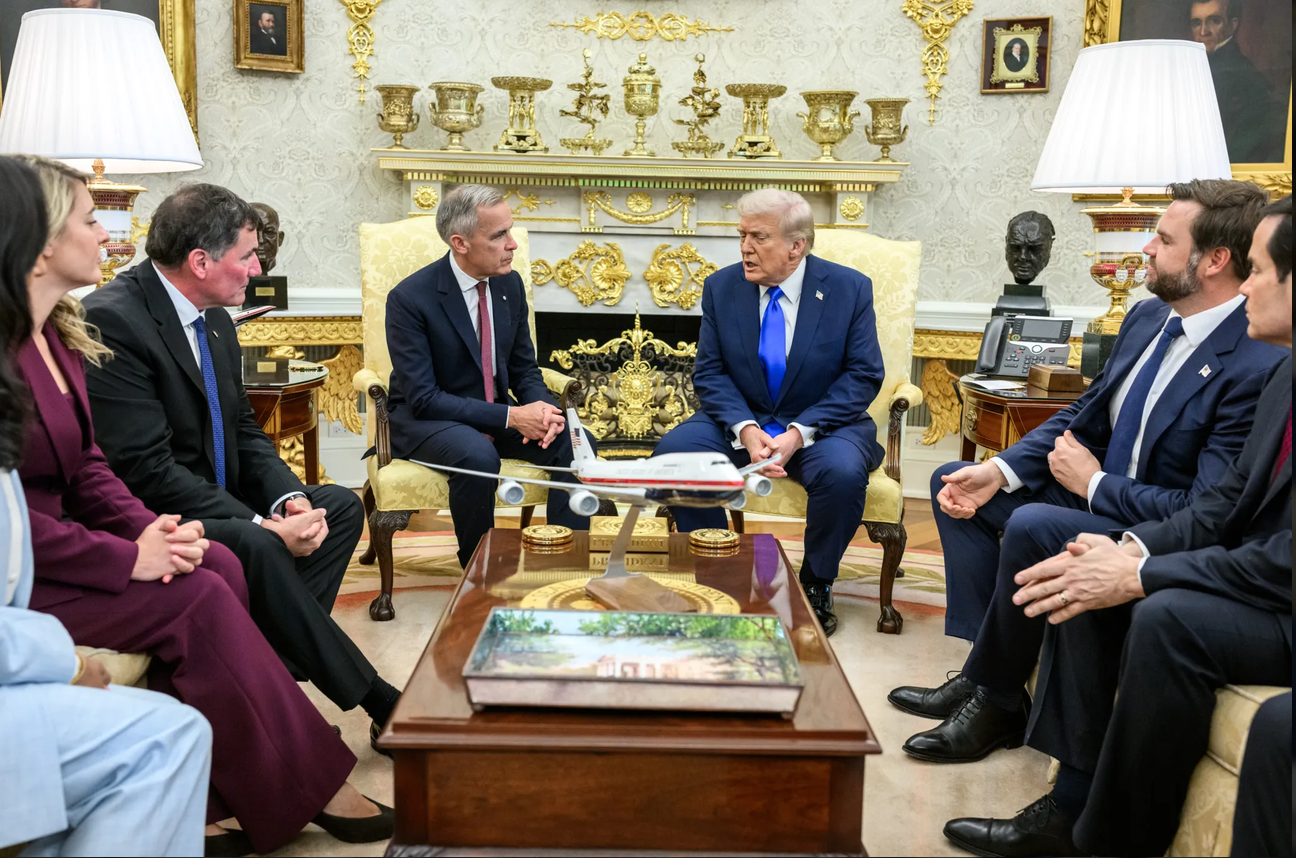
Prime Minister Mark Carney, pictured at the White House with U.S. President Donald Trump in 2025. The U.S. indicated on July 1 it would not renew CUSMA in its current form. / WHITE HOUSE PHOTO
Businesses in Canada and the U.S. face continuing uncertainty about the continental economy after the Trump administration confirmed it would not extend CUSMA, but economists say cancelling the agreement altogether is unlikely.
“Near-term trade risks for Canada haven’t gone away; Article 34.6 of CUSMA still allows any country to leave the agreement with six months’ written notice,” RBC assistant chief economist Nathan Janzen and senior economist Claire Fan wrote in a report.
“We continue to view the outright termination of CUSMA as unlikely if economic reasoning holds. Decades of free trade in North America have left industrial supply chains heavily integrated across borders, and exporters and importers in Canada, U.S. and Mexico with strong incentives to preserve the deal.”
As expected, U.S. President Donald Trump’s government in effect ushered in annual three-country reviews of the North American pact by declining to renew the Canada-U.S.-Mexico pact for a 16-year period. Both Canada and Mexico had offered to do so in advance of the July 1 decision deadline.
Although CUSMA remains in force, it will be subject to negotiations that could last for several months, or longer, as the U.S. seeks to modify it to address Trump’s various trade complaints.
“The United States didn’t agree to renew (CUSMA) in its current form,” wrote U.S. Trade Representative Jamieson Greer in a statement to CTV News. “As a result, (CUSMA) is not renewed.”
“The United States will continue to engage with Mexico and Canada to address the agreement’s shortcomings and our trade deficits with these countries,” Greer added. “However, the agreement remains in force pending resolution of these issues or until the agreement’s termination.”
Foregone conclusion
The virtual meeting of the three countries’ top trade officials on Wednesday was a foregone conclusion, as many observers including Prime Minister Mark Carney had expected the U.S. to refuse to extend the current pact.
Trump, who made tariffs a key element in his second administration’s economic policies, has regularly criticized CUSMA despite the fact that he took part in its creation in 2020. He has threatened to scrap the deal entirely, as allowed under the treaty on six months notice. But it is widely believed that this is unlikely since CUSMA is strongly supported by the American business and farm communities.
Still, the requirement for continued negotiations prolongs uncertainty about future trade opportunities — which is undermining investment and economic activity.
“Annual uncertainty is a tax on North American competitiveness,” Daniel Tisch, President and CEO of the Ontario Chamber of Commerce, remarked in a statement. “When the rules aren’t clear, businesses and investors on both sides of the border pull back. North America has an opportunity for a jobs and investment boom – but only if we restore stable trade rules for businesses in all three countries.”
While LeBlanc and other Canadian officials continue to hold closed-door talks with Greer and his team, the Trump administration has yet to schedule official CUSMA negotiations with Carney’s representatives. This is in contrast to the U.S.’s dealings with Mexico: those two countries will hold formal negotiations for a third time in the week of July 20.
The Trump administration has regularly aired the idea of working out separate trade agreements with Canada and Mexico, but both countries have rejected that approach.
Not ‘looking for a pen’
On Tuesday, Carney dismissed expectations for an eventful CUSMA meeting this week. He told the media he was anticipating “a constructive exchange” but noted he “wouldn’t expect any drama,” and was “not looking for a pen” for signing any agreements.
Janzen and Fan said even if CUSMA were terminated unexpectedly, the economic impact would likely be less severe than previously anticipated because newer U.S. tariff measures would generally impose a 10% tariff on affected imports rather than the significantly higher rates proposed under earlier policies. Many Canadian exports would also remain exempt under separate U.S. tariff exclusions.
The review is expected to focus less on the future of the agreement itself and more on potential updates to its rules, including stricter Rules of Origin requirements that could mean higher North American or U.S. content in manufactured goods. The United States may also seek greater alignment with Canada and Mexico on trade policies involving China and other non-market economies.
“Businesses seeking immediate resolutions will be disappointed, but the review remains relevant,” the economists wrote. “It will be the first such process for any U.S. free trade agreement, and will bear procedural importance in terms of scope, process, and legislative requirements that will establish precedents for similar reviews in the future, even if it yields little tangible change.”
Meanwhile, LeBlanc said in a statement Canada will continue to work with the U.S. and Mexico, and discuss sectoral tariffs with the U.S. related to steel, aluminum, autos and lumber.
“Canada approaches these discussions from a position of strength and with the goal of preserving and strengthening one of the most successful trading relationships in the world. At a time of global economic uncertainty, Canada is a stable, reliable and trusted partner. We have the energy and natural resources the world needs, a world-class workforce, and a predictable business environment attracting the highest investment in decades,” LeBlanc said.
“We look forward to further engagement with the United States and Mexico in the coming weeks and months as we work together to strengthen our shared economic prosperity.”