A house of dynamite
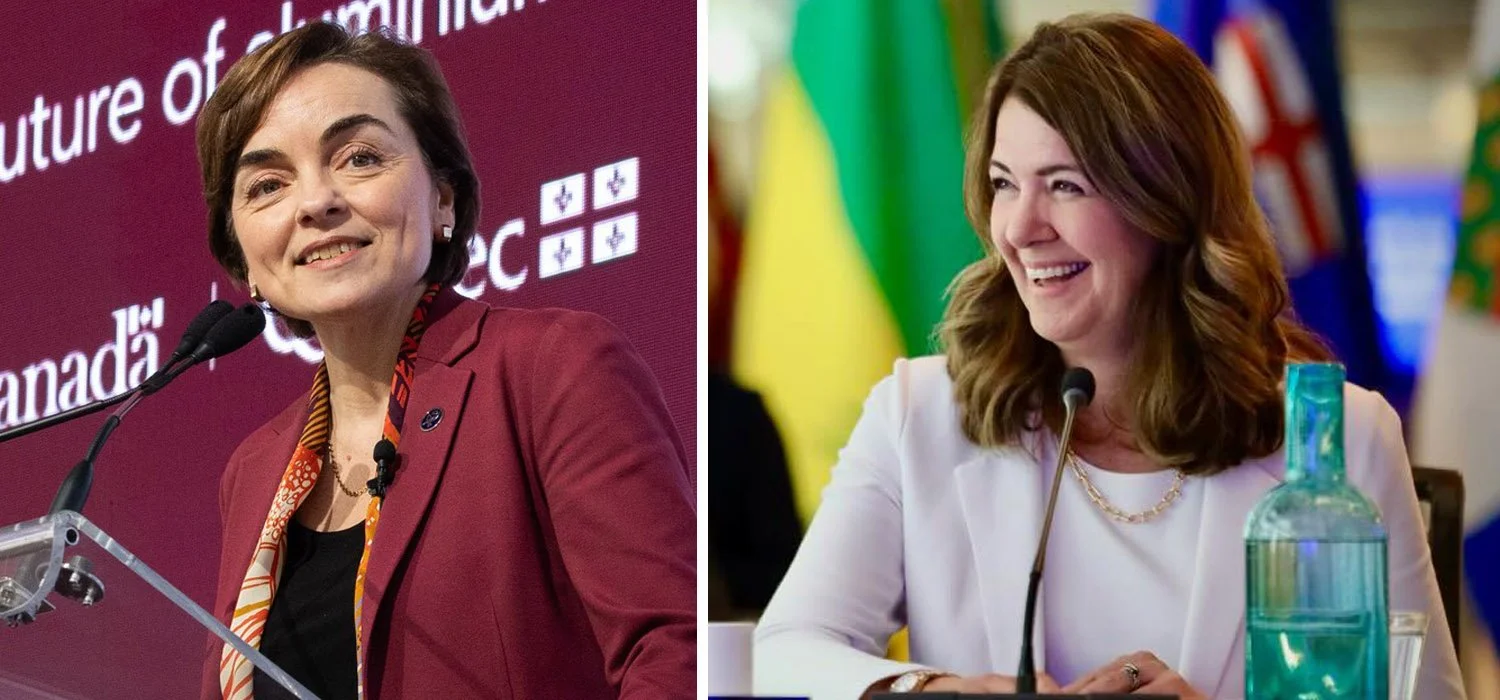
Quebec Premier Christine Frechette and Alberta Premier Danielle Smith. ‘Between now and October, the atmosphere of federal-provincial relations will be febrile,’ writes Ken Polk. / FACEBOOK PHOTOS
Anyone who worked in the Prime Minister's Office or the Privy Council Office between 1976 and 1995, if asked to participate in another separation referendum, would no doubt feel tempted to respond: I would rather have needles stuck in my eyes.
The idea of handling two separate referenda from different provinces would likely translate that mordant thought into action.
But here we are.
Two Mondays in October
The sovereigntist Parti Québécois (PQ) is likely to be elected on Monday, October 5. Although the Quebec Liberal Party has caught up with the PQ in the polls, the PQ still holds a comfortable lead among francophone voters, who determine who forms governments in the province
The PQ’s main weakness heading into the election is low support for sovereignty, fluctuating between 26 percent and 31 percent depending on the poll. Nonetheless, sovereignty remains Article 1 of the PQ’s constitution and a reason—if voters are looking for one— not to make the PQ’s Paul St-Pierre Plamondon their premier.
In Alberta, we have federalist Premier, Danielle Smith, leading a United Conservative Party with a significant base of supporters who would like to leave Canada. While support for separatism is as low as in Quebec—25 percent to 35 percent, depending on the poll—they actually do have a date for a referendum, Monday, October 19.
So we are heading toward two highly consequential Mondays this October for Canadian unity and the Canadian economy.
Feelings are just as important as facts
Anyone who lived through the 1995 referendum will tell you that there was an air of complacency about the federalist strategy. At that time, the PQ seemed shackled to an unpopular Premier, Jacques Parizeau, who, in turn, was shackled to an unpopular policy: sovereignty. Yet what seemed to be a foreordained march to federal victory became a near-death experience, with a razor-thin margin of 50,000 votes out of 4.7 million cast for federalism.
Everything changed halfway through the campaign when the charismatic Lucien Bouchard took over from Parizeau. He seemed to strike a kind of mystical chord of pride among Quebecers, one that the federalists, whose campaign was premised on a kind of bloodless recitation of the economic damage that sovereignty would inflict on a new Quebec nation, could not match.
For younger referendum watchers, the federal strategy may sound familiar. It was used by the “Remain” side in the 2016 BREXIT referendum, as they warned voters of the economic costs of leaving the European Union (EU).
The “Leave” side, on the other hand, struck a resonant chord with the grievances of millions of Britons who felt that they were losing control of their lives, livelihoods, and country amid the steady march of Conservative and Labour governments towards European integration. On the way to victory, the “Leavers” successfully hung the label of “Project Fear” on the seemingly bloodless recitation of economic facts and figures that emanated from the “Remainers.”
Another similarity between today and 2016 is that then UK Prime Minister David Cameron decided to hold the Brexit referendum in order to shut up, once and for all, the so-called “Euroskeptics” in his Conservative Party who had been clamouring to take the UK out of the EU since the time of Prime Minister Margaret Thatcher. In Cameron’s eyes a “Remain” win would end the matter.
And this sounds very much like what Premier Smith is up to with the “non-referendum” referendum scheduled for October. Albertans will be asked if they want a binding referendum on separation. If she can head her “Wexit-eers” off at that pass, she may feel that they have been dealt with.
Maybe so. But this strategy seems premised on ignoring a fundamental lesson of 1995 and 2016: feelings can be more important than facts. And a strategy based on the latter without reference to the former could result in a very near run thing — and perhaps outright defeat.
A toxic dance of discontent
Then there is the potentially toxic dynamic between the grievances of Quebec sovereigntists and those of Alberta separatists.
At one level, Alberta and Quebec have had common cause in limiting federal involvement in what they view as sole provincial jurisdictions, from health care to natural resources. More viscerally, however, there has been deep mutual resentment: Albertans have strongly opposed any special treatment or constitutional concessions for Quebec, while Quebecers, in turn, have felt misunderstood and insulted.
For Albertans, there was the legendarily loathed National Energy Program of the 1980s, which they widely viewed as the federal government cutting a sweetheart energy deal with Quebec (and Ontario) at their expense. For Quebecers, there was the collapse of the Meech Lake Accord in 1990. In the end, it was strongly opposed by Albertans because it failed to deal with their special constitutional concerns such as reform of the Senate. The Accord’s demise was widely received by Quebecers — federalist and sovereigntists alike — as a searing humiliation.
Like many Westerners, Albertans feel ignored by federal governments elected by Quebec (and Ontario) voters.
And for the past decade, Ottawa has been struggling, ineffectually, to bridge Canada's two emerging energy solitudes: fossil fuels in Alberta; clean energy (hydro) in Quebec, with oil and gas often depicted as the past, while clean energy is hyped as the future.
What's an investor to do?
So, between now and October, the atmosphere of federal-provincial relations will be febrile. Both Alberta separatists and Quebec sovereignists will be on the lookout for any issue they can use to stoke their voters. This decades-old sense of mutual antipathy suggests that there will be ample opportunity to light the constitutional fuse.
For Prime Minister Mark Carney, this could be the first time since his election that his nation-building economic message and agenda are supplanted by the nation-breaking agenda and message of significant portions of the populations of Alberta and Quebec.
None of this will strengthen Carney's primary preoccupation and mission: attracting foreign investment to fund the build-out of his promised “one Canadian economy.” Memories of the unpredictability of the 1995 Quebec referendum and the 2016 Brexit vote will no doubt soon see capital markets price in a political uncertainty premium for prospective lending to or investment in Canada.
Carney is doing his best to stay on economic message, framing each new major investment, like the one this week in LNG with Germany, as demonstrating that Canada works even though the rules-based international economic order no longer does.
We’ll see if he can hold to that. But already in the last week, he has been dragged into the fray over the application or non-application of the Clarity Act, passed under the Chretien Liberals after the near-death experience of 1995.
With the Quebec election and the Alberta referendum approaching, Canada may strike investors not as a safe haven but rather a constitutional house of dynamite. For the next five months, the risk of detonation will be high.