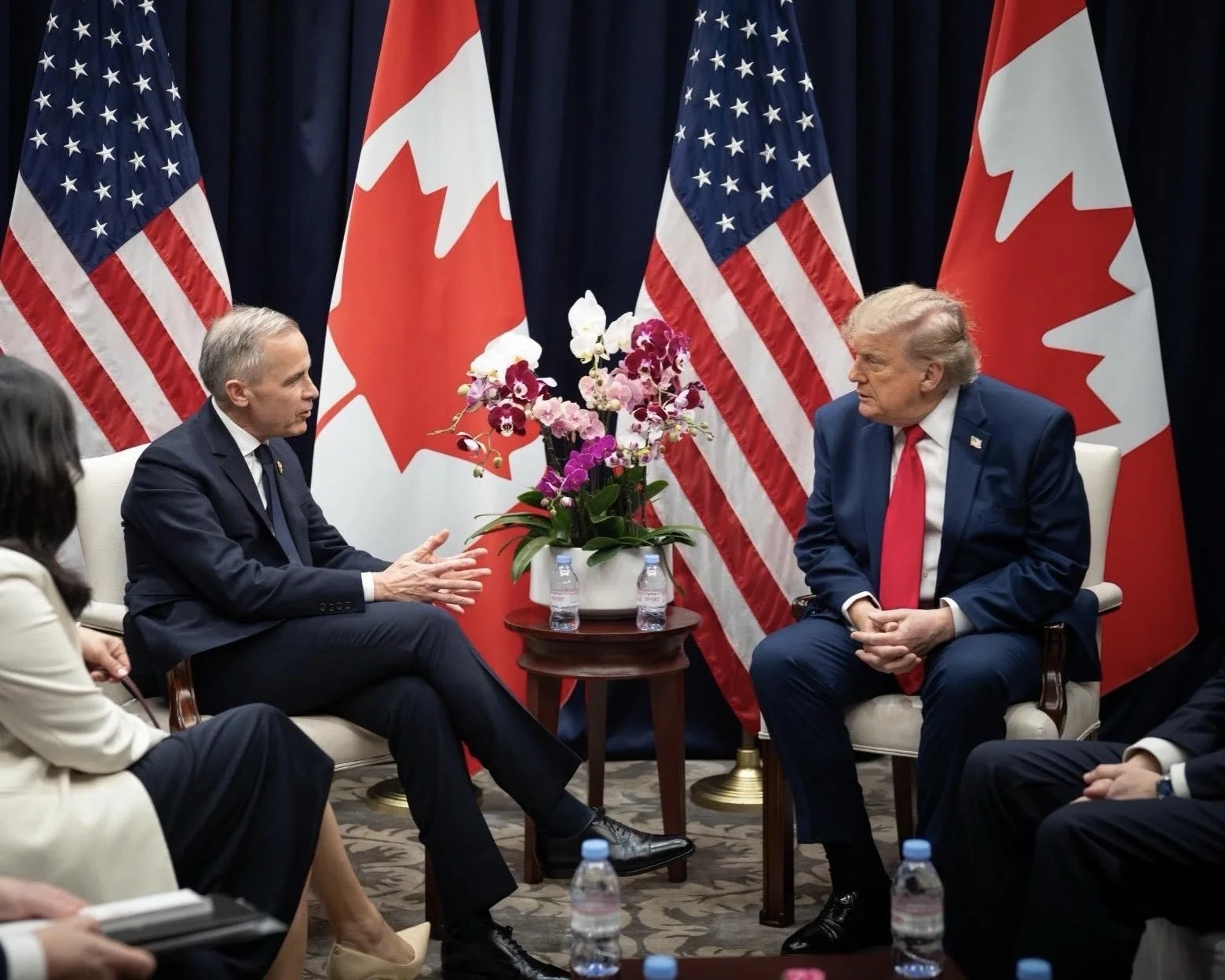
Prime Minister Mark Carney met with U.S. President Donald Trump in Shenzhen. ‘We discussed the work underway to reach a mutually beneficial trade agreement that would create good jobs, boost affordability, and fully respect Canada’s languages, culture, and sovereignty. We agreed to continue the work and to stay in close contact,’ Carney wrote on social media. / TWITTER PHOTO
Speaking this week at the New York Times’ annual DealBook Summit, the Prime Minister showed pronounced insouciance about the prospects of landing a trade deal with U.S. President Donald Trump: "We'd like to do a deal. If the U.S. doesn't want to do a deal, we're busy."
What is noteworthy about this comment is that it came shortly after he and Trump held a bilateral meeting on the margins of the APEC Summit in Shenzhen, China. It also followed comments by Carney suggesting that Canada could deepen its auto manufacturing ties with China, a move that Trump White House trade advisor Peter Navarro said would be “offensive in the extreme.”
Where once the Prime Minister seemed careful not to say anything that might provoke the wrath of the Orange God King and his court, he now seems fine with appearing to trivialize the President’s overbearing agenda in front of global audiences.
Of course, at one level this is just more of the same for the Prime Minister. His two overriding international priorities are shifting Canadian exports away from the U.S. and promoting Canada as the best place in the world to invest in massive natural resource projects. To that end, he seemed to score two more Asian free trade deals with the Philippines and the Association of Southeast Asian Nations. (Though the characterization of both deals as “substantially concluded” suggests they are not in the bag quite yet.)
Even so, the Trump-and Navarro-provoking rhetorical garnish seems new and edgier, certainly so soon after a Trump-Carney face-to-face meeting
End-stage MAGA
If one week is a lifetime in politics, then two weeks is a generation, and “generational” is the best way to describe the rhetorical whipsaw that has transformed the perception of Trump’s political power in the two weeks since the gob-smacking defeat the Republicans sustained in the midterm elections.
Until November 3, Trump seemed a magical political conjurer whose pull among supporters defied modern polling techniques and was certainly beyond the capacity of the perpetually insecure Democratic Party to confidently resist and defeat. Since then, the President has been characterized as an extinct volcano.
Indeed, so fast have the proverbial rats been abandoning the sinking ship that even Elon Musk — once a fixture at Trump’s MAGA rallies — is doing his very best to memory-hole his affiliation with the movement, saying with a straight face this week, “I’m not MAGA. … I’m not sure what MAGA means.”
For the broad mass of Trump-hating Canadians, the midterms and the heralding of what seems to be the end stage of his presidency could not be sweeter to behold. But for Carney, whose political brand has been built on such loathing, the President’s midterm beatdown is a more complicated political proposition.
Trump is not a busted flush just yet
The fact is that Trump — though clearly damaged — is not a busted flush just yet. Anyone familiar with his record knows that he would not be one to go quietly into retirement. He has an almost infinite capacity to try and gain short-term political advantage by sowing chaos.
The Democratic seizure of Congress might mark the beginning of the end of the tariffs that have hit the Canadian auto, aluminum, forestry and manufacturing sectors, among others, very hard. Indeed, it has been reported that senior Democratic Senator Ron Wyden has identified Trump’s tariffs on Canada as an “early target” for repeal when the new Congress convenes in January.
Trump remains President and would have to sign such a bill for it to become law, a doubtful proposition since tariffs are at the core of Trump’s agenda. A veto would seem almost a certainty.
The Democrats could try to override a Trump veto. But that would require significant Republican support, since a two-thirds vote in both the Senate and the House of Representatives would be necessary. Or they could try to cut some sort of deal with the President to secure his signature on a no-doubt watered-down tariff-repeal bill. Or wait two more years in the hope that a Democratic president would sign it.
This optimistic scenario also overlooks the equally inconvenient fact that tariffs have some appeal among Democrats, particularly within the party's progressive wing. So it is not even certain that a clean repeal bill would clear a Democratic Congress.
So, like it or not, the most direct route for the Prime Minister to alleviate tariff pain is to strike a bargain with Trump.
Why would Carney even strike a deal?
Of course, there is an immensely strong public policy case for Carney to secure a deal as soon as possible. Tariffs are hurting Canadian companies and workers and creating broad economic anxiety in key economic sectors. Moreover, they are costing the government billions of dollars in various forms of support.
But as a purely political proposition for Carney, doing any kind of deal with Trump has little to recommend it at this point.
Remember, he seemed close to securing a deal in August but walked away at the last minute, citing unacceptable demands from Trump’s bargaining team. Far from hurting him politically, the mere act of walking away saw his poll numbers, which were already strong, get even stronger.
So, at a minimum, any new deal in prospect would have to look demonstrably better than the one just thrown back in Trump’s face. Trickier still, it has to be seen as better by the First Ministers of the provinces and the territories, all of whom saw the first deal and who unanimously — if unevenly — supported Carney’s decision to walk away.
True, it has been reported that the Prime Minister’s negotiating team made the case, behind closed doors late this week, against waiting to strike a deal until after the 2028 presidential election. Apparently they argued that “neither the auto industry, nor the sectors affected by…tariffs, can afford to wait two more years before meaningful tariff relief.”
Saying this behind closed doors is one thing; publicly defending striking a deal with a deeply unpopular and politically repudiated President is quite another.
Should there be a deal in the near future, Prime Minister Carney will have to be its defender-in-chief. As a politician who owes his election to resisting Trump, Carney has to know that signing a deal with him carries a very real risk of toxifying his core political brand. He also knows that there will inevitably be winners and losers in any deal.
So the simplest and most politically compelling way for Carney to show that any deal is better is to wait two more years and sign it with a president not named Trump.
So delivering a deal attractive enough to overcome the initial political stink of Trump among Canadians will be key to whether the Prime Minister decides to expend his political capital to defend it.
Over to you, negotiating team.