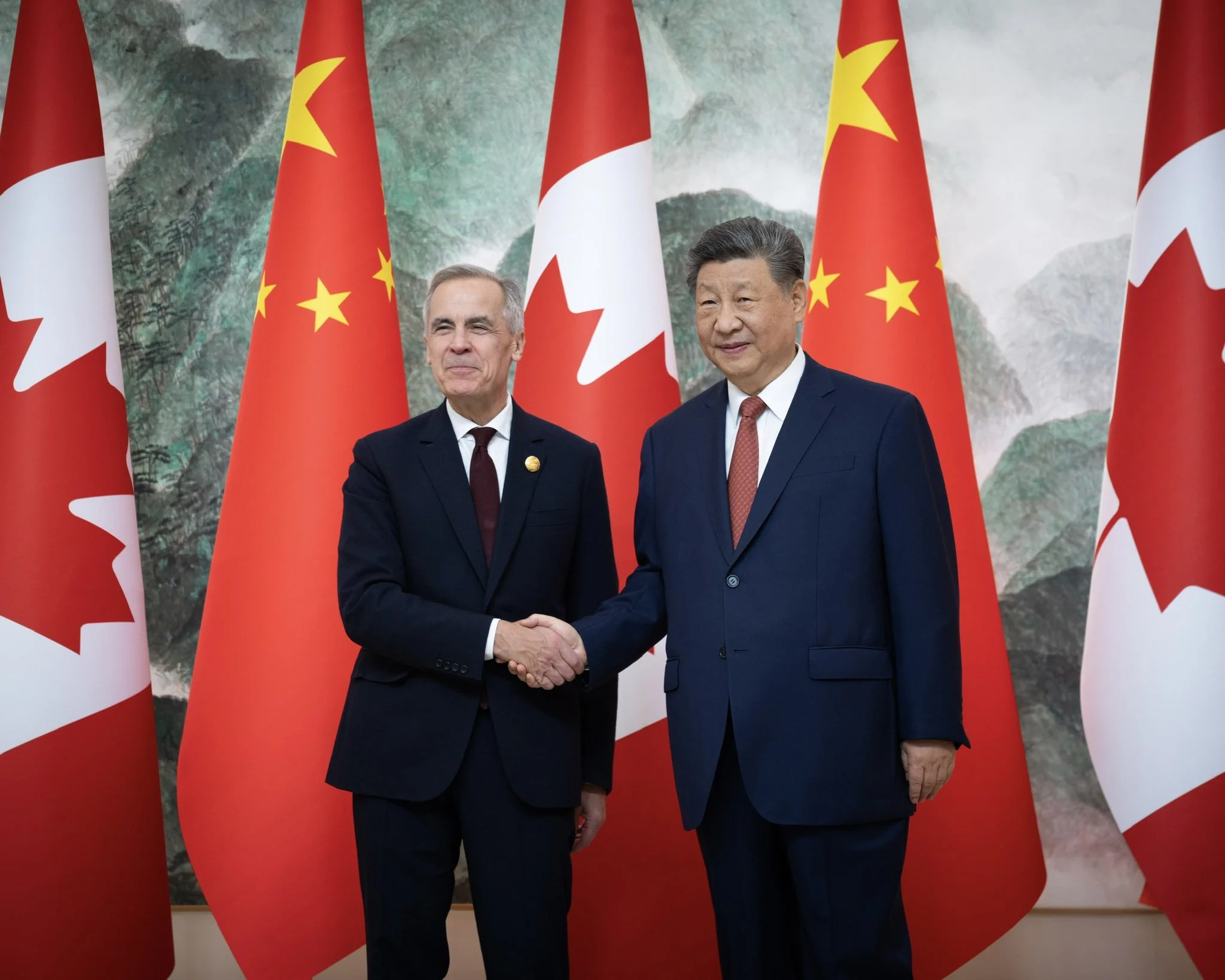
‘Canada and China have recalibrated our relationship — pragmatically and decisively. Today in Shenzhen, I was honoured to meet with President Xi to take stock of the progress we’ve made in trade, energy, tourism, and culture. We looked to the future and focused on what more our countries can achieve together,’ Prime Minister Mark Carney wrote on social media. / TWITTER PHOTO
The federal government is working to get a Canada-U.S. deal to lower steel, auto and aluminum tariffs by January, before new tariffs on Canadian goods are put in place, the Toronto Star reported.
U.S. President Donald Trump said in August that all cars, trucks, automotive parts and steel will be subject to 50% tariffs as of Jan. 1, 2027. Prime Minister Mark Carney met with Trump on the sidelines of the APEC Summit this week, however, and said nothing has changed in the U.S.’s position and therefore neither has Canada’s.
“We continue to have a series of issues there. Look, there is a very, very good trade arrangement that is possible. We had an existing one under USMCA. There is one under the new trade policy that is possible, but we're not yet there,” Carney said during a virtual Q&A with Andrew Ross Sorkin at the New York Times DealBook Summit. “What will change views will be policy decisions that are taken and that stick. I think in the end, that is what is going to change views. … Until policy actually changes, it's hard to change the view. That's the reality.”
Foreign Affairs Minister Anita Anand told media that the meeting was 20 minutes long and discussions will continue.
“It was my second meeting in the room with the Prime Minister and President Trump, and so I know that their relationship is productive and professional. But those negotiations are continuing, and I want to make sure that they do so in the context of those negotiations,” she said.
In a press conference, Trump acknowledged the meeting, saying Carney “was very nice” before reiterating that he doesn’t believe the trade relationship is fair. “Let me put it that way. We have about a 80 billion dollar deficit with Canada. I said when it’s down to zero, come over and let’s start talking,” he said, also noting that the U.S. is getting closer to a deal with Mexico but won’t let them have a trade surplus.
Canada-U.S. Trade Minister Dominic LeBlanc convened a meeting of the Advisory Committee on Canada-U.S. Economic Relations this week. Canada’s chief trade negotiator, Janice Charette, told the council that multiple unresolved trade issues with the United States continue to prevent an agreement, Global News reported. The 25% U.S. tariff on Canadian automobiles remains the biggest obstacle.
Council members were told the government sees an opportunity to secure an interim trade deal by year’s end, ahead of broader Canada-U.S.-Mexico free trade negotiations. However, some council members questioned Ottawa’s approach, with one warning that the government appears “desperate for a deal.”
Meanwhile, Carney noted at the DealBook Summit that Canada continues to collaborate on several issues with the U.S., for example defence.
“We are NATO allies. There are a host of issues where we collaborate in national security and other other aspects. We still have quite an open trading relationship as well, but there are dependencies for which it would be unwise for us to not hedge, and once you hedge, then you take a decision. You know this from finance: Do you take the decision to take the hedge off just because the market's repriced, or is it better to leave it on? And I think people will be leaving on their hedges for a while until they truly believe they're in a different market environment,” he said in response to whether Carney would work with a new U.S. President.
Carney said negotiating a trade deal with China was “insurance” for Canada even if “it’s not ideal.”
“You're always taking some risk, right? Different governments could come in. Their priorities could shift. Different alliances could come into place, and so you have to build in some redundancy. And look, this is not ideal. To be clear, it's not ideal. There is a cost to insurance.”
Tariff relief for pork, fish and seafood
On Nov. 17 in Shenzhen, China, Carney and Chinese President Xi Jinping agreed to expand tariff relief for approximately $400 million worth of Canadian exports, including pork, fish and seafood products. Ottawa says the move means more than 90% of trade previously affected by Chinese tariff measures has now regained market access.
Carney also announced a Team Canada trade mission to China next year and said 2027 would be designated the Canada-China Year of E-commerce. The two countries also unveiled measures aimed at increasing flights between Canada and China and signed more than $15 million worth of cultural agreements.
Speaking at the APEC Summit on Wednesday, Carney pointed to newly concluded free-trade negotiations with the Philippines and the Association of Southeast Asian Nations, a bloc of nearly 700 million people that the federal government says could add almost $2 billion to Canada's GDP and create roughly 14,000 jobs once an agreement enters force.
“Abroad, we are building a dense web of reliable partnerships — creating more opportunities for our businesses, more choice for Canadians, and less reliance on any single market,” he said.
At APEC, Carney said leaders would renew the bloc's Connectivity Blueprint, a framework focused on strengthening links through infrastructure, institutions and people-to-people connections.
He tied that effort to domestic measures including trade-corridor projects, noting “we're fast-tracking major projects across the country, including trade corridors, doubling the capacity of the Port of Vancouver, and building energy infrastructure to Asia.”
Carney said the initiatives are already producing results. “Our goal, as we have said for over a year, has been to double our exports beyond the United States by 2035. We are well ahead of that schedule,” he said.
Carney argued the initiatives are helping accelerate Canada's trade diversification strategy, noting that one in three Canadian export dollars now comes from non-U.S. markets and that Canada has preferential trade access to more than two billion consumers through 20 free-trade agreements covering 60 countries.