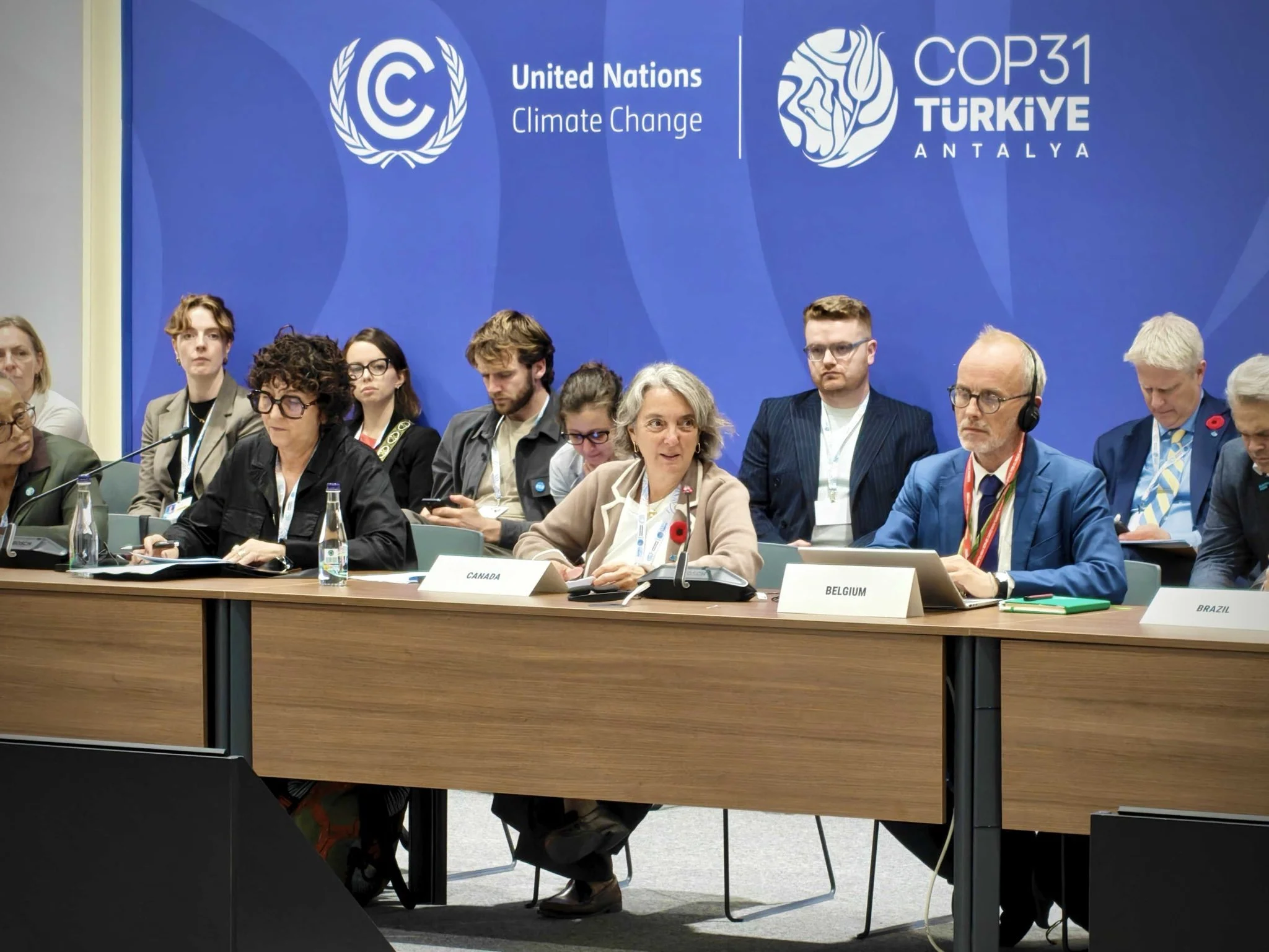
Environment and Climate Change Minister Julie Dabrusin pictured at COP31. ‘Our government is laying the foundation for more clean power, electrification and lower costs for people across the country,’ she wrote on social media bout the government’s National Electricity Strategy. / TWITTER PHOTO
The federal government’s efforts to expand clean electricity, support new technologies and mobilize private investment are welcome, but their effectiveness will depend on how they are implemented and whether they are undermined by continued investments in fossil fuels, says Geoff McCarney, Executive Director of the Smart Prosperity Institute.
“We're seeing increased use of higher fossil-intensive energy sources to meet increasing peak power demands, and so some of the advantage Canada has put forth of having a relatively low emissions grid will be eaten away at unless we expand the capacity to keep putting low emission sources into the grid,” McCarney told Means & Ways.
Budget 2026 outlined $115 billion in electrification-related investments over the next 15 years. The government projects that a larger electricity system could add $3 trillion to the Canadian economy, create 1.6 million jobs and generate $5 in economic benefits for every dollar invested by 2050. “By acting now, Canada can secure its place as a leading energy superpower and build a stronger, more prosperous future for generations to come,” the government’s plan says.
McCarney said expanding electricity generation and transmission is essential to reducing emissions, particularly as transportation, buildings and industrial processes increasingly switch from fossil fuels to electricity; however, he said the government needs measurable targets and regular progress assessments to ensure its electricity strategy delivers results. Whether the government’s plan will make a difference “remains to be seen,” he said.
“What matters is how well what they are proposing works, but also, how we pursue other commitments to reducing our climate impacts,” he said. “But we're not talking about how while we're doing this, we're also investing public money in things like pipelines and in expanding natural gas production and in allowing for more flexibility in the use of natural gas along the transition to a 2050 target. And so, how those things play out together will determine whether it really matters.”
His comments come as Canada reaffirmed its commitment to the Paris Agreement at the United Nations climate conference (COP31) in Türkiye where it was acknowledged that exceeding the agreement’s 1.5 C warming threshold is now widely considered unavoidable. Canada also signed a global electrification pledge, supported international efforts to move away from coal and welcomed an agreement to assess the potential use of Canadian CANDU nuclear technology.
The federal government also used COP31 to announce $116 million in new international climate funding — including money for early-warning systems and adaptation planning — part of its commitment to provide $13 billion in climate-related support over five years.
Environment and Climate Change Minister Julie Dabrusin also announced that Canada will chair the Global Methane Initiative and launched AVOID-Methane, a program designed to connect international emissions-reduction opportunities with Canadian businesses and technologies.
“Canada is committed to the Paris Agreement and to achieving net-zero emissions by 2050. Our path to get there is about investing in the infrastructure, energy and technologies that lay the foundations for emissions reductions that last while making Canada more productive, competitive, and prosperous,” Dabrusin said in a press release.
McCarney said the government's announcements at COP31, including funding for international climate initiatives and tropical forest protection, were positive but relatively modest compared with domestic investments in projects such as pipeline expansion. He suggested the government's approach reflects a broader effort to protect Canada's economic interests amid uncertainty over the pace of the global energy transition.
Rising impacts, dwindling resources
“Canada could have its voice more squarely aligned with increased ambitions while being realistic about where we currently are,” he said. “We're in an environment where impacts are increasing, and international resources committing to help address those impacts are decreasing.”
That issue is also highlighted in a new report from RBC's Climate Action Institute, which found Canada's climate policy momentum has weakened even as investment in some clean technologies continues. The report's Climate Action Barometer declined again, reflecting policy shifts, trade tensions with the U.S. and a renewed emphasis on major resource development.
Nearly three-quarters of climate analysts surveyed for the report said federal climate policy was “weaker” or “much weaker” than five years ago, while only 14% considered it stronger. Nine in 10 analysts said they were either “not confident” or “very unconfident” that Canada would meet its 2030 greenhouse gas emissions reduction targets.
“Policy, not technology, is holding up progress,” the report stated, pointing to improvements and falling costs in solar panels, wind turbines and batteries. The report found that financing for decarbonization in Canada's oil and gas sector declined 21% between 2023 and 2025, reaching a five-year low.
However, it also identified progress in energy storage, with Canada adding 2.1 gigawatt-hours of capacity in 2025, compared with just 0.1 gigawatt-hours the previous year.
“We find ourselves in a new era, where climate policy is impacted by geopolitical forces that are changing global trade, energy security, investment flows and competition,” the report said. “The ‘Paris dream’ of one path, one target, has given way to six regional areas, each battling with its own challenges.”
McCarney said those geopolitical pressures make it important for Canada to develop a competitive domestic clean technology sector rather than depend on the policy direction of major trading partners.
He pointed to the rapid expansion of American clean energy incentives under former president Joe Biden and their subsequent reversal under President Donald Trump as evidence that U.S. policy can change dramatically between administrations.
Canada needs to be prepared for renewed international demand for clean technologies without assuming that support will remain consistent, he said.
Another key element of the federal budget is its proposed sustainable bond framework and green bond initiatives, aimed at attracting more private capital to clean technologies and emissions-reduction projects.
Work is underway on made-in-Canada sustainable investment guidelines that will help direct investment toward low-carbon projects, with draft criteria for the electricity, transportation, and buildings sectors expected by the end of 2026, the budget says.
The federal government plans to develop a new Sustainable Bond Framework based on the Made-in-Canada sustainable investment guidelines, with progress on the guidelines and new investment opportunities to be highlighted at a Canadian Climate Institute conference in February 2027.
The guidelines, also known as a green taxonomy, aim to clarify which investments qualify as environmentally sustainable, potentially boosting investor confidence and attracting capital.
However, McCarney said their effectiveness will depend on how they are developed, including the treatment of a proposed abatement category that proved contentious during public consultations. He pointed to research from the Smart Prosperity Institute showing that Canadian companies tend to pay a premium when issuing green bonds because international investors are uncertain about their environmental credibility in the absence of clear standards. McCarney said credible investment guidelines, combined with a government sustainable bond framework, could reduce those borrowing costs and attract more financing for clean technologies and other sustainable projects.
“The devil is going to be in the details about whether what they're developing does in the end create that kind of investor confidence or not,” he said.
According to the RBC report, annual investment in Canada’s clean economy has remained at $20 billion to $25 billion since 2022, well below the estimated $60 billion needed annually to reach net-zero emissions by 2050. In addition, uptake of federal clean economy investment tax credits has been slower than expected. Canada also accounted for just 1% of the more than US$1 trillion in global sustainable debt issued in the first half of 2026, down from a peak share of 3.1% in 2022.
“Tech dollars are most likely being diverted to AI or areas where policy is on surer footing and returns are quicker. Climate-tech, innovation and programs seem to be jostling for attention to show competitive return on investment compared to other sectors,” the report said. “There was also broad agreement that Canadian climate action needs to be balanced by the country’s ability to remain economically competitive: 86% of respondents believe international developments on environmental policy are relevant or very relevant to Canada’s climate trajectory.”
McCarney added: “It's possible for us to both be taking a realistic perspective to what our domestic policy needs to look like to ensure we're maintaining competitiveness and affordability while continuing to try to advance clean innovation, decarbonization and maintaining a stronger voice internationally. Doing these things are important and the reduced focus is not consistent with a type of future we are going to want for our children and our grandchildren.”