The Stelco and Stellantis controversies have exposed tensions between Carney’s embrace of economic nationalism and his longstanding commitment to free markets and foreign investment, writes Ken Polk.

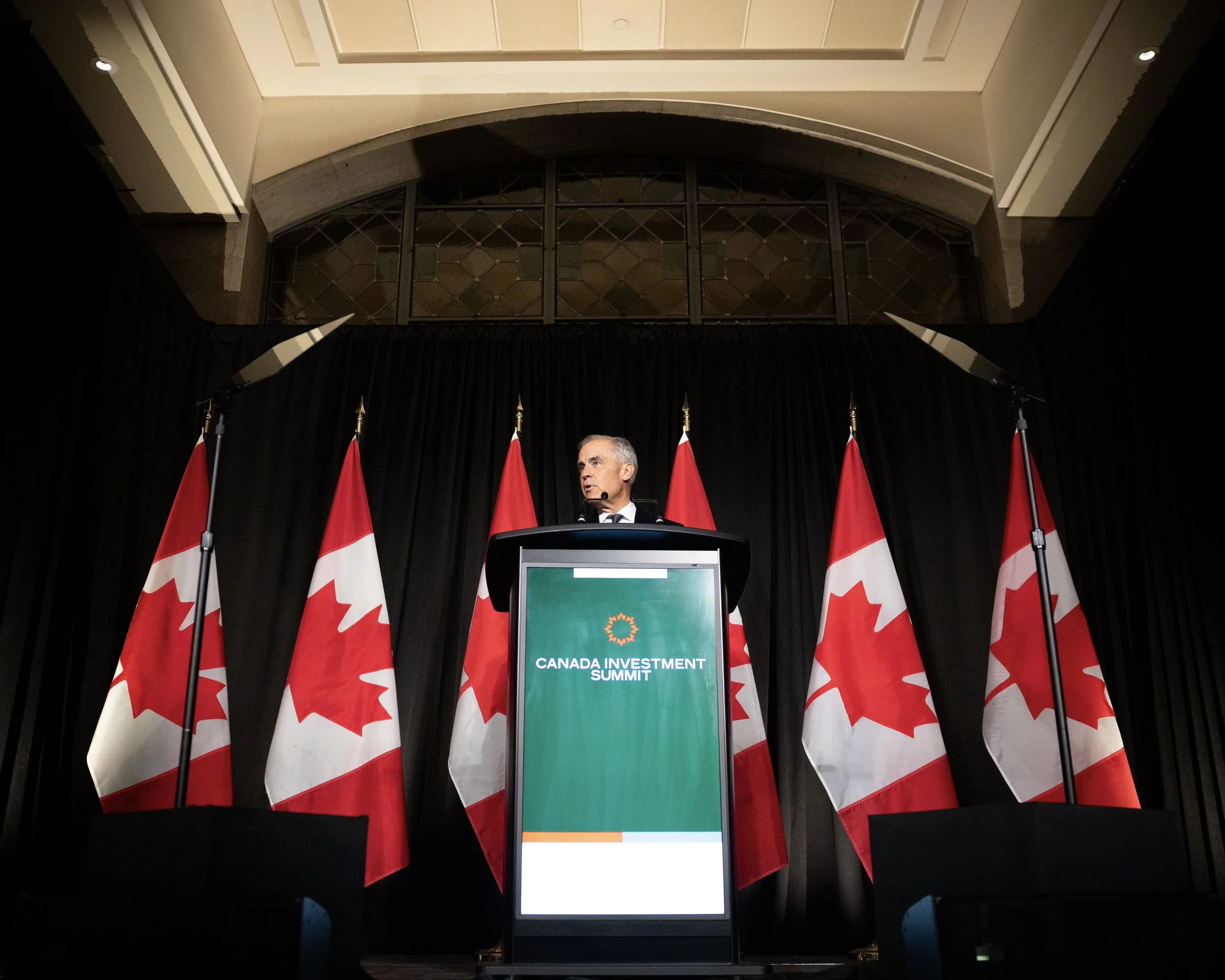
Industry Minister Mélanie Joly says Ottawa is still working to prevent Stellantis from selling its Brampton assembly plant to defence contractor Roshel, despite threatening legal action to recover federal funding. / MEANS & WAYS PHOTO
Until quite recently, Mark Carney was a highly influential international spokesperson for globalization. Today, as Prime Minister, he has remade himself as an avatar of Canadian economic nationalism.
Once, he extolled the economic virtues of the free movement of goods, services, capital, technology, information, and people across national borders. He preached the orthodoxy that the proper role of the state was to liberalize trade and investment rules and to open economies to international competition.
From his office at Wall Street powerhouse Goldman Sachs, Carney made a comfortable living helping multinational companies make the most of globalization. As a central banker, he became the “firefighter” of globalization, first protecting Canada from the worst impacts of the 2008 global financial crisis, then protecting the United Kingdom from the impact of Brexit.
As Prime Minister, by contrast, Carney’s governing agenda comes wrapped in the Maple Leaf and dipped in maple syrup. “Elbows Up,” “Canada Strong,” and “One Canadian Economy” are rhetorical flourishes that have swiftly defined his public persona.
His two budgets have been rife with allusions to building “an economy by Canadians for Canadians.” Indeed, the 2026 Budget was itself entitled “Masters of our Destiny,” a term right out of the revolutionary anti-colonial nationalist movement that swept the globe in the 1950s and 1960s.
Where once Carney quietly made millions assisting corporations to hopscotch their operations across the globe to maximize profit and avoid risk, he now makes headlines denouncing Cleveland-Cliffs over Stelco layoffs and Stellantis over the sale of its Brampton assembly plant.
Politically troubling
The Prime Minister has justified a philosophical volte-face — most famously at Davos — on the pragmatic grounds that the world has changed, so he, and Canada, have to change.
The chaotic ravings of President Donald Trump, he says, are but the most visible evidence of a deeper, tectonic shift by the Great Powers away from free-trading globalization back toward their own narrow national economic interests. Canada doesn't make the rules, so his argument goes, but we have to do what we can to make the most of the new rules in the political and economic interests of Canadians.
Of course that may be true. But we won’t know how deep and enduring the “rupture” is for some time yet. The almighty thumping that Trump took in last week’s U.S. midterm elections suggests that his tariff assault on Canada — and the world — may not have the permanence that Carney foretold. Time will tell.
What may be more politically troubling down the line for the Prime Minister is that his response to the Stelco and Stellantis controversies suggests that, over time, the legal fine print of his bold commitment to economic nationalism may not live up to the patriotic headlines it generates.
Carney and Industry Minister Mélanie Joly have referred to Stelco's September announcement of layoffs in Hamilton and Stellantis’ recent sale of its Brampton production facility as betrayals of Canadian workers; and, in both cases, as violations of contractual commitments the companies made to the Government of Canada in return for various forms of government financial support.
More galling still for the government in the case of Stelco were public comments by Cleveland-Cliffs CEO Lourenco Goncalves in support of President Trump’s 50% steel tariffs which, according to the company, had made the layoffs necessary in the first place. This led Joly to refer the original sale of Stelco to Cleveland-Cliffs to the Competition Bureau to assess whether it violates the Competition Act. Whether Friday’s late breaking news that Stelco is recalling laid-off workers on Dec. 1 will yield a parallel climb down from its legal sabre-rattling remains to be seen.
Subsequent reporting on the Stellantis controversy has alleged that Joly played an “active role in the negotiations” that led to the sale of the Brampton plant, a claim that the Minister’s spokesperson has called “false.” Meanwhile, the Prime Minister has conceded he was aware of elements of the sale but argued “Being informed or being aware of some aspects is not the same as Stellantis providing a global solution for those workers at the plant, which is their obligation.” This alleged dithering inconveniently strikes to the heart of the government’s avowed brand as a stalwart defender of the economic interests of Canadians.
Whatever facts come to light in either controversy, they are now obscured by a fog of legal threats and counter-threats, the latest being Joly’s service notice to Stellantis Thursday that the government has found it in default of its funding agreement and threatening legal action if it does not comply within 30 days.
Be that as it may, threatening to sue does not have the rhetorical heft of “Elbows Up.” In effect, it means “legal briefs out.” For these workers whose jobs are similarly put at risk by such corporate decisions, the legal process would leave them in suspended animation for an indeterminate time until either the courts determine who is right, or the parties decide to settle.
Next stop, nationalization?
All of which suggests that the government may be talking itself into a rhetorical corner when it comes to protecting its “Maple Leaf” brand. Neither losing in court nor a hair-splitting a settlement would be particularly satisfying outcomes for what were alleged to be “betrayals” of Canadian workers.
The last remaining step on the nationalist escalation ladder might be for the Prime Minister to at least consider, or threaten, nationalization. This would seem to be contrary to every intellectual fibre of his economic being. A habit of governments the world over from the 1950s to the early 1980s, nationalization became more or less unthinkable as the global consensus emerged in favour of free markets and global competition. Indeed, much of the 1980s and 1990s saw governments selling off state owned enterprises.
The government’s recent purchase of a billion-dollar stake in the burgeoning Canadian AI company Cohere has already demonstrated that public ownership in a private concern is not anathema to the Prime Minister if he determines that it is in the national interest; in the case of the Cohere purchase, the imperative is for Canada to have a sovereign AI capacity.
And for her part, the Industry Minister recently said “everything is on the table” in respect of the Stelco layoffs.
But nationalization would likely be a bridge too far for Carney. No doubt the thought of delivering exemplary punishment in this way to Cleveland-Cliffs or Stellantis would at least be satisfying in the short term . But he also knows that nationalization would likely provoke those big global investment beasts, whose trillions Carney knows he needs to “Build Canada Strong,” to recoil from the Canadian market in abject horror.
The perils of rhetorical overkill
It has been said that “a foolish consistency is the hobgoblin of little minds.” As a technocrat, this saying surely resonates with a Prime Minister who has executed an astonishing political back flip from lifelong avatar of globalization to “Captain Canada” in just over two years.
The less charitable — Pierre Poilievre, for instance — would argue that the Prime Minister’s flexibility is just another example of the craven reflex of Liberal leaders to sacrifice inconvenient principles in order to juice the polls.
Be that as it may, the Cleveland-Cliffs and Stellantis controversies have reminded us of the inherent and unavoidable tension between foreign investment, Liberal economic policy and Canadian sovereignty.
As a political exercise the Stellantis and Cleveland-Cliffs cases are interesting and instructive. First, despite the current Liberal domination in the polls, the muscular rhetoric from the Prime Minister and his Industry Minister suggests that they are alive to the fact that the NDP still lurks as the primary threat to urban Liberal MPs outside Quebec and the Bloc Québécois in that province. So appearing to cave in to American corporations in advance of the December 7 bye-elections would not do at all.
Second, and more fundamentally, the Prime Minister and his Cabinet surely know that down the line they are playing with political and economic fire and may want to consider the merits of minding the rhetoric gap.