Who holds the keys to Canada’s digital sovereignty?
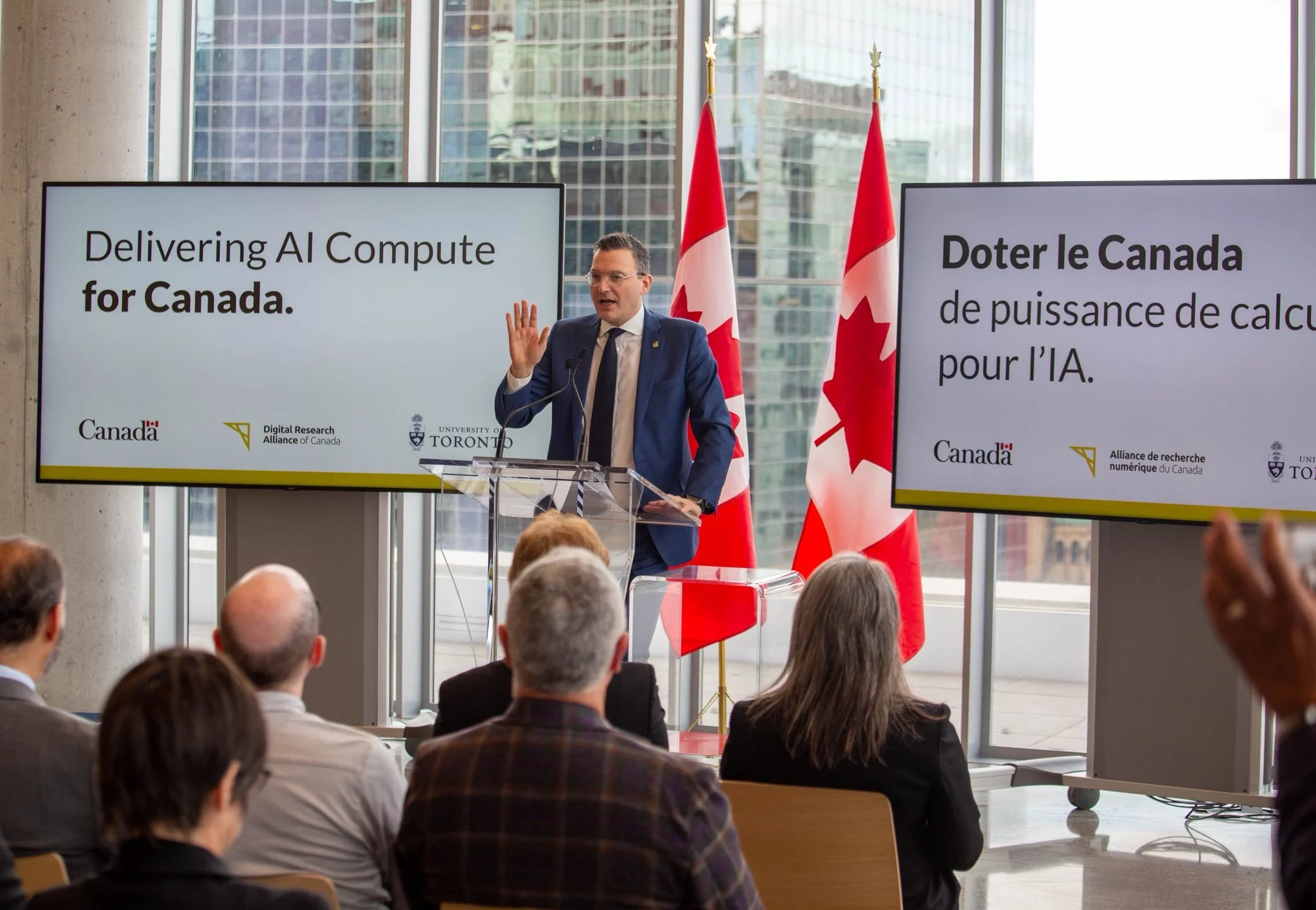
‘Today we’re strengthening Canada’s AI future,’ AI Minister Evan Solomon wrote on social media. ‘More compute → bigger models, faster breakthroughs, faster commercialization. This is how we build digital sovereignty in Canada.’ / TWITTER PHOTO
When it comes to AI and data sovereignty, the government says it’s about “making sure Canada’s most sensitive data is Canadian.” The devil will be in the details, but those details won’t be public until the new year as the long-awaited strategy from the AI Task Force has been delayed.
“Sovereignty is at the core of our strategy, and making sure that we build a sovereign AI ecosystem is critical,” Artificial Intelligence Minister Evan Solomon told the House Science and Research committee Wednesday. “[It] has multiple definitions. There's operational, there's legal, in terms of how we RFP, but I would say this is making sure Canada's most sensitive data is Canadian.”
In his opening remarks, Solomon said that’s why the government is updating privacy and data protection legislation “to keep Canadians' information safe, to protect children online, ensure companies are accountable for how data is handled.”
He added: “All this work is about digital sovereignty. It means having the capacity, talent, the infrastructure, the partnerships to shape our digital future and maintain our leadership in science and research. We are building in Canada. We are buying in Canada and we are believing in Canada.”
That lack of clarity around the data sovereignty term has been a theme during the committee’s study.
Diane Gutiw, Vice-President, Corporate Services and AI Research Center Lead, CGI and co-chair of Canada’s strategic AI council, told MPs on Nov. 24 that despite Canada’s strengths in both fundamental and applied AI research, the country cannot move forward without a precise definition of what must be protected and a definition of sovereignty.
The cost of collaboration
“We need to clearly define what it is we must absolutely protect, such as data, intellectual property and our talent, what we're willing to give up if we collaborate and for what benefit to Canada,” she said.
Gutiw noted that concerns about intellectual property are directly tied to the broader need to clearly define “sovereignty.” She said Canada must collaborate to advance, given its size, but must do so carefully. Protecting intellectual property, she stressed, is essential, including safeguarding early ideas and publicly funded research as they move toward commercial application.
“We need to ensure that if we are working with Google and Microsoft in Canada, they are hiring Canadian staff, they are using the tools to enable and advance Canadian talent within those organizations. It becomes part of defining what we mean by ‘sovereignty’ and who we are best willing to partner with that's going to preserve our culture, our intellectual property, our data and our talent.”
When asked directly what sovereignty should mean for AI, Gutiw said, “What we need is clarity. The lack of definition or clarity on what we mean by ‘sovereign’ is causing confusion.”
Questions around cloud infrastructure dominated part of the meeting, especially the status of foreign-owned hyperscale data centres on Canadian soil.
Conservative MP Kelly DeRidder argued these facilities remain “subject to U.S. or other foreign jurisdiction laws like the U.S. CLOUD Act,” calling it “a real-world risk” to the protection of Canadian health, financial and government data.
Angela Adam, Senior Vice-President, Sales, Marketing and Government Relations, eStruxture Data Centers, agreed the concern is valid: “The answer is yes,” she said when asked if hosting data in large U.S.-based hyperscalers compromises sovereignty under the CLOUD Act.
Who can ‘turn things off?’
Adam said Canada needs “access boundaries. Who holds the encryption keys? Who decides where the data flows? Who can turn things off if needed?” She added that sovereignty requires ensuring “we have the key. When that subpoena comes through, we need to be able to decide whether we release the data or not.”
She suggested a hybrid approach in which domestic platforms operate alongside hyperscalers using “frameworks that embed Canadian governance, cryptographic controls and also create some local value.”
Liberal MP Aslam Rana asked Solomon how the government plans to protect IP and data while still collaborating with industry and research institutions. Solomon said the government is working to “incentivize the private sector” and pointed to existing support, including AI institutes, a digital cluster tasked with commercialization, and a $2 billion investment fund “to stimulate growth and job creation in this sector.”
In September, Solomon told an AI conference in Montreal that the updated federal strategy would be released later this year, “almost two years ahead of schedule,” however, he told the committee the work is still ahead of schedule but now expects it to arrive “in the new year.”
The AI Task Force received more than 11,300 submissions for its consultation.