Canadians have the resources to be an energy superpower. Do they have the patience?
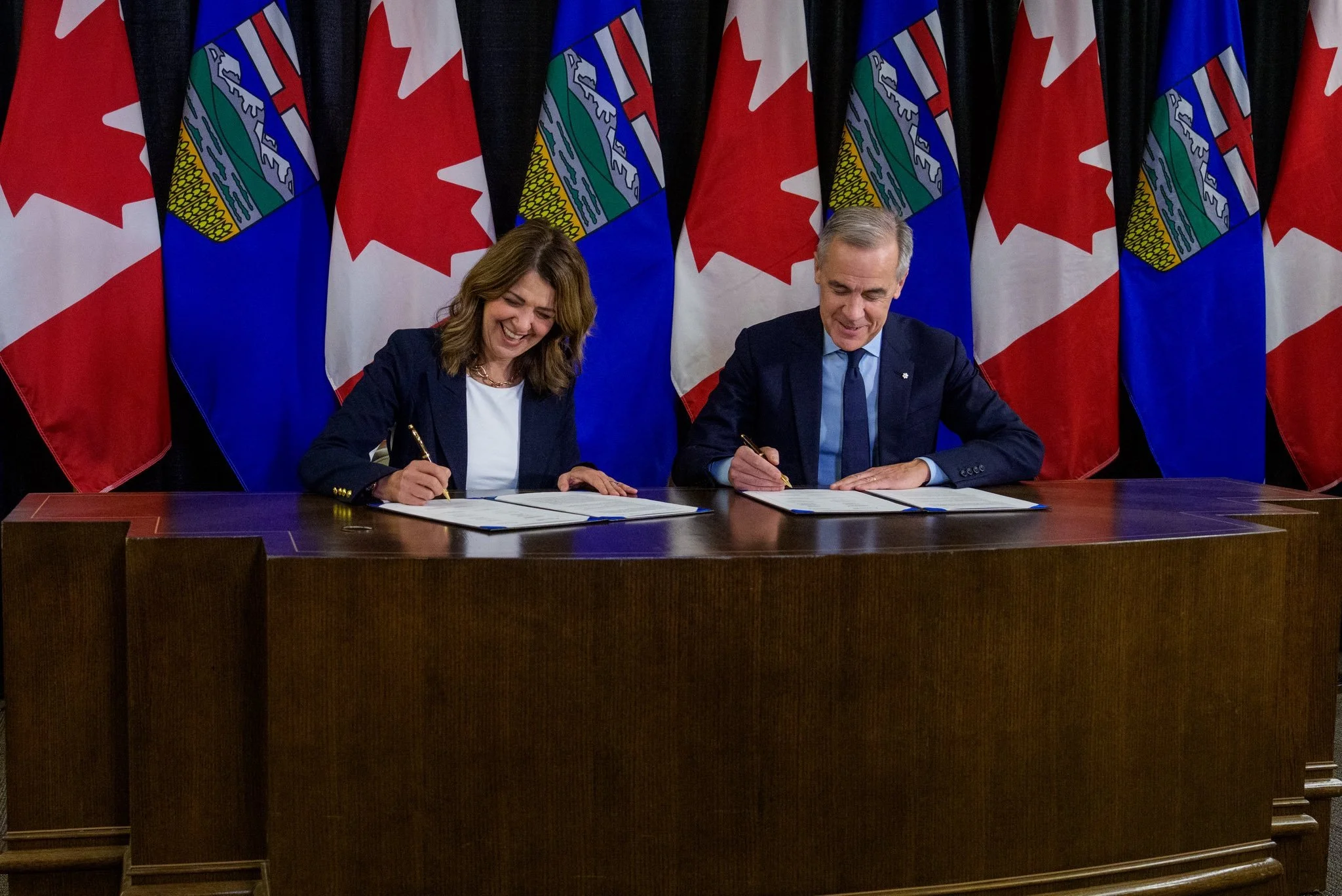
Alberta Premier Danielle Smith and PM Mark Carney signed an MOU recently for a new pipeline. ‘Canada and Alberta share the same ambitions: diversify our export markets, make Canada an energy superpower, and build a stronger, more sustainable, more competitive economy,’ the federal government said in a press release. / TWITTER PHOTO
Canada’s bid to re-establish itself as a global energy superpower is generating what one economist describes as “positive intrigue” among investors, as the government works to overcome more than a decade of underinvestment, policy uncertainty and regulatory delays.

Rebekah Young, Vice President, Head of Inclusion and Resilience Economics at Scotiabank.
The federal government’s recent push — including Budget 2025 measures, a new major projects framework, and a memorandum of understanding (MOU) with Alberta on a new pipeline — is being met with early but cautious optimism from the business community.
“There's an intrigue, a positive intrigue,” Rebekah Young, Vice President, Head of Inclusion and Resilience Economics at Scotiabank told Means & Ways. Investors are “perking up. The message is getting out there that this may be different.”
For Canada, there’s a lot riding on whether it really is different this time. Ian Lee, an associate professor at the Sprott School of Business at Carleton University, says if the country wants economic prosperity, it must lean into natural resources rather than manufacturing.
“The resource sector, which I have studied for 35 years, is extraordinarily capital intensive, using extremely sophisticated exploration, extraction, refining, smelting and transportation technologies in conjunction with sophisticated and highly educated human capital in engineering, geology, IT and corporate finance,” Lee said Nov. 18 in testimony to the Senate energy committee. “Far from being a drain, the oil industry — and the resource sector more generally — is a boon. Without it, we would be poorer and our economy worse.”
Canada is the world’s second-largest hydro electricity producer, the fourth-largest crude oil producer and the fifth largest natural gas producer, according to the International Energy Agency. The energy sector, including crude oil, natural gas, LNG, uranium, electricity, biofuels, coal and coal products and renewables, accounted for 9.8%, or $282 billion, of Canada's nominal GDP in 2024, exporting $208.2 billion to 132 countries, data from the Canadian Centre for Energy Information show.
The advantage of diversity
Such diversity of resources — including conventional energy, the critical minerals necessary for the renewable industry, clean electricity in the central part of the country and wind on the East Coast — is a massive advantage, Young said. “It's got such a wide range of so many of the different inputs and outputs that are needed for energizing the global economy.”
Still, investors need to see a few “quick wins” before they trust that the government is living up to its commitments around timelines, she said, calling the promised two-year window to approve projects “impressive” because that would include impact and environmental assessments that typically take 12 months alone. “Seeing a few projects moving forward on this accelerated timeline would be very helpful.”
But that may not be so easy. “The math might be simple but execution isn’t,” Young said in a recent analysis of the government’s investment and growth agenda. “The government faces tremendous hurdles ahead, from skill-specific labour shortages to a well-documented history of chronic major project delays and cost overruns. The geo-political overlay has also otherwise dampened the investment environment.”
While Prime Minister Mark Carney has acted decisively in his latest policy moves, it will be up to businesses to come to the table and for the government to ensure economic growth also directly betters the lives of Canadians, Young said.
Young said there is no shortcut to higher investment, greater competitiveness and higher welfare. “Over time, disciplined execution should pay off if Canadians have the patience and resolve.”
In its World Energy Outlook 2025 report released last month, the International Energy Agency said countries face unprecedented energy security challenges across a wide range of fuels and technologies and called on governments to diversify energy supplies and cooperate internationally to navigate growing uncertainties.
‘Breakneck’ growth
The report highlights surging electricity demand, driven in part by “breakneck demand growth” in data-intensive services like AI. Global investment in data centres is expected to reach $580 billion in 2025, surpassing spending on global oil supply, the IEA said.
While near-term oil and gas supplies are ample, with new LNG projects set to increase global supply by 50% by 2030, the IEA warned that markets remain vulnerable to geopolitical shocks and rapid demand growth.
The largest obstacle is the lack of a clear project proponent — partly as a result of the “decade of underinvestment policy uncertainty and regulatory gridlock” Young has mentioned.
Amid these longstanding concerns, she said the Major Projects Office, the goal of “one project, one review” between provinces, public investment in projects and tax credits help create a more predictable and efficient investing environment that also reduces costs and risks.
“The list is really long at what tools the government could use, but the more they try to overly design these programs, the more difficult it becomes for investors,” she said, highlighting options such as concessional loans, loan guarantees, equity stakes, or off-take agreements, cautioning against overly rigid financial structures.
Young praised the government’s approach to using existing mechanisms, such as the Canada Infrastructure Bank and other Crown corporations, to leverage investment without direct fiscal spending. “The federal government can scale up or crowd in without the kind of direct fiscal cost being as large,” she said.
“Renewables are booming, and speeding up the clean energy transition serves multiple policy objectives. Whether the national priority is to bring down the cost of living, expand energy access, reduce import dependence or prepare for the reshaping of energy markets, NZE [net zero emissions] shows the way.”
While the government is leveraging financial tools to attract investment, it faces separate challenges around major infrastructure projects, including the future of the Trans Mountain pipeline and Indigenous participation.
The Canadian government plans to boost output of the state-owned Trans Mountain pipeline before selling equity, with a significant stake potentially going to Indigenous groups along the route, Energy Minister Tim Hodgson told Bloomberg.
At a crossroads
Indigenous leaders have raised concerns about limited consultation and environmental risks. Assembly of First Nations National Chief Cindy Woodhouse Nepinak told Canadian Press, “Canada is at a crossroads in its relationship with First Nations. Our rights are being threatened in new ways, but we're not afraid. Far from it. First Nations across the country are stronger than ever.”
Carney’s government has emphasized Indigenous co-ownership in new pipeline projects, including federal loan guarantees to support it, but has not clarified whether the same process will apply to Trans Mountain.
Young also linked the need for timely investment to broader economic outcomes. “There is a public interest in driving sustainable growth in the economy, because what we’ve seen is that Canadian welfare eroded because of this weak, underinvestment in capital stock,” she said.
In response to the IEA report, the International Institute for Sustainable Development said in a press release: “The good news from this year’s WEO is that renewables are booming, and speeding up the clean energy transition serves multiple policy objectives. Whether the national priority is to bring down the cost of living, expand energy access, reduce import dependence or prepare for the reshaping of energy markets, NZE [net zero emissions] shows the way.”
“We need to see signs of progress in an environment that’s really difficult to pin down.”
Joel Finnis, Professor, Memorial University of Newfoundland, told the Senate energy committee, which is studying Newfoundland and Labrador’s offshore petroleum industry, that carbon emissions globally almost plateaued in 2024. “What that’s due to has been really, again, that growth in renewable production. We are starting to see a real shift towards something different,” he said.
In its pre-budget submission to the House of Commons Finance Committee, Energy NL, which represents the supply and service sector of the Newfoundland energy industry, wrote: “For some time, Energy NL has been emphasizing the need to secure Canada’s energy sources and support Canadian produced energy. To this point, Energy NL believes the oil offshore Newfoundland and Labrador that is 30% below the global average for emissions at extraction is a key component of Canada’s energy security and energy future. For this reason, expedited development of oil offshore Newfoundland and Labrador should occur.”
Meanwhile, new polling from the Angus Reid Institute shows the environment and climate change are lower on Canadians’ priority list with 18% saying it’s their top concern. Cost of living remains the highest at 59%. In B.C., where the Alberta-Ottawa MOU triggered political backlash, Prime Minister Mark Carney’s approval remains unchanged at 52%.
Despite the focus on oil and pipelines, one of the most significant aspects of the Ottawa-Alberta energy agreement focuses on electricity rather than fossil fuels, Falice Chin wrote in The Hub. The MOU suspends the federal Clean Electricity Regulations for Alberta, easing pressure on a grid that is more than 70% natural gas, and clears the way for something far more transformative: major new transmission interties linking Alberta, B.C., and Saskatchewan, she wrote. These high-voltage lines would allow provinces to share power in real time, balance their grids and capitalize on complementary strengths such as Alberta’s flexible gas and strong wind resources and B.C.’s hydro reservoirs.
Scott Stoness told The Hub that stronger interties are “good for cost,” “good for reliability,” and “really good for GHG-friendly generation,” while University of Calgary economist Kent Fellows noted that adding redundancy would let provinces “use more of what’s already there.” A second Alberta-B.C. intertie would remove the current “single point of failure,” expand access to low-carbon hydro, and give B.C. greater flexibility to store water when Alberta’s renewables surge.
As Canada positions itself to leverage its energy advantages — traditional and renewable alike — the next phase will depend on whether businesses decide the investment environment this time really is different. Ultimately, she said, businesses need confidence amid global uncertainty: “We need to see signs of progress in an environment that's really difficult to pin down.”