Trade uncertainty remains with no U.S. deal, businesses holding back investment
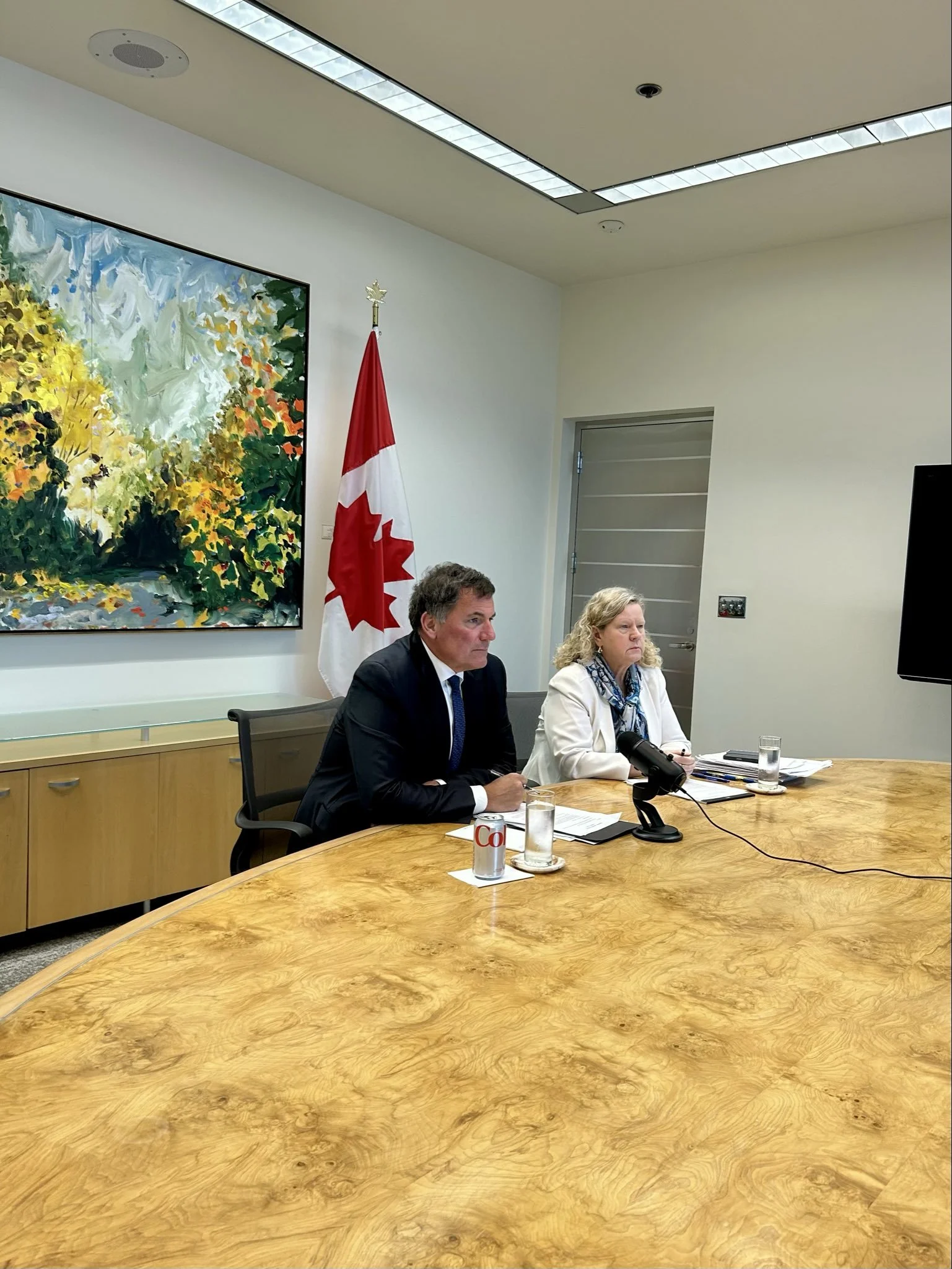
Canada-U.S. Trade Minister Dominic LeBlanc, pictured with Canada’s Chief Trade Negotiator Janice Charette. / TWITTER PHOTO
Uncertainty over Canada-U.S. trade is impacting the Canadian economy, with businesses holding back on investment despite signs of resilience in domestic demand, according to a new analysis from Desjardins.
The assessment comes as negotiations between Canada and the U.S. broke down minutes before the midnight deadline that ushered in 50% tariffs on nearly $28 billion of Canadian goods, including products that comply with the Canada-U.S.-Mexico Agreement. Prime Minister Mark Carney said Canada will match those tariffs dollar-for-dollar in countervailing duties.
“Last-minute changes in the U.S. proposed terms were unfair, uneconomic, and called into question the reliability of any deal,” Carney said in a statement. “Our goal has been to secure the best deal for Canadians, never a deal at any price or on any deadline.”
Carney said that there was progress in recent weeks, but it was not “enough to meet our objectives for Canadians,” which included protecting tariff-free U.S. access, strengthening trade stability, supporting key Canadian industries and small businesses and preserving Canada’s economic independence and sovereignty. Carney said he has suspended the negotiations and recalling negotiators to Ottawa.
“They have worked hard, in good faith, to defend the interests of Canadians throughout these negotiations up until the very last minute,” he said.
U.S. Trade Representative Jamieson Greer called the situation “a missed opportunity.”
Canada-U.S. Trade Minister Dominic LeBlanc left the negotiating table shortly after 7 p.m. Friday and said there was still “more work to do” to reach an agreement with the United States.
“Our job is not finished,” LeBlanc told reporters outside U.S. Trade Representative Jamieson Greer’s office in Washington. “Canadian workers, Canadian businesses expect us to do all of this important work.”
Canada’s chief trade negotiator Janice Charette remained at the table with Greer Friday evening. The two sides were negotiating for much of the day, with Carney’s chief of staff Marc-André Blanchard and Canada’s ambassador to the United States, Mark Wiseman, also involved.
With no deal in sight, questions remain, leaving businesses in an uncertain position.
“What we do know is that sustained trade uncertainty is weighing on the Canadian economy,” Desjardins deputy chief economist Randall Bartlett wrote in the firm's weekly commentary Friday.
The talks have been described by Canadian officials as “complex and consequential,” with the stakes “significant.”
Volatile trade
According to Bartlett, the uncertainty has contributed to shifts in economic growth. “Volatile trade and inventory numbers have largely been driving the recent swings in headline real GDP growth,” he wrote. At the same time, he said, “final domestic demand growth has been surprisingly resilient.”
Desjardins said federal income transfers have boosted household consumption, while higher spending on health care and defence has supported the government's contribution to economic growth. But business investment has been much weaker.
“Business investment is the component of final domestic demand that is least adulterated by expanding government spending,” Bartlett wrote. Despite government support for industries affected by tariffs, including steel, aluminum, autos and lumber, business investment “has remained on the sidelines for much of the last year and a half.”
Former Finance Minister Chrystia Freeland told Bloomberg Television on Friday that Carney was prepared to sign a deal in order to restore economic certainty.
Permanent tariffs ‘really harmful’
She said however that having tariffs on steel, aluminum, cars and car parts is “really harmful” and if Canada accepts the tariffs it’s a "really big deal."
“I think that is a bad outcome for Canada ... But I think it's a bad outcome for the United States as well,” she said. "It's really important for people to recognize that you can lose by winning if you've defined winning in a way, which is self-mutilating.”
Sources with knowledge of the talks told CBC News the draft proposal under discussion would lower U.S. tariffs on Canadian steel and aluminum from 50 to 25%, with a quota system limiting the volume of steel eligible for the lower rate. The prospective agreement also includes changes to how the federal government allocates dairy import licences, which could increase access for U.S. dairy products in Canadian stores.
Politico reported that the draft text also contains provisions on autos and digital trade, including a possible reduction of the U.S. tariff on Canadian vehicles to 15%.
Meanwhile, Carney has asked provinces to return American alcohol to store shelves as part of the negotiations, which premiers have said they will comply with.
Desjardins said its weaker outlook for business investment assumes “little in the way of tangible and tractable progress on trade talks between Canada and the U.S.”
A deal that “meaningfully improves the North American trade environment,” it said, would be the best outcome for both countries.