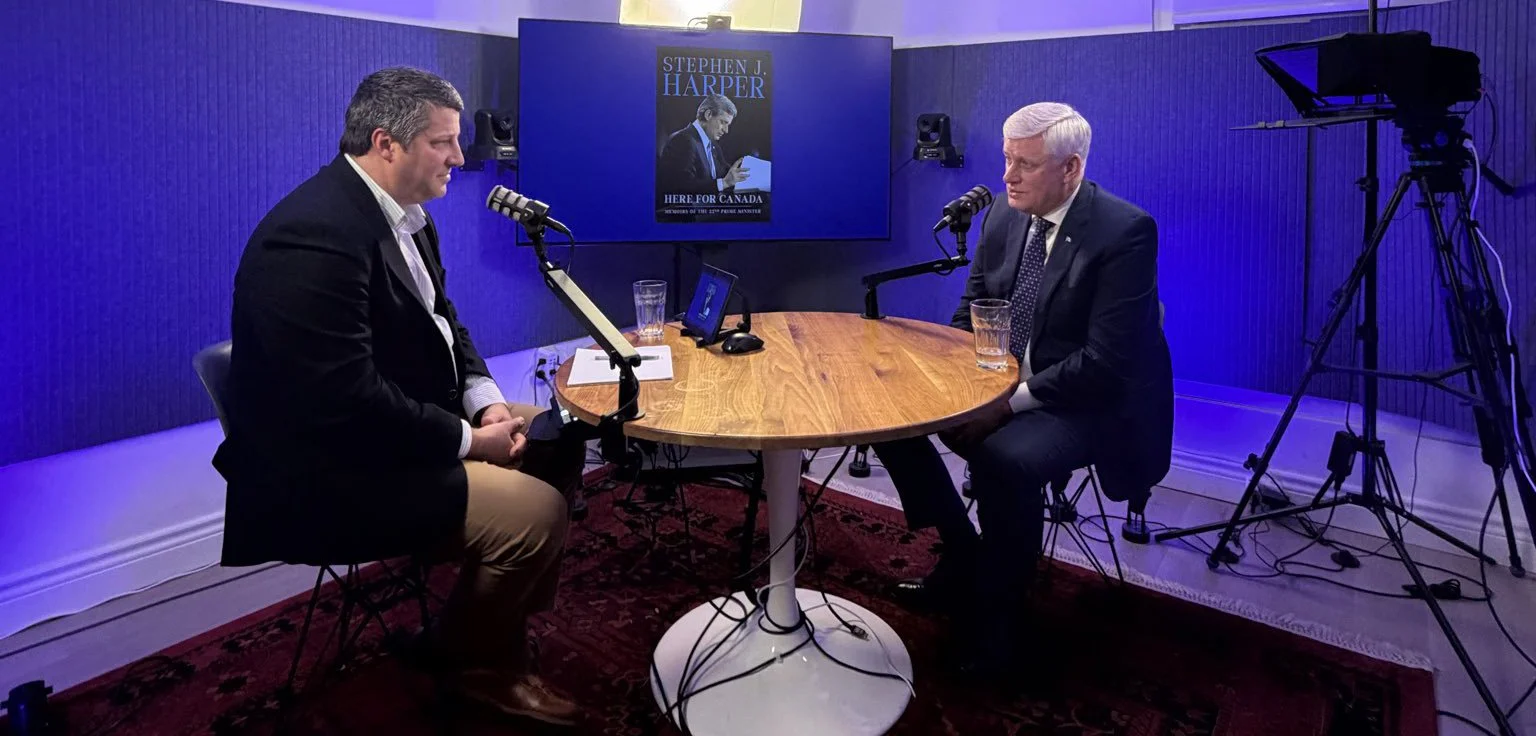
‘The truth of the matter is, in politics, if you lose the anchor of a balanced budget, deficits just tend to get bigger and bigger and bigger,’ says former prime minister Stephen Harper, pictured with The Hub’s Sean Speer. / TWITTER PHOTO
Governments have lost the fiscal discipline that once commanded widespread political support and years of sustained deficit spending could trigger major financial crises around the world, says former prime minister Stephen Harper.
“There's going to be a rude awakening,” Harper said in conversation with Sean Speer, editor at large of The Hub. “We are going to see major financial crises in major countries in the years to come. And it's going to make people realize that sustained deficits are very dangerous.”
Harper, whose memoir Here for Canada revisits his time in office, said that while there is an economic argument for governments running relatively small deficits on an ongoing basis, the political realities of government make it difficult to prevent borrowing from escalating.
“The truth of the matter is, in politics, if you lose the anchor of a balanced budget, deficits just tend to get bigger and bigger and bigger,” he said, noting that maintaining balanced budgets while lowering taxes was fundamental to his government's economic agenda. He added that he disagreed with some fellow conservatives over the merits of cutting taxes without controlling spending.
“I was never a believer in lowering taxes if it meant running a sustained deficit,” he said.
Harper argued that structural deficits make future tax increases inevitable, undermining efforts to establish a sustainably lower-tax environment.
He also criticized the fiscal direction former prime minister Justin Trudeau took following the 2015 federal election, arguing that the departure from balanced budgets was intended to finance permanent spending increases rather than respond to temporary economic conditions.
“If I'd run in 2015 promising kind of a sustained deficit, I mean, people would have been shocked,” he said. “And now, nowhere in the world has anybody not only got close to a balanced budget, nobody even seems to think it's important.”
Harper said his government benefited from entering office during relatively favourable economic conditions, when Canadians were not demanding significant changes to how the country was governed.
“I actually think as a conservative that is inherently the best way to do things,” Harper said of incrementalism. “By the way, I wouldn't advocate that today.”
He pointed to the state of the Canadian economy and the country's relationship with the United States as areas where a future Conservative government would need to demonstrate greater boldness.
Reflecting on his economic legacy, Harper said Canadians continue to benefit from the trade deals his government opened up and the fiscal position his government left behind in 2015.
“The trade network we created — I think that's a legacy which the country is now getting serious about building on,” he said, adding leaving the economy with low debt is another legacy he is proud of. “Because of the extraordinarily low debt levels we created at the federal level, we are still one of the least indebted developed countries after all of this. It's not all about flashing charisma, as I say, it's about governing well and I thought administratively and in terms of basic policy, we ran a solid government. I think that's increasingly being recognized.”
He added: “Now, that could have been used to do a lot of things to take us to the next level. And it wasn't and that's a tragedy. But nevertheless, the benefits of that have actually endured.”