Mega deduction tax incentive could boost business investment, but impact still uncertain: Scotiabank
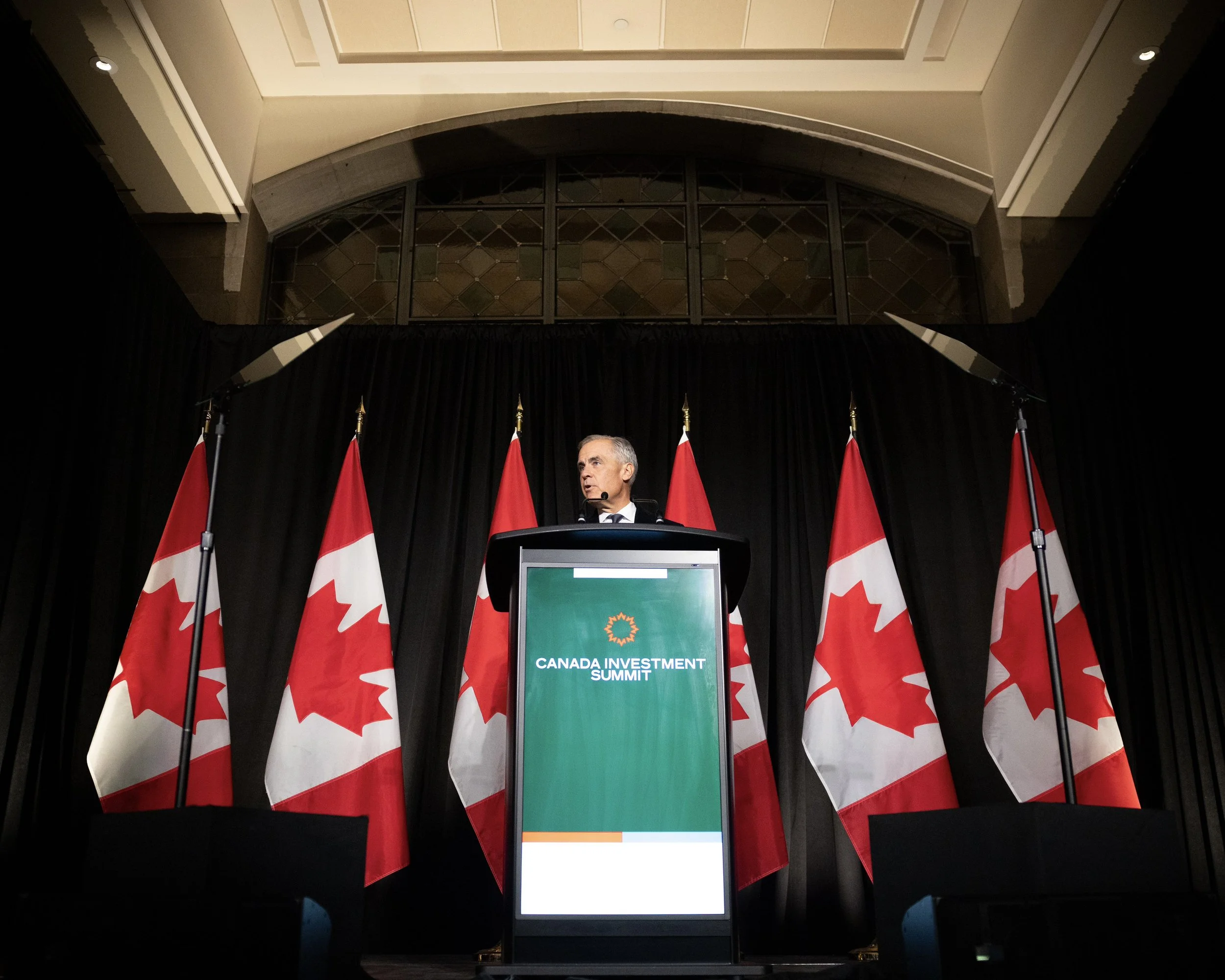
‘This is Canada today: a country that is building, trading and investing with an ambition and speed not seen in generations,’ Prime Minister Mark Carney said at the Canada Investment Summit. / TWITTER PHOTO
A new federal tax measure meant to spur business investment could give Canada’s economy a meaningful boost though the size and timing of the impact remain uncertain, says Rebekah Young, Scotiabank Vice-President, Economic Policy.
“Tax policy matters, but the cost of capital is only one input in capital spending decisions,” she wrote in an analysis. “Demand, financing conditions, regulatory timelines, labour availability and business confidence will determine how much incremental investment is unlocked and over what timeframe.”
The federal government unveiled a sweeping new tax incentive and touted almost $500 billion in new investment commitments this week at Canada's first-ever Investment Summit in Toronto, with Ottawa matchmaking projects and investors.
“This is Canada today: a country that is building, trading and investing with an ambition and speed not seen in generations,” Prime Minister Mark Carney told investors Tuesday.
The centrepiece announcement was a new Productivity Mega Deduction, which Carney called a “game-changing” tax incentive raising the share of capital assets eligible for immediate expensing from roughly 15% to more than 65%, covering everything from fibre-optic cable and mining property to software, aircraft, patents and bridges.
“Canada's policy will now cover more than four times the capital assets previously eligible for immediate expensing,” Carney said. “Today's announcement will make Canada by far the most tax-competitive advanced economy for new investment, with the lowest marginal effective tax rate in the G7, less than half the U.S. rate, roughly one-third of the OECD average and one-quarter of the G7 average.”
The federal government estimates the measure will generate an average of $8.5 billion in additional investment annually, with broader economic impacts of up to $22 billion — a roughly 6% increase in newly eligible investment, Young said.
Past U.S. experience offers some guidance, though Young cautions the comparison is limited. 2017 U.S. tax reform produced a 3.5% increase in business investment, according to IMF analysis, while a University of Toronto study on depreciation allowances estimated 4.5%. Demand is building in sectors such as energy security, critical minerals and defence. The Scotia Growth Institute pegs Canada’s project inventory at more than $1 trillion.
Young describes the government’s upper-end estimates as “optimistic but plausible.”
Claudio Rojas, CEO of the National Angel Capital Organization (NACO), said more attention to early-stage capital is needed, warning Canada risks losing the benefits of its own investment boom to the U.S.
Riding the investment supercycle
“Canada is on the cusp of an investment supercycle. With capital flowing at a scale we haven't seen in a generation, it's imperative that we capture the value it creates and not, as has historically been the case, allow it to leak en masse to foreign economies,” Rojas told Means & Ways in a statement.
He pointed to figures showing 517 U.S. tech companies founded by Canadians have raised more than $414 billion, and two-thirds of Canadian founders who raised over $1 million are now based in the U.S. — citing co-founders of Slack, Uber and OpenAI as examples.
Finance Minister Philippe-François Champagne’s press secretary, John Fragos, told Means & Ways that Canada’s marginal effective tax rate on new investment has been reduced to about 6.34% from 13%, compared with roughly 17% in the U.S., making Canada about three times more tax-competitive for new investment.
Industry associations broadly welcomed the Productivity Mega Deduction, saying permanent immediate expensing and broader eligibility would reduce investment costs, improve certainty and strengthen Canada’s competitiveness for business capital.
The Ontario Chamber of Commerce called it “a big step to make Canada a highly attractive place to invest, build and grow,” while the Canadian Association of Petroleum Producers said it “closes a significant competitive gap” with the United States. The Mining Association of Canada described the measure as “transformative,” while Canadian Manufacturers & Exporters agreed it “better reflects the long planning horizons manufacturers face when making major capital investments.”
Canada is a “supplier of choice” and a source of “trust” for investors navigating an uncertain geopolitical landscape, Champagne said in his remarks at Global Dialogues Toronto. “Let's show the world that we can be the partner of choice,” he said.
Carney also announced Ottawa is opening four of Canada's largest airports to private investment through long-term concessions. “We will reinvest the tens of billions of dollars of capital we raise into the infrastructure that Canada needs for the next generation,” he said.
The government touted close to $500 billion in new investment commitments secured around the summit, including a $50-billion Maple Fund launched by CPP Investments and Brookfield Asset Management to invest in critical infrastructure and strategic industries across the country.
Speaking to reporters at the summit, Champagne said energy and critical minerals were key pillars of Canada's investment pitch, citing its nuclear certification, energy leadership, carbon capture capacity and its standing as the only G7 country with free trade access across North America, Europe and Asia-Pacific simultaneously.
More than 1,000 people gathered in downtown Toronto to protest the summit, with two people arrested after police said protesters blocked a road and interfered with an arrest. Protesters from labour, Indigenous, climate and housing groups argued that attracting foreign investment could put public services, natural resources and environmental protections at risk.
When asked about foreign ownership concerns, Champagne said the Investment Canada Act gives Ottawa the tools to protect economic security while still attracting capital at scale.
During a speech closing the summit Tuesday, former prime minister Stephen Harper said while there will be costs, Canada must reduce its reliance on the U.S.
“It is clear that the current U.S. administration views our level of economic integration as incompatible with our separate sovereignty,” he said. “Thus, to maintain that sovereignty we must pursue diminished reliance upon the United States… There will be significant costs to this effort, but those are costs that I hope and believe Canadians are able and prepared to accept.”