
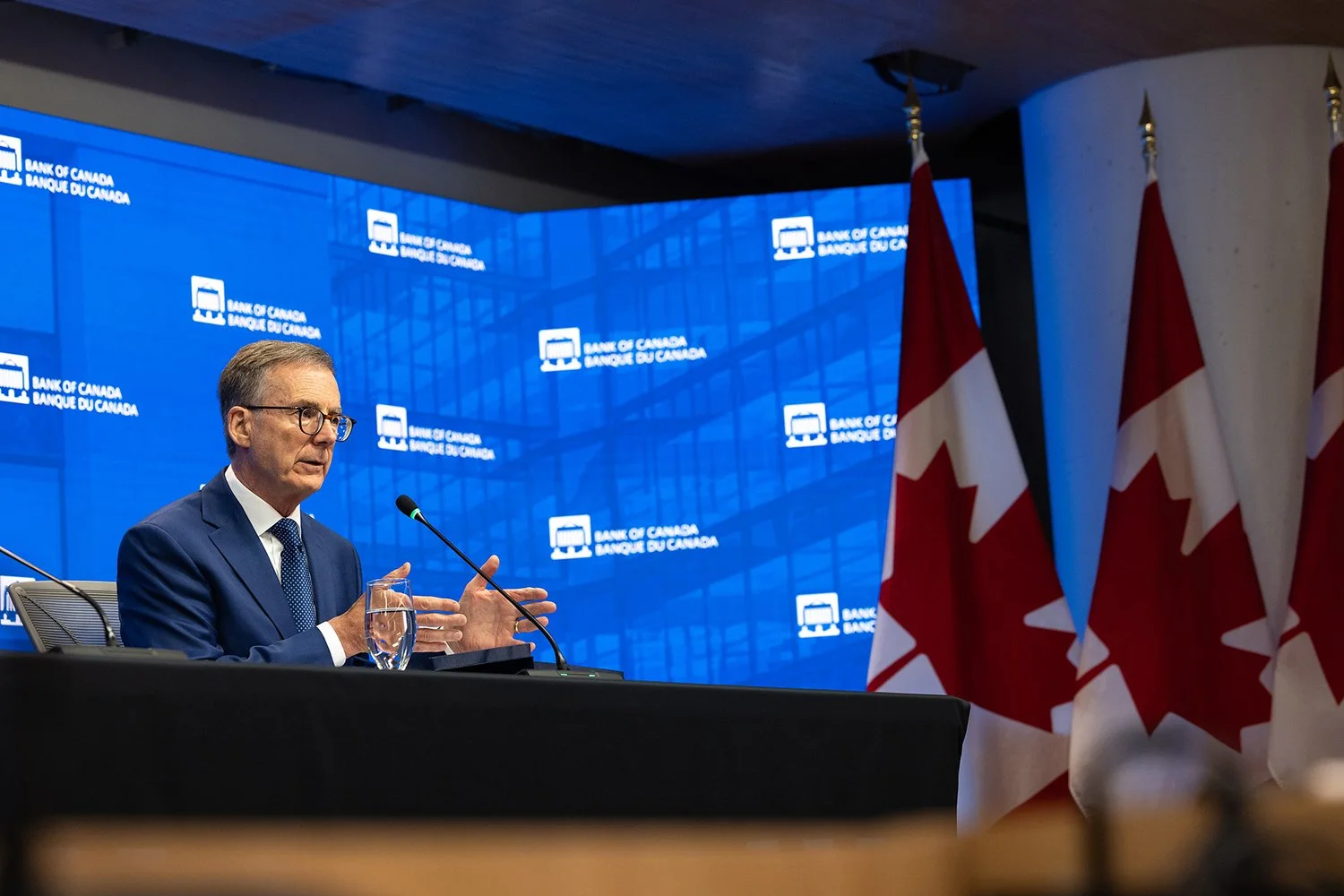
‘Looking ahead, we can expect developments in the Middle East and our trade relationship with the United States to continue to evolve. The build-out and adoption of artificial intelligence could be bumpy, and there may well be new unforeseen shocks. Our assessment of inflationary pressures will change with them,’ says Bank of Canada Governor Tiff Macklem. / BANK OF CANADA PHOTO
Canadian consumers could face a new wave of price increases in the year ahead as businesses begin passing on months of accumulated production and transportation costs, Bank of Canada Governor Tiff Macklem warned, even as oil prices have been falling.
“So far, businesses have largely absorbed the higher production and transport costs. But historical lags and our own business surveys suggest more pass-through to consumer prices in the year ahead,” Macklem said during a keynote speech at the Economic Club of Canada on Nov. 24. “This second-round effect of the oil shock will add to inflation persistence.”
The prospect of more widespread price increases presents a challenge for the central bank as it seeks to bring inflation back to its 2% target without unnecessarily weakening the economy or placing additional financial pressure on households.
Macklem’s remarks come ahead of the Bank’s Dec. 9 interest rate decision and follow the renewal of Canada’s monetary policy framework for another five years.
“Monetary policy can’t lower global energy prices. But it can limit how much they spill over. Our goal is to avoid a situation where Canadians face rising prices for a wide range of goods and services,” Macklem said.
Lower oil prices could ease pressure on interest rates
During a subsequent press conference, Macklem indicated that falling energy prices could reduce the need for further interest rate increases, with oil prices declining to approximately $90 from more than $100 at the time of the Bank’s October rate decision.
The central bank had previously forecast inflation would reach approximately 3.5% by year-end. However, with inflation holding at 3.1% in the latest consumer price index report and refinery margins declining, Macklem said inflation could remain closer to its current level.
He stopped short of signalling whether the Bank would raise or hold its benchmark interest rate in December, emphasizing the importance of forthcoming third-quarter economic growth figures and employment data, particularly what they reveal about economic momentum heading into the fourth quarter.
Monthly GDP figures have suggested some downside risks to third-quarter growth, although export data have been stronger.
The Bank raised its benchmark interest rate by 25 basis points to 2.5% in October, citing persistent inflationary pressures and greater-than-expected economic resilience.
It would take a significant economic or financial shock to derail a Bank of Canada interest rate hike on Dec. 9, said Derek Holt, Vice President and Head of Capital Markets Economics. Holt argued that the recent stock market selloff has not been severe enough to warrant a change in course.
Despite falling oil prices, Holt said commodity prices remain high enough to encourage business investment and prompt companies to pass higher costs on to consumers. He also warned that a potential escalation of the Iran war could drive oil prices higher again.
While upcoming GDP figures could show weaker-than-expected economic growth, Holt does not expect employment data to significantly influence the Bank’s decision, noting that tighter immigration policies have reduced the number of new jobs needed to keep the labour market stable.
Instead, Holt expects the Bank to focus on inflation risks heading into 2027, when elevated commodity prices, government spending, AI investments and federal tax incentives could boost economic activity.
With Canada’s economy estimated to be capable of growing by just 1.5% annually this year and next without fuelling inflation, Holt argues that even modest growth could lead to demand outpacing the economy’s ability to supply goods and services, driving prices higher.
“It’s the outlook that matters as monetary policy can’t do anything about wherever inflation lands this quarter,” Holt said.
Holt said in a subsequent note: “There is a very high bar for any of that data to matter. And in any event, the BoC is very clear about being forward-looking, concerned about an inflation overshoot throughout 2027 and beyond. Backward data isn’t carrying the day in their thinking. Nor is strict adherence to its forecasts that will take time to assess. The BoC is in risk management mode, concerned about inflation risk and seeking to avoid falling behind like they did the last time. In my view, they are already behind.”
All of the other major banks now expect the Bank of Canada to raise its key interest rate
Bank prepares for more frequent economic shocks
Macklem outlined the need to adapt monetary policy to a global economy increasingly vulnerable to supply disruptions stemming from geopolitical conflicts, tariffs, extreme weather and technological change.
Unlike demand shocks, supply disruptions can simultaneously increase prices and weaken economic growth, leaving central banks facing difficult policy choices.
“Households face higher prices while job prospects worsen. Businesses face higher input costs while demand softens,” Macklem said.
“Unlike with demand shocks, monetary policy cannot stabilize output and inflation at the same time.”
Macklem rejected the suggestion that the Bank’s renewed monetary policy framework necessarily signals a more hawkish approach to future supply shocks.
Instead, the Bank will assess the magnitude and persistence of disruptions, how widely costs spread throughout the economy, the strength of demand and whether inflation expectations remain anchored.
Temporary disruptions may not warrant an interest rate response, but larger or successive shocks could require intervention to prevent inflation from becoming entrenched.
Macklem acknowledged that the Bank could have responded more effectively to the post-pandemic inflation surge, which saw Canadian inflation reach 8.1% in 2022.
“We were too slow to recognize the persistence of inflationary pressures and how broadly they were spreading through the economy,” he said.
The Bank must balance the risk of unnecessarily weakening the economy by responding too aggressively to temporary inflation against the consequences of allowing persistent price pressures to gain momentum.
“If inflation gains momentum, the central bank usually has to raise rates further and for longer to get it back down.”
Housing unlikely to lead economic recovery
While the Bank anticipates a broader economic recovery, Macklem said housing activity is expected to improve only modestly.
“We don't see the housing market leading that recovery,” he said during the press conference.
The governor emphasized the limitations of monetary policy in addressing Canada’s housing affordability challenges, pointing to structural supply constraints rather than borrowing costs alone.
While lower interest rates can reduce mortgage carrying costs, they can also contribute to rising home prices when supply is insufficient. Conversely, higher rates can constrain prices while making mortgages more expensive.
The Bank has been consulting developers about the impact of interest rates on financing costs and their ability to deliver new housing. However, its research indicates that monetary policy has a considerably greater and faster impact on housing demand than on supply.
On rising mortgage delinquencies, Macklem acknowledged that some borrowers are experiencing considerable financial strain but said overall delinquency levels remain relatively low and do not represent a significant headwind for the economy.
He credited previous interest rate reductions and efforts by financial institutions to work with borrowers with helping Canada navigate the wave of mortgage renewals following the pandemic.
In a recent report, TD Bank economist Rishi Sondhi noted that housing affordability has worsened across Canada amid rising borrowing costs, with Ontario and B.C. remaining the most expensive markets and Quebec and much of Atlantic Canada particularly unaffordable by historical standards. With interest rates expected to remain elevated and home prices unlikely to fall much further, lasting affordability improvements will likely require stronger income growth and a sustained increase in housing supply over several years.
“There is no quick or painless route back to lasting relief in affordability, particularly with prices unlikely to deteriorate much further and interest rates set to remain elevated. The recent federal budget contained laudable initiatives to address homelessness, but much of the effort is concentrated on non-market housing. The federal government also recently exempted newly built homes from the foreign-buyer ban, but this should be demand-stimulative, on the margin,” Sondhi wrote. “A lasting improvement will likely require several factors working together, including stronger income growth and a sustained increase in housing supply. That points to a gradual, multi-year adjustment rather than a rapid return to historical norms.”
New tools aim to improve inflation forecasting
The Bank is introducing a new inflation dashboard and placing greater emphasis on two core inflation measures, CPI-trim and CPIX, to better assess underlying price pressures.
Macklem acknowledged that previous communications around core inflation had confused Canadians, particularly when measures excluded essential household expenses such as food and gasoline.
“So we’re going to sharpen the distinction: our 2% target applies to total CPI inflation. Core measures are an input into our outlook for total CPI, not a target,” he said.
The Bank’s new forecasting model, Prima, will help policymakers track how rising costs filter through supply chains to consumers, complemented by expanded business and household outreach, surveys and more frequent communications to improve transparency and decision-making.
AI, trade and currency risks remain
Looking ahead, Macklem identified artificial intelligence, ongoing trade tensions with the United States and geopolitical conflicts as potential sources of continued economic disruption.
Growing demand for computer equipment and chips associated with AI development is already contributing to higher import prices, although Macklem said the direct impact on consumer inflation remains relatively small.
Recent stock market volatility linked to AI investments could also affect household spending, particularly among higher-income Canadians with greater exposure to equities. However, Macklem expects the economic impact to be less in Canada than in the United States.
Despite these uncertainties, Macklem reiterated that the Bank’s commitment to price stability would remain unchanged, providing households, businesses and retirement planners with a long-term benchmark.
“Looking ahead, we can expect developments in the Middle East and our trade relationship with the United States to continue to evolve. The build-out and adoption of artificial intelligence could be bumpy, and there may well be new unforeseen shocks. Our assessment of inflationary pressures will change with them,” Macklem said. “But our anchor will not. Canadians can continue to count on the Bank to keep inflation anchored at 2%.”


