A tale of two leaders
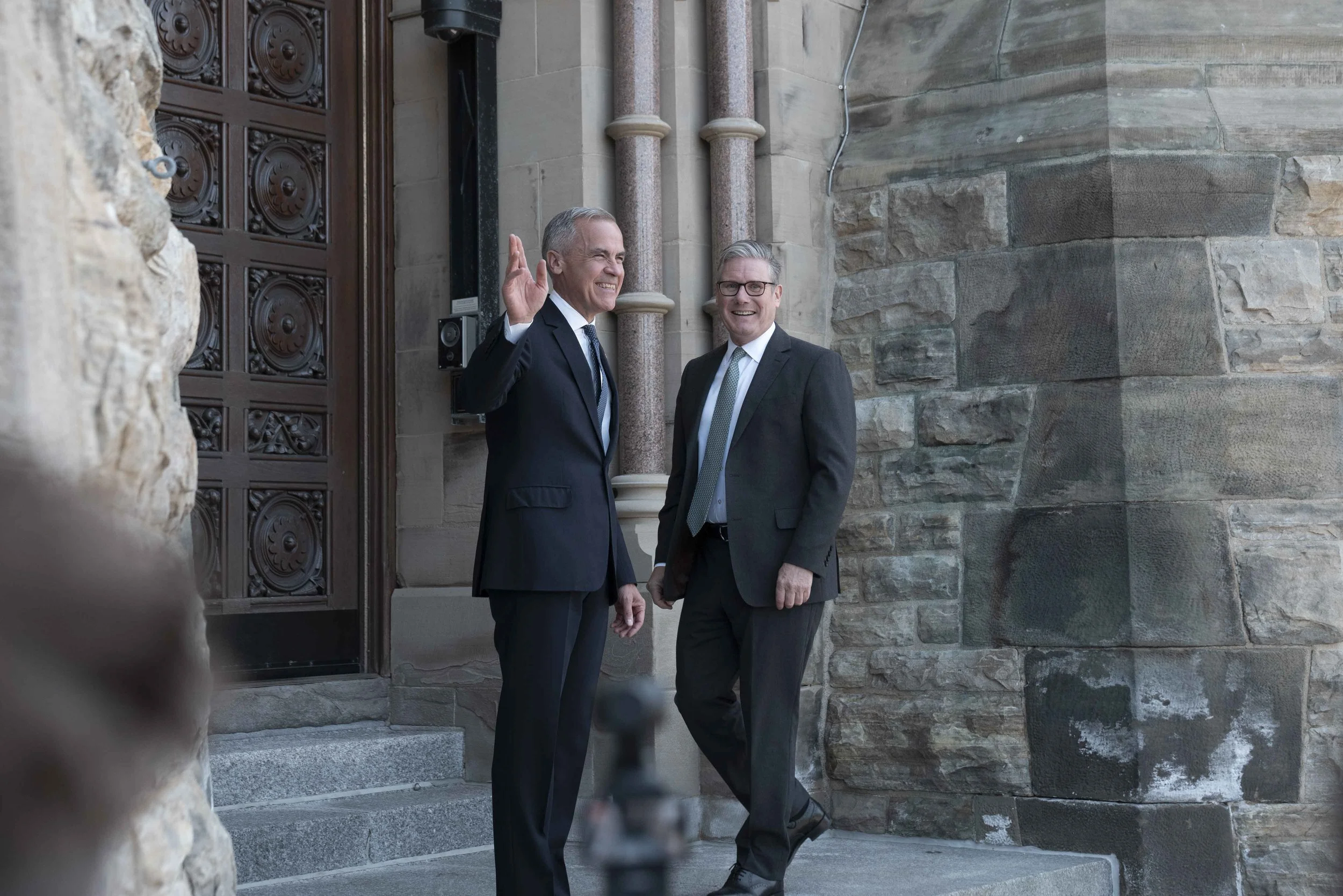
Prime Minister Mark Carney and Prime Minister Sir Keir Starmer, pictured in front of West Block on Parliament Hill, June 2025. / PMO PHOTO
So Prime Minister Carney has a majority. Now what?
Well, the Prime Minister has certainly leaned into the freedom that a majority — however narrow — should give him, pledging that he now has a mandate for decisive, streamlined policymaking; “more substance” and less “showboating.”
A liberated PM
For someone characterized as an economic technocrat, Carney doesn’t lack nerve or boldness. Nor does he seem afraid to raise public expectations too high. Perhaps he feels that his new majority has liberated him to govern in the style he prefers, as a confident corporate CEO, forceful in strategic direction, nimble in exploiting opportunities, dismissive of dilatory compromises, and insistent on results.
His dominance in the polls suggests Canadians have embraced his confidence and certainty, as well as his outwardly calm, low-key manner. They clearly like what they have seen so far. And they will expect more now that the Prime Minister no longer has to skirmish or negotiate with the opposition.
Canadians have a deep investment in the Prime Minister’s success. The stakes could not be higher for the country. Carney has taken on nothing less than the re-wiring of the Canadian economy in a highly unstable continental and global setting.
He passed the One Canadian Economy Act, removing federal barriers to interprovincial trade and setting a framework for speedier approval of major infrastructure and “nation-building” projects. This Budget Implementation Act, among other things, enabled cuts to the public service and increased defence spending, a massive increase that has, in turn, created the fiscal space to fund the new Defence Industrial Strategy, another pillar in his plan to strengthen Canada's manufacturing and technological base.
Carney has undertaken a global tour to stump for investment in Canada. And he just announced a Canada Investment Summit for September, intended to shift global investment in Canada into a higher gear.
We are still awaiting the overdue AI strategy. And the stalled Build Canada Homes Act should speed through Parliament now, establishing the Build Canada Homes Agency to oversee the development of a Canadian modular housing sector at scale. And of course, there is the small matter of maneuvering an erratic American President into a new trade and security arrangement.
But these have been scene-setting measures.
Following through will be what counts: the number of projects approved, affordable houses built, investments made, and jobs created. This will ultimately determine the Prime Minister's political fate. In this regard, his new majority affords Carney the time to show results without the fear of facing an early election.
And then there is Keir Starmer
But he has to deliver the goods. If Carney does not succeed, his election may be remembered as the last kick at the can in Canada for establishment, technocratic government. A look at the state of UK politics at the moment provides a striking example of what can happen when a government doesn’t deliver the goods.
Remember, up until the Trump eruption, Opposition Leader Poilievre seemed like a cinch to take power on the same wave of anti-establishment, populist, anger at out-of-touch, ineffective governments that swept Trump to office in the U.S., and also saw the British vote reject the European Union with Brexit.
Starmer’s Labour government swept to power — with the second largest parliamentary majority in UK history — after years of tumult, instability, and economic stagnation following the 2016 Brexit vote and the COVID pandemic. This tumult is best captured by the fact that there were five Conservative Prime Ministers over the eight years between the 2016 Brexit vote and their defeat at the 2024 general election.
Starmer won a classic change election, capitalizing on voter sentiment to “toss the buggers out,” with core pledges that contrasted sharply with the shambolic economic incompetence of the Conservatives: stable government, economic recovery, stronger public services, and non-ideological pragmatism. But judging recent polls, he seems to have spent every day since his sweeping victory losing the confidence of voters.
He has not delivered a stronger economy, with growth weak, unemployment up, and inflation persistently high. With the public finances tight, Starmer has refrained from deficit financing to rebuild public services or to spark economic growth. He has seemed a weak flip-flopper, announcing bold, even controversial policies and then backing off under the least political pressure.
As result, Starmer has dropped into second choice among voters, in the mid-teens in the latest polls. Interestingly, Conservative fortunes have not improved, as would have been expected were this an ordinary political time in the UK. In fact, the Conservatives have fallen from their 2024 election poll result — which was the worst in the history of the Party — into the mid-teens.
Instead, the new Reform Party under populist pro-Brexit firebrand Nigel Farage has vaulted into first place. His core message is that the establishment Conservative and Labour parties are out of touch with voters, promising forceful action policies to cut taxes and immigration, slash government, and fulfill what he argues is the economic promise of Brexit that first the Conservatives and now Labour have let slip away.
But Farage’s polling rise, though sudden, has plateaued for now in the mid-20s, well below the level of voter support historically necessary to win government in the UK.
Indeed, the most striking quality of the current UK polls is that they show an unprecedented level of political fragmentation, with the Green Party and the Liberal Democratic Party grouped with Labour and the Conservatives in the mid-teens.
This fragmentation is a sign that British voters despair of any one party having solutions to the country’s challenges. Should it persist into the next election, almost any combination of results could be possible.
The anger is still out there
The anger that fueled Poilievre's rise seems to have been calmed by Carney’s election. But anger among a wide swath of Canadians over the failure of governments to address affordability remains. It will not take too much to reignite it.
A failure by Carney, like Starmer, to deliver on his big promises and high hopes could be all it takes to see our politics go the way of the U..K.
And then who knows what the future would hold.