Pipeline federalism may undercut Alberta separatists
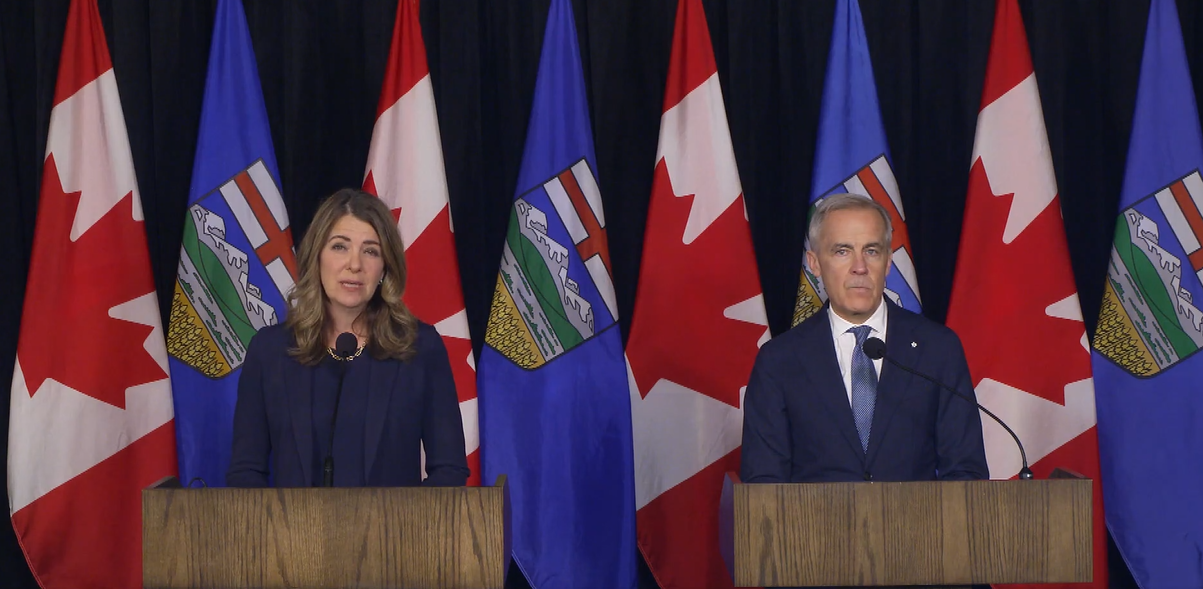
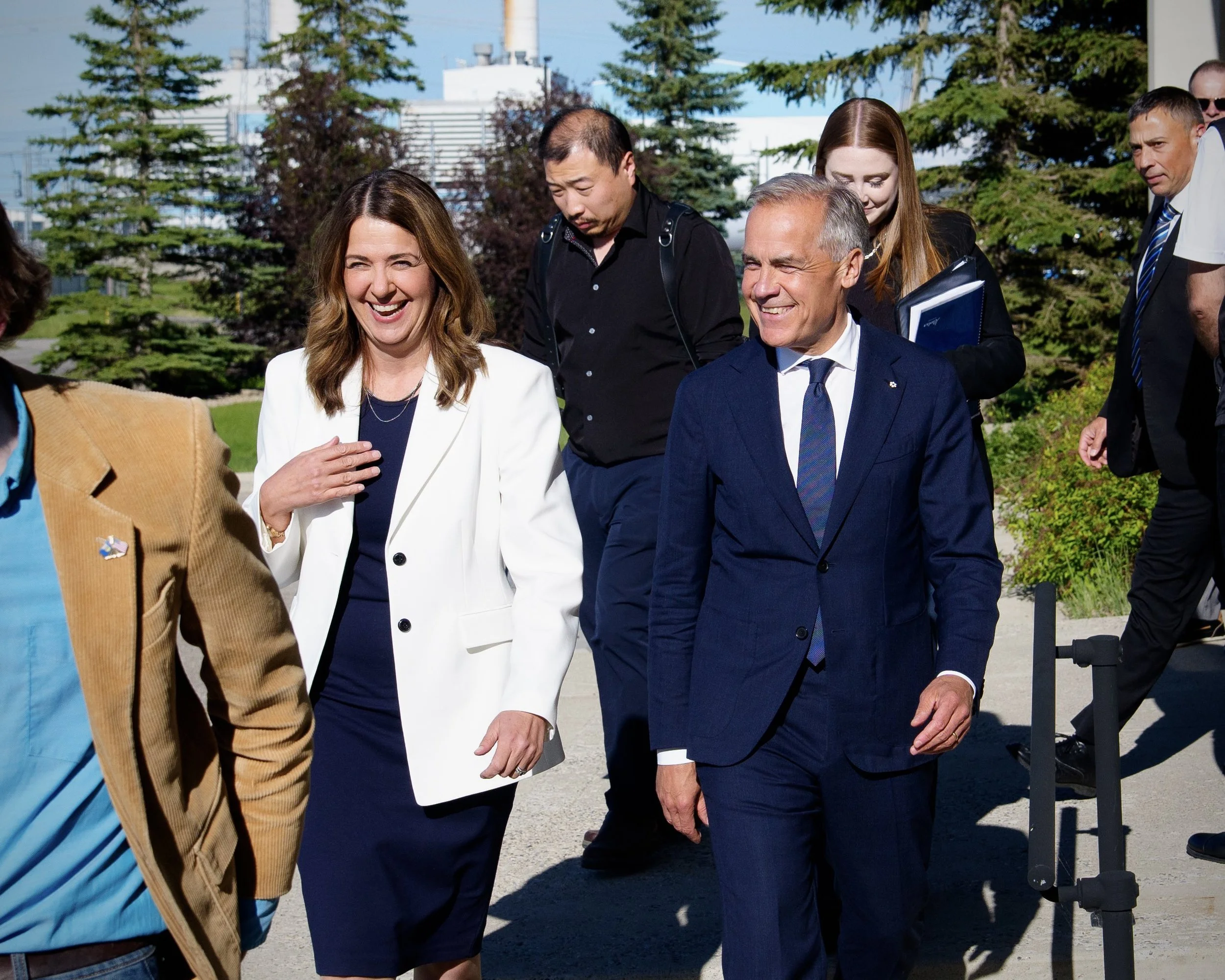
Alberta Premier Danielle Smith, pictured with Prime Minister Mark Carney, announced that the two governments signed an ‘implementation’ agreement for a new pipeline. / SCREENSHOT
Prime Minister Mark Carney and Alberta Premier Danielle Smith announced an “implementation agreement” the two leaders said would diversify exports, lower emissions and build a stronger, more sustainable economy.
A key element of the package is that Alberta will submit a comprehensive proposal for a bitumen pipeline to Asian markets to the federal Major Projects Office by July 1, 2026.
In turn, Canada will pursue its designation as a project of national interest, for approval under the Building Canada Act by Oct. 1, 2026, while ensuring that all steps and decisions follow from discussions with British Columbia and are fully consistent with the duty to consult Indigenous Peoples.
The Alberta government says it would like to see construction of a pipeline to a West Coast port start by Sept. 1, 2027, with oil beginning to flow by 2033-34.
The Alberta government will be the proponent of the pipeline as of July 1, 2026, but further details on a private proponent — as required under the Ottawa-Alberta agreement — will be available when the submission is made.
An Alberta official said there is a lot of interest among Asian countries in ensuring access to Canada’s oil but did not go into detail about any participation in the project by investors.
Discussions on whether the Pathways carbon-capture-and-storage project will go ahead — another requirement for approval of a new pipeline by Ottawa — are ongoing among the Pathways companies and the federal and Alberta governments. No decision on Pathways has been made yet.
But, in a news release, the two governments said they reaffirmed their commitment that the Pathways project “would achieve 16 million tonnes of annual emissions reductions — the equivalent to taking 90% of vehicles off the road in Alberta — while generating $16.5 billion in GDP, $12.2 billion in labour income and up to 43,000 jobs annually.”
Discussions between Alberta and B.C. about a new pipeline from Alberta to the Pacific are focused on benefits for B.C. that would help support some of the province’s own nation-building projects.
In another key element of the agreement, Canada and Alberta have agreed to an effective carbon price of $130 per tonne by 2040.
This will be achieved by agreed-upon annual benchmarks for the headline carbon price, including $115 by 2030 and $130 by 2035.
Canada and Alberta have also agreed to annual tightening, or “stringency” rates under the Technology Innovation and Emissions Reduction (TIER) system. These tightening rates will gradually strengthen emissions benchmarks over time.
Alberta has committed to enforcing a minimum floor price for TIER credits beginning in 2030. This is a critical “insurance policy” that will prevent carbon markets from collapsing and will provide a binding price for investment certainty.
Canada and Alberta will jointly issue 75 million tonnes of Carbon Contracts for Difference (CFDs) to support emissions-reduction projects, with costs shared equally between Canada and Alberta.
Further to the federal government’s proposed National Electricity Strategy, Canada and Alberta agree to work towards doubling the grid by 2050, including by expanding nuclear, wind, solar, geothermal and lower-carbon forms of generation — while maintaining the overall stability of Alberta’s grid.
A joint Electricity Working Group to identify the projects, technologies, and investments needed to achieve net-zero emissions in Alberta by 2050 will be launched. This includes measures to support grid stability, modernisation, and services for baseload and intermittent power sources, including renewables, storage, interties, intra-provincial transmission, nuclear, and geothermal.
The two governments also agreed to better enable investment for renewables and expand supply of electricity for AI and data centre projects.
Alberta separation
At a press conference announcing the electricity plan, Carney was asked if efforts to enable construction of a pipeline from Alberta to the West Coast were part of a strategy to assuage the province’s voters at a time when the push for an independence referendum there has been gaining some momentum.
The prime minister said no, but also said: “I view that very much the best place for Alberta is in Canada, and certainly, a Canada that works, which is what we’re pursuing.”
Separatists’ efforts to have an independence vote this fall have hit the headlines with investigations of their use of citizens’ private data and a new court decision. The ruling this week quashed the Smith government’s approval of the referendum vote in part because of a lack of consultation with Indigenous groups. Premier Smith is appealing the ruling.