Ford: The relationship with U.S. has changed for good
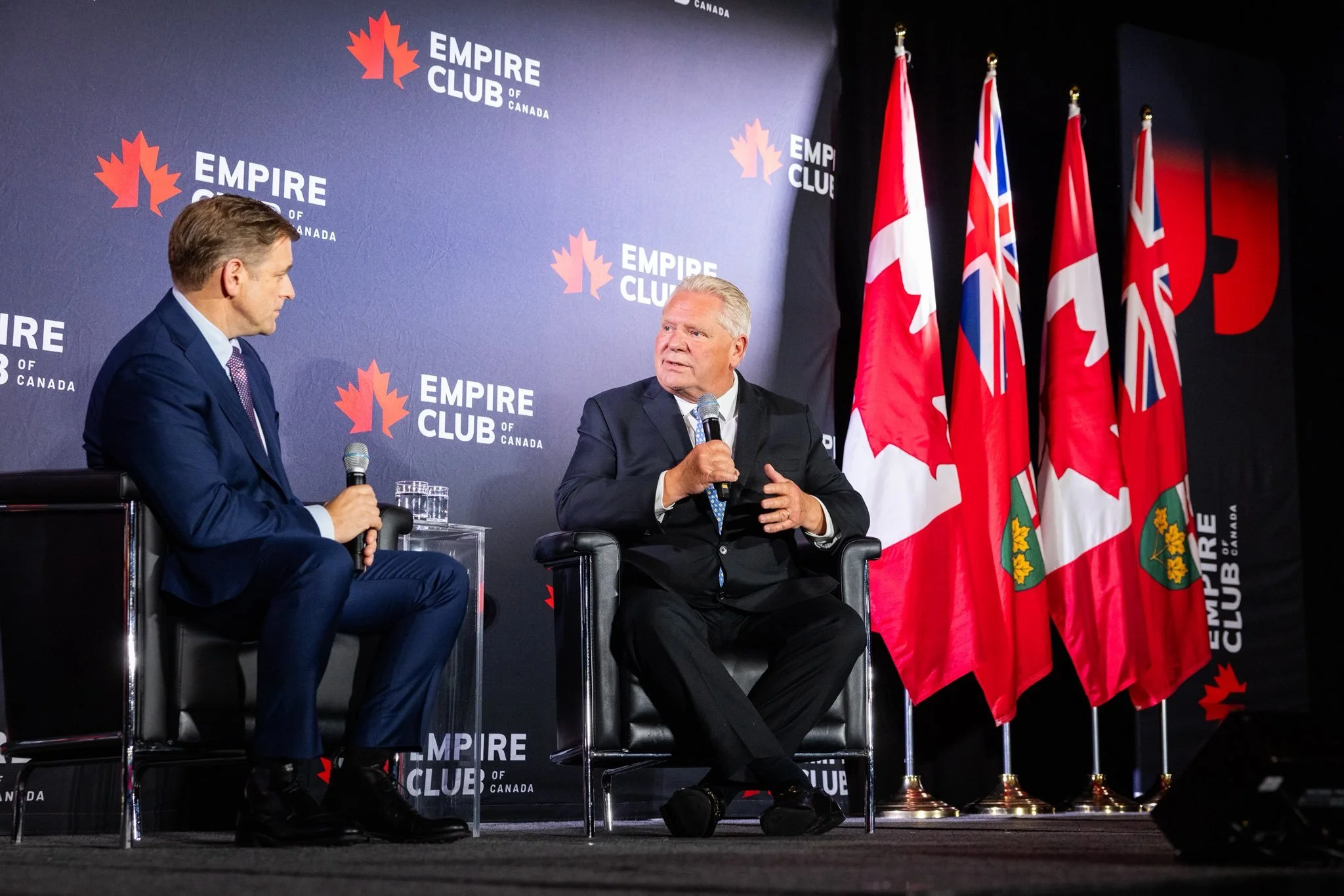
‘Ontario has everything we need here at home to protect our workers and our province. We just need to get out of our own way and get building,’ Ontario Premier Doug Ford, pictured with National Bank vice chair and former Newfoundland and Labrador premier Andrew Furey, wrote on social media. / TWITTER PHOTO
Ontario must adapt to a fundamentally altered trade relationship with the U.S., says Ontario Premier Doug Ford.
In an Oct. 14 keynote address to the Empire Club, Ford said the province should “plan as if tariffs are here for good,” arguing that “Canada's relationship with the United States has changed permanently” after “two years of crisis and chaos from the White House, ripped up trade deals, tariffs, threats of annexation, and economic force.”
He pointed to the government's “Plan to Protect Ontario,” which he said is “fortifying our industrial base, including our auto, steel, and manufacturing sectors” while building out critical minerals, nuclear, data centres, artificial intelligence, defence, life sciences and agri-food.
Ford called the Ring of Fire a key component of that strategy, saying critical mineral deposits in the region will add $22 billion to Ontario's economy and create 70,000 jobs, and that “the best part is President Trump can't do a thing about it.” He also cited a permit review “cutting the time the province spends processing permits by nearly 220,000 days.”
The government is upgrading and expanding nuclear facilities at Darlington, Bruce and Pickering, he said, while building “the first small modular reactor in the G7 and the first new large-scale nuclear power plants in generations.” Ford said the nuclear buildout is expected to create 150,000 jobs and contribute $800 billion to Ontario's GDP.
To meet labour demand, the province has put more than $2.5 billion into skills training, aiming to train one million workers, plus $1.7 billion to prepare 70,000 students for STEM, health care, skilled trades and AI jobs.
Speaking with National Bank vice chair Andrew Furey, the former Newfoundland and Labrador premier, Ford said Ontario's answer to trade tensions has been to build domestic capacity.
“When the whole world heard him attacking our sovereignty, calling us the ‘51st state,’ I believed in putting Trump to the side and focusing on what we can do to grow our economy,” he said. “We must achieve energy sovereignty so we never rely on anyone else, data sovereignty, critical minerals, and electricity grid independence."
Ford also stressed Ontario's importance to the U.S. economy, noting the province conducts half a trillion dollars of trade with the US. Were Ontario a country, he said, it would be America’s third-largest trading partner, and it remains the top trading partner for 11 states and the second-largest for another 15.
Many American lawmakers oppose measures targeting Canada, he added. “Even Republicans I meet say they don't endorse attacking their closest friend, ally and number one customer,” he said.
Ford defended Prime Minister Mark Carney’s handling of recent trade negotiations with Washington, saying he had advised the federal government that “no deal is better than a bad deal.”
“I give the prime minister full credit. He's a smart prime minister who listens and calls back,” he said. “If he hadn't walked away, a bad deal would have destroyed our steel, auto and manufacturing sectors.”
Ontario is also working to expand trade beyond the U.S., Ford said, citing export growth to the United Kingdom.