Canadian jobs, IP, local impact, not just ownership key to procurement decisions: Joly
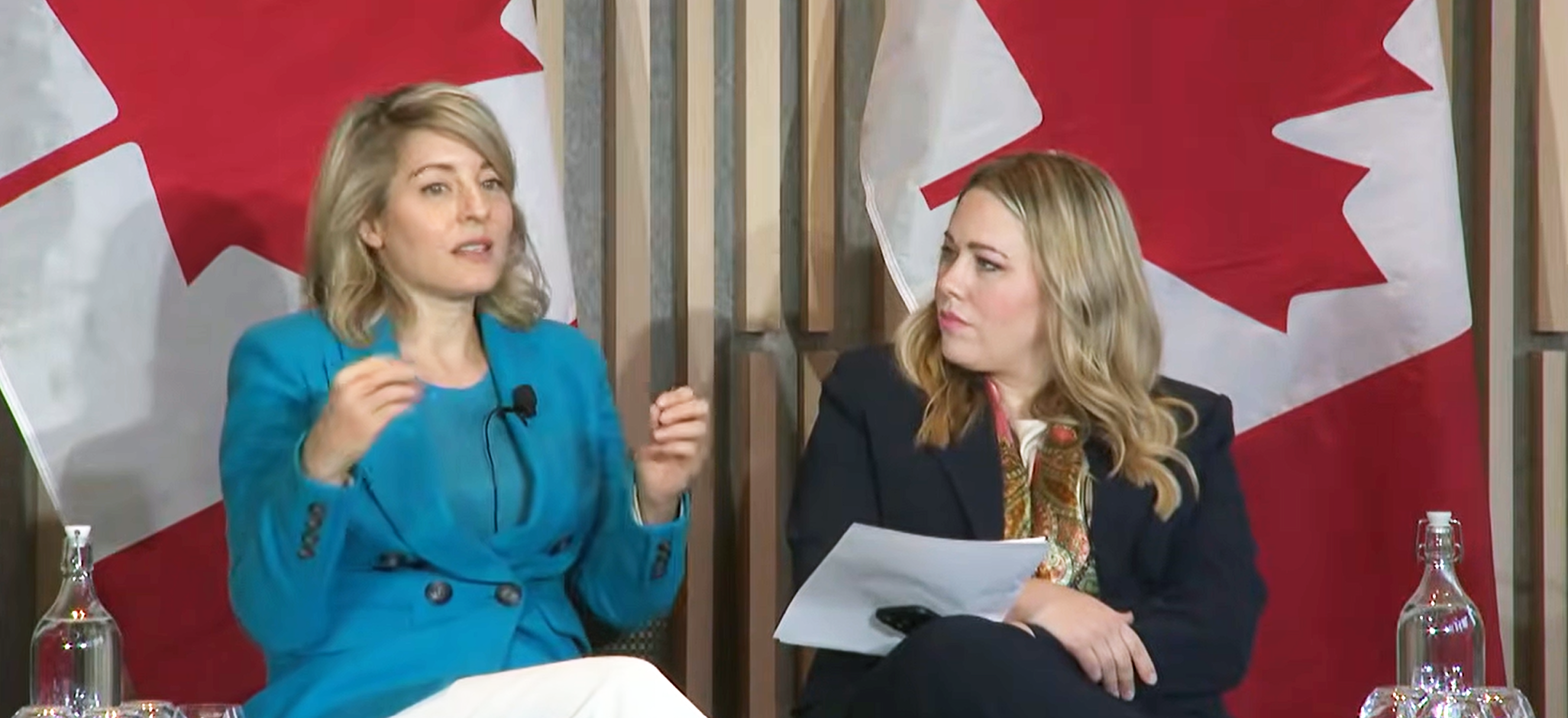
Making the Defence Investment Agency a Crown corporation will ‘make procurement faster and more predictable,’ says Industry Minister Mélanie Joly, pictured with Globe and Mail Ottawa bureau chief Mercedes Stephenson. / SCREENSHOT
The federal government is looking beyond corporate ownership and domestic presence when assessing which companies should benefit from defence procurement, with job creation, intellectual property, R&D and local economic effects all factoring into decisions.
“I know the big question has been, what is a Canadian company? Because that's also at the core,” Industry Minister Mélanie Joly said in conversation with The Globe and Mail’s Mercedes Stephenson during a lunchtime discussion event in Ottawa focused on defence industrial growth.
“We look obviously at shareholders and presence in Canada, but it's mainly also the jobs impact, the IP production, the R&D investment,” she said. “And of course we want to anchor companies in their towns and cities.”
Joly said major defence contracts should form part of wider commercial partnerships, with the government using its purchasing power to encourage companies to invest in their civilian businesses in Canada, rather than focusing exclusively on defence-related commitments.
Joly said the bill to make the Defence Investment Agency a Crown corporation would accelerate procurement, while regional development agencies help small and medium firms get into defence supply chains through the Regional Defence Investment Initiative.
“This will make procurement faster and more predictable … faster decisions, clearer signals and stronger outcomes,” she said.
Pressed on whether momentum behind Canada’s defence-industrial build-out could survive Donald Trump’s departure as U.S. president, Joly said the effort must continue regardless, warning that a Democrat successor would not necessarily reverse Washington's approach.
“I don't think that a U.S. administration tomorrow morning that would be different would make the world much safer,” she said, noting bipartisan consensus in Washington on reducing America's role as the world's security guarantor, restricting immigration and maintaining tariffs.
“They agree with the fact that tariffs should stay, [but] the question is whether they should stay on Canada, and it's unclear what the position [is] from the Democrats,” she said.
Joly said procurement would also be leveraged to support tariff-affected industries, including steel and aluminum. “You cannot take procurement decisions right now without thinking of the impacts of the trade war,” she said. “We need to create jobs through our investments in defence, period.”
She announced the National Research Council of Canada Industrial Research Assistance Program has invested more than $135 million in defence and dual-use technologies since launching Defence Industry Assist, supporting nearly 550 innovation projects and more than 2,000 jobs.
More integrated economy
Meanwhile, at a different keynote at the Canadian Club Toronto on Friday, Joly said Canada can no longer rely on the assumptions that underpinned the Canada-U.S. economic relationship for decades and must instead build “a stronger, more integrated economy at home, and deeper industrial partnerships with trusted nations around the world.”
The minister framed the government's response around key industrial sectors, including steel, aluminum, automotive manufacturing and aerospace, while signalling a larger role for government financing and intervention.
On steel, Joly said Ottawa would work with industry to align production with domestic demand and use federal procurement to support Canadian producers.
“When we purchase icebreakers and when we build pipelines, we must source the steel from Canadian suppliers,” she said. “We must ensure that strategic production capabilities remain right here at home.”
She said the government is prepared to provide financing and, in some cases, take ownership stakes in companies. “We will provide financing and even take equity positions to do what is right in these dire times for workers and businesses,” she said.
Joly devoted significant attention to Stelco and its U.S.-based owner Cleveland-Cliffs, accusing the company of backing tariffs that are hurting Canadian operations.
“Cleveland Cliffs must uphold its commitments, full stop,” she said. “We will apply the full force of the law and every tool in the toolbox to ensure that this strategic capacity remains operational.”
She added that the company “must keep the jobs in Canada or face the prospect of having to sell their Canadian assets.”
During the discussion portion of the event, Joly was asked whether the government was considering nationalizing Stelco. She pointed instead to enforcement measures available under the Investment Canada Act, including compliance orders, financial penalties and potential forced divestiture. She said the government believes the company has breached commitments made when it acquired Stelco.
Asked about timing to either resolve this conflict at Stelco or to pursue legal action, Joly said a decision could come quickly.
“It's a question of days,” she said. “I have a strong sense of urgency.”
Automotive sector transformation
On aluminum, Joly said Canada has retained its position as North America's major producer but has lost much of its capacity to process the metal domestically. She said rebuilding that capacity would be a central objective of the government's industrial strategy, pointing to opportunities in aerospace, automotive manufacturing and consumer goods.
Joly also highlighted the transformation underway in the automotive sector, arguing Canada must both protect existing manufacturing jobs and compete in emerging technologies.
“We'll bring back production to Brampton,” she said. “These are well-paid jobs here in Ontario, and we'll make certain that Stellantis honours its commitment to Canadians.”
At the same time, she argued Canada's future competitiveness will increasingly depend on software and artificial intelligence, highlighting BlackBerry QNX and Toronto-based autonomous vehicle developer Waabi.
“The cars of tomorrow will be electrified and connected,” she said. “We must be AI-driven and networked. And we must lead the world in technological development or we will be doomed to fail.”
Joly said Canada has agreed to permit 49,000 Chinese electric vehicles into the country this year, but said prospective Chinese investments would be subject to conditions, including Canadian-controlled joint ventures, domestic production commitments, workforce requirements and data-security protections.
Growth opportunities
She also presented aerospace as a strategic growth opportunity, pointing to Bombardier's manufacturing capabilities and a planned partnership with Sweden's Saab on airborne surveillance aircraft.
“We are leaders already in civil aerospace, but we must be leaders also in defence,” she said. “Yes, we can build fighter jets here at home.”
During a discussion following the speech, Joly said Canada remains prepared to negotiate a trade agreement with the United States but only if it is “a fair deal" and "in the interest of all Canadians."
Joly also previewed a series of upcoming announcements: "Again, Spacebound is happening, so we'll talk about space this week in Ottawa. We're coming up also with a venture cap strategy to increase the pool of capital in this country that is from Canadian sources. And we're looking at a sea-to-space strategy also, because we need to have the right telecommunication infrastructure. We're coming up with a commercialization of lifeline strategies as well.”