BoC holds steady, but critics see a 'fade' of strong data
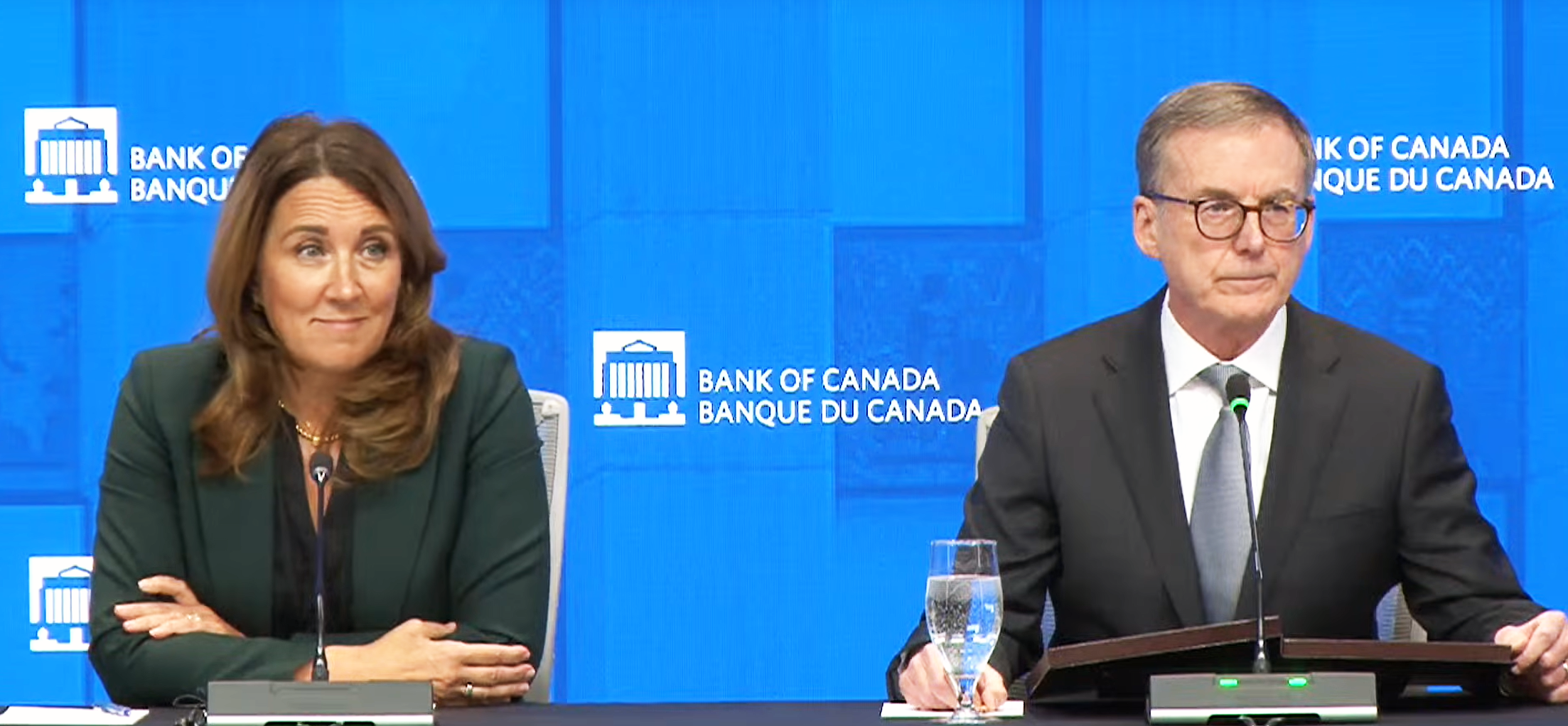
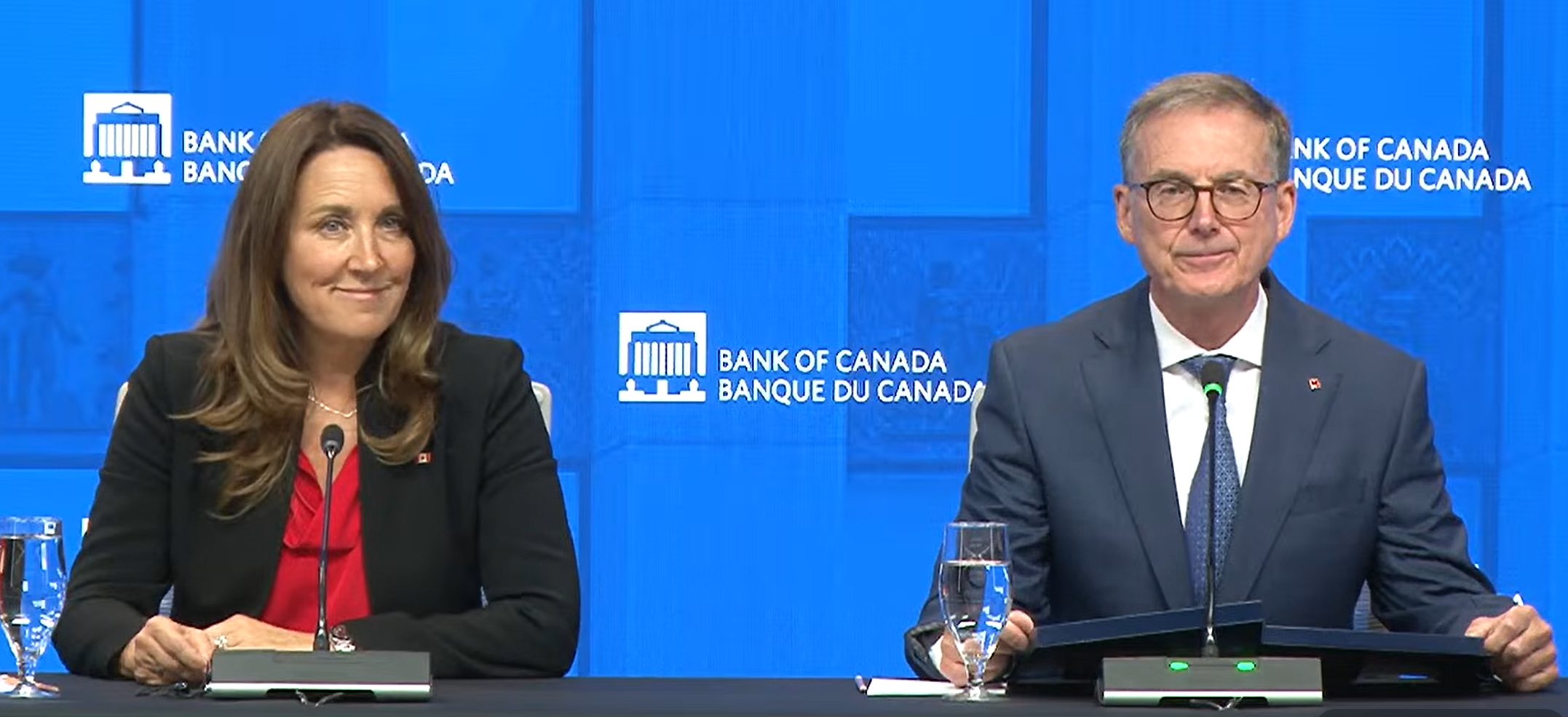
Bank of Canada Senior Deputy Governor Carolyn Rogers and Governor Tiff Macklem pictured at a press conference on Dec. 10 announcing the bank’s interest rate would remain at 2.25%. / SCREENSHOT
The Bank of Canada is “buying time” until its full forecast update in late January while selectively downplaying major economic developments that challenge its narrative, says Derek Holt, Scotiabank Vice-President and Head of Capital Markets Economics.
The central bank held its overnight rate at 2.25% on Wednesday. Like others, Canada’s economy has shown resilience in the face of U.S. trade disruption, Bank Governor Tiff Macklem said in announcing the decision. But, although Canadian growth is expected to pick up next year, “uncertainty remains high and large swings in trade may continue to cause quarterly volatility,” he said.
"Increased trade friction with the United States means our economy works less efficiently, with higher costs and less income. This is more than a cyclical downturn — it’s a structural transition. Monetary policy cannot restore lost supply. But it can help the economy adjust as long as inflation is well controlled," Macklem said in his opening statement. "The Bank of Canada is focused on ensuring Canadians continue to have confidence in price stability through this period of global upheaval."
Holt wrote in a note to clients, however, that the bank “put on horse blinders and heavily faded developments in ways I think went too far.” He pointed to three examples: the Bank’s handling of surging jobs data, its treatment of recently revised GDP figures, and its deferral of any new assessment of fiscal-policy impacts.
Holt argued the Bank leaned too heavily on business survey measures of hiring intentions — despite their poor track record — while minimizing recent blockbuster employment gains.
The Bank also suggested that recent GDP revisions “roughly” balance out on the supply and demand sides, implying no material change in its estimate of economic slack, Holt said.
“Define ‘roughly’ is my counter,” he wrote, noting by the Bank’s own calculation, the revisions cut the estimated output gap roughly in half from –1.1% to around –0.6%.
“If the BoC is going to fade all of that by staying at –1.1% then I’d like to see their math,” he said, adding that the Bank has “invoked some pretty arbitrary assumptions on potential GDP and hence the supply side in the past.”
The Bank also declined to incorporate the federal government’s latest fiscal measures into its outlook, saying it had not “really estimated” the impact yet. Holt is skeptical: “Of course they’ve looked at the effects. But just wait until the next forecasts before the BoC unveils the estimated impact as they see it.”
Don’t ‘rock the boat’

Derek Holt, Scotiabank Vice-President and Head of Capital Markets Economics
Holt said the Bank of Canada may be acting cautiously for two main reasons: it doesn’t want to overreact to recent strong data—such as a burst of job growth that likely won’t last—and it’s wary of numerous uncertainties on the horizon, from geopolitics to trade.
“Don't rock the boat, see you in seven weeks when we have full forecasts and some actual data on what’s going on in the U.S.,” he said.
Meanwhile, RBC senior economist Claire Fan said that the bank's decision reaffirms the "cautiously optimistic base case rather than a fundamental shift in the Canadian economic outlook."
She added: "Looking back, Canadian economic growth has already tracked toward the more optimistic end of the range of possibilities that the BoC projected in April, thanks to a combination of CUSMA exemptions shielding the bulk of goods exports to the U.S., and underlying resilience in household spending. With that, we think the BoC is done with rate cuts, and that the next change in interest rates is more likely to be a hike. Our base case assumes this won't occur until 2027, but risks are tilted toward an earlier move."
While the BoC believes current interest rates are “at the right level” because economic slack should offset higher costs from shifting trade patterns, several risks could push inflation above 2%, Fan said. Although the economy still shows excess supply, recent data points to a smaller-than-expected output gap, reducing downward pressure on prices. At the same time, consumer demand has remained resilient and could strengthen further as labour markets improve, adding upside risk to inflation, she noted.
Meanwhile, the costs associated with “trade reconfiguration” — such as supply-chain adjustments and higher input prices — could also keep inflation elevated.
“Overall, the risks are skewed toward more inflation, not less. If these pressures intensify, the likelihood of BoC rate hikes in the second half of 2026 increases,” she said.