Bank of Canada plays down recession data, holds steady on key interest rate
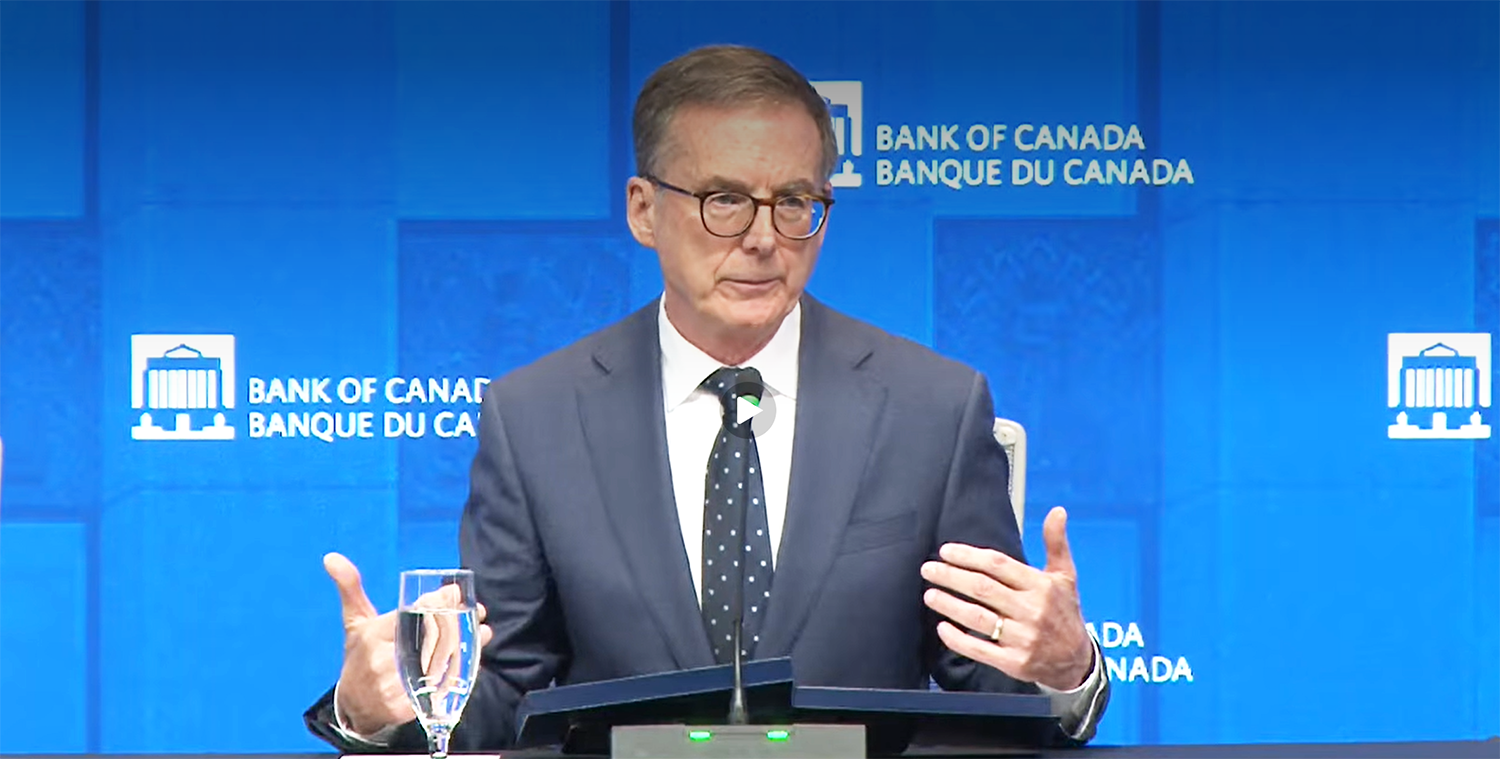
Bank of Canada Governor Tiff Macklem, pictured at a press conference announcing the bank maintained its overnight rate at 2.25%. / SCREENSHOT
Bank of Canada Governor Tiff Macklem played down indications that the Canadian economy is in a recession, saying it’s “not the word” he would use to describe current conditions.
Macklem weighed in on this issue after the BoC’s decision, as expected, to keep its trend-setting overnight interest rate at 2.25%.
The depth of Canada’s economic problems has been a hot-button topic since Statistics Canada released data on May 29 indicating the economy was in a technical recession in the last two quarters.
“Economists typically define a recession as a significant broad-based decline in economic activity that lasts for more than one quarter,” Macklem told reporters. “Based on the data we’ve got, based on that definition, the economy is weak, but it’s not clearly in recession.”
He noted that the unemployment rate’s been relatively stable in the 6.5 to 7% range. “So, so far we have not seen a significant broad-based decline in economic activity. So recession is not the word I would use,” Macklem added.
But he acknowledged the economy continues to be weak as Canada seeks to restructure its economy in the midst of the disruption in traditional trade patterns with the U.S.
“I would describe the economy as weak. It hasn’t grown really in the last year. There’s excess supply in the economy. There’s slack in the labour market,” he commented.
Conservative leader Pierre Poilievre sharply criticized the Liberal government after StatsCan said last month that GDP in the first quarter of 2026 fell 0.1% on an annualized rate, following a revised one per cent annualized decline in the fourth quarter of 2025.
As for the future outlook, Macklem said the BoC is in a wait-and-see mode in the face of major uncertainties arising from the inflationary impact of the Middle East war and the potential for decisive changes to the economy from trade negotiations with the U.S.
“For now, holding the policy rate unchanged balances those risks,” he remarked. But he said the BoC may have to push up interest rates to slow inflation if the energy price increases from the U.S.-Iran conflict feed through into higher consumer costs in the wider economy.
Conversely, he said: “If the United States imposes significant new trade restrictions on Canada, we may need to cut the policy rate further to support economic growth.”
The Bank said it expects growth to rebound in the second quarter, even as “the economy is expected to remain in excess supply.”
On inflation, the Bank reiterated it is "looking through" the near-term impact of elevated oil prices stemming from the Middle East conflict, noting there has been “limited evidence of broad-based pass-through of higher energy prices to other consumer prices.” Still, the statement made clear the Bank "will not let higher energy prices become persistent inflation.”`
The most notable addition to Wednesday's policy statement was a new line acknowledging that “economic activity in Canada has been weak and uncertainty about US trade policy persists” — language that Benjamin Reitzes, Managing Director of Canadian Rates and Macro Strategy at BMO, characterized as “a touch more dovish.”
“Very little new information from the Bank of Canada,” Reitzes wrote in a note to clients, adding that the June policy statement was “similar to April's.”
RBC Senior Economist Claire Fan echoed that view. "We remain cautiously optimistic that per-person and per-worker economic activity will continue to broadly improve this year," she wrote, adding that "persistent economic slack still suggests an extended runway before their next moves."
Jay Zhao-Murray, chief economist at Sibley Creek, argued that Wednesday's meeting marked a meaningful shift. He noted the Bank dropped the word “appropriate” from the statement in describing the current level of rates, and eliminated the phrase “changes in the policy rate can be expected to be small” that appeared in the April statement.
“The tell is that today's hold was framed purely as a balance of risks,” Zhao-Murray said. “Back in April, the bank held rates out of patience — looking to buy time and wait out the oil price shock. Today, it held rates out of a tension between two opposing forces.”
He believes the Bank of Canada is “getting closer to ending its pause” and expects it will have “enough information” by September to determine which scenario wins out — a stagnating economy undercut by trade troubles, or inflation spreading beyond the gas pumps. A cut or hike, he suggested, could arrive alongside the October Monetary Policy Report.
“If those indicators are rising, it would be a blaring alarm that it's time to hike rates,” he said of metrics including core inflation, the share of CPI components rising faster than three per cent, and medium- and long-term inflation expectations.
Scotiabank's Derek Holt struck the most hawkish tone, arguing the central bank is overemphasizing trade risks given that approximately 90 per cent of exports to the U.S. are entering duty-free and the Canadian dollar has continued to depreciate. He said Macklem is ignoring rising commodity prices beyond oil and natural gas, calling that “just plain wrong.” Scotiabank is forecasting the rate will rise to 3% by year-end.
The next scheduled rate decision is July 15, when the Bank will also release its updated Monetary Policy Report — the first detailed look at how it has incorporated recent economic disappointments into its base case forecasts.