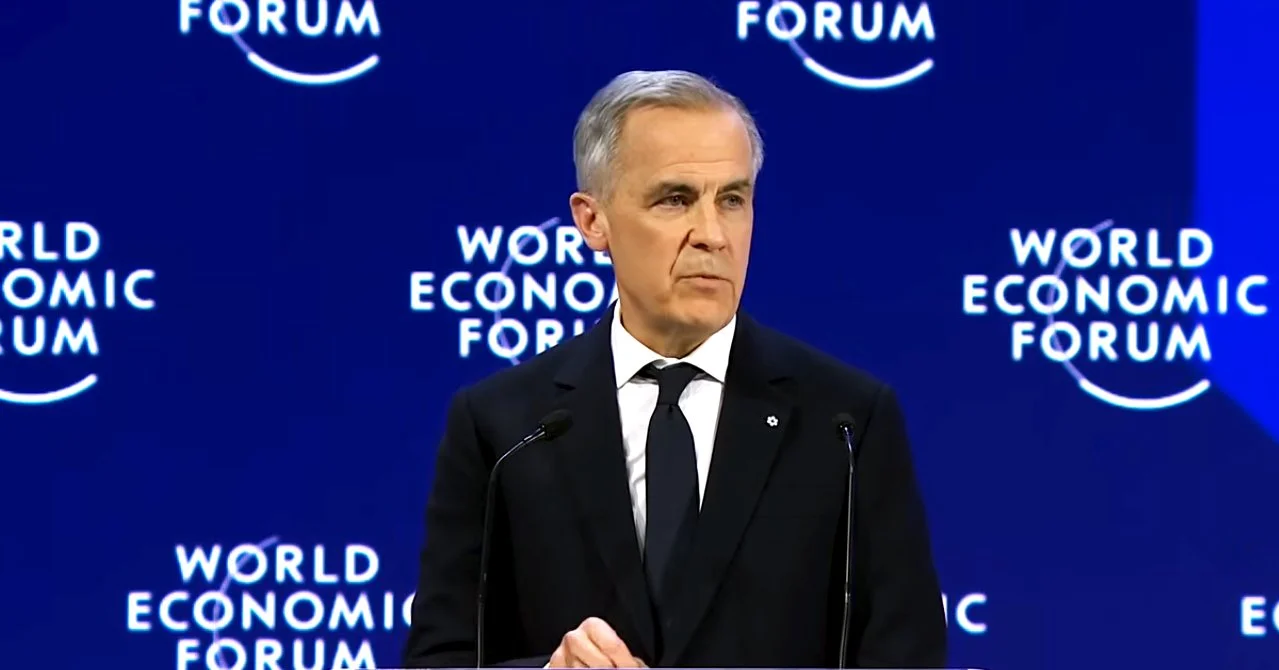
‘The old order is not coming back,’ Carney says, preparing Canadians for ‘rupture’ in global trade, economic landscape
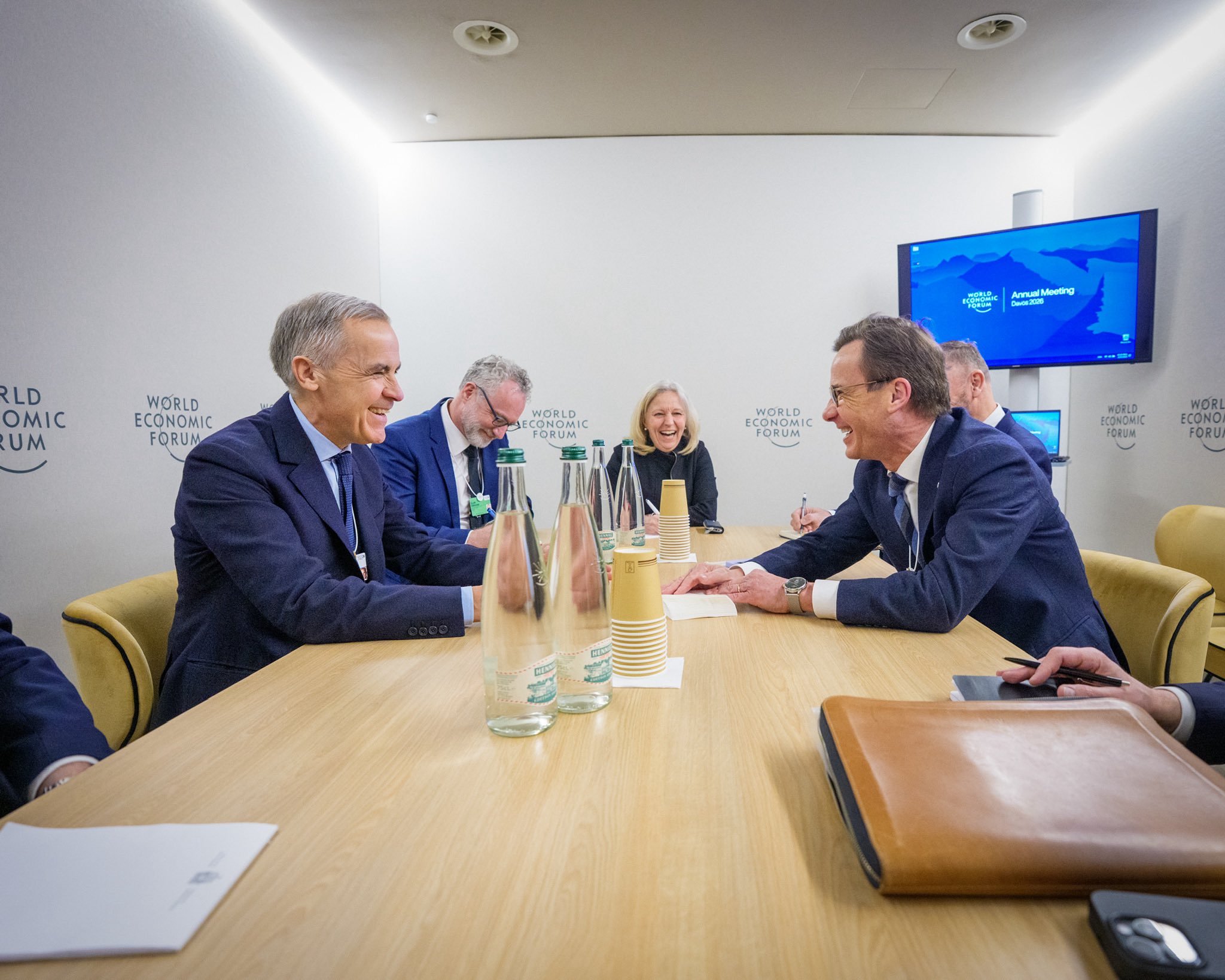
‘Good to meet with Swedish Prime Minister Ulf Kristersson today, to discuss the growing partnership between our nations,’ Prime Minister Mark Carney wrote on social media. ‘We’re leveraging each other’s strengths — in clean energy, critical minerals, and defence — and working together in shared missions, like bolstering security in the Arctic.’ / TWITTER PHOTO
National unity is back in the spotlight, following Prime Minister Mark Carney’s speech at the World Economic Forum outlining the shifting world order and the need for Canadians to understand there is no going back to the safe and secure economy of the last 70 years.
“The old order is not coming back,” he told the World Economic Forum. “Canadians know that our old, comfortable assumption that our geography and alliance memberships automatically conferred prosperity and security is no longer valid.”
Without naming U.S. President Donald Trump, Carney said, “great powers began using economic integration as weapons, tariffs as leverage, financial infrastructure as coercion, supply chains as vulnerabilities to be exploited.”
He added: “Let me be direct: we are in the midst of a rupture, not a transition.” This means Canada must respond with a new “principled and pragmatic” strategy founded on building a stronger domestic economy while diversifying trade away from the U.S.
He called for middle powers like Canada to “act together because if we're not at the table, we’re on the menu.” He said there is strength in numbers. “In a world of great power rivalry, the countries in between have a choice. Compete with each other for favour or to combine to create a third path with impact,” he said. “That is Canada’s path. We choose it openly and confidently. And it is a path wide open to any country willing to take it with us.”
That’s why he’s been overseas as much as possible to negotiate new deals and alliances — approximately 60 trips since taking office last year. His speech, which received a rare standing ovation from the audience, is the clearest signal yet that the Prime Minister is approaching this new paradigm from a very sober perspective and is not under any illusions that Canada can repair the relationship with the U.S. — nothing in the world order is as it was.
He reiterated this message ahead of a cabinet retreat in Quebec City, speaking directly to Canadians. He promised action on his party’s priorities, including rebuilding defence, better cooperation with the provinces, reforming criminal justice, expanding trade ties, making AI work for Canadians and beefing up the economy to expand employment.
“Now we need to execute. Fairly. And fast,” said Carney, whose government has been accused of failing to move quickly to fulfill its goals.
He called for Canadians to stand together in defence of their values. “In a time of rising populism and ethnic nationalism, Canada can show how diversity is a strength, not a weakness,” he said. “Canada can't solve all the world's problems. But we can show that another way is possible. That the arc of history isn't destined to be warped towards authoritarianism and exclusion, it can still bend towards progress and justice.”
This domestic signal was not only to Canadians, but very specifically to provincial leaders he’s meeting with next week — the time for internal feuding has passed and the country won’t weather this storm if it is not united.
International reactions
Carney gave Canadians a vision of a more independent, dynamic future.
Ian Bremmer, president of the Eurasia Group, a geopolitical risk consultancy, told the Washington Post that people would be thinking about the speech for a long time.
“We know that it reflects a change in the global order that we’ve almost all seen coming increasingly over the past years, but no major government leader was prepared to actually say it,” Bremmer said.
But not everyone agreed the change was a “rupture.” Several senior economists and multilateral leaders told Reuters that diagnosis overstated the moment.
“I’m not exactly on the same page as Mark,” European Central Bank President Christine Lagarde said in Davos, just days after Carney’s address. “I’m not sure that we should be talking about rupture.”
Rather than a breakdown, Lagarde said countries should focus on adaptation — identifying vulnerabilities and reducing dependencies. “I think we should be talking about alternatives. We should be identifying, much more so than we have probably in the past, the weaknesses, the sore points, the dependencies, the autonomy,” she said.
World Trade Organization Director-General Ngozi Okonjo-Iweala also struck a more measured tone, predicting that today’s heightened uncertainty would ease over time.
“I don’t think we’ll go back to where we were,” she said. “But they will not be as bad and maybe we’ll have a slightly better, steady state for the future.”
International Monetary Fund Managing Director Kristalina Georgieva said the current moment reflects a longer-term trend rather than a sudden break. Change, she argued, has been underway for years and must be embraced as recurring shocks become the norm.
“We are not in Kansas anymore,” Georgieva said, invoking The Wizard of Oz to underline that the comfort of familiar global arrangements is gone for good.
Lagarde, who earlier in the week walked out of a Davos dinner during a speech critical of Europe by U.S. Commerce Secretary Howard Lutnick, adopted a conciliatory note Friday. Recent criticism of Europe, she said, may have had an unintended benefit.
“We should say ‘thank you’ to the bashers,” Lagarde said, “because I think it has given us a complete realization of the fact that we have to be more focused… we have to work on those plans B.”
CUSMA negotiations
Carney’s speech also raised new questions about keeping CUSMA intact in the coming negotiations with Trump.
While U.S. business supports CUSMA, Trump has already said it’s irrelevant, and his administration has been non-committal about renewing the pact in its current form.
At Davos, Trump responded to Carney’s remarks by saying the prime minister was ungrateful, adding that “Canada lives because of the United States.”
On Thursday, the prime minister shot back: “Canada and the United States have built a remarkable partnership. In the economy, in security and in rich cultural exchange. But Canada doesn't live because of the United States. Canada thrives because we are Canadian.”
But Carney’s unvarnished Davos talk ruffled feathers in Washington at a crucial time. Dismissing it as “political noise,” U.S. Commerce Secretary Howard Lutnick said Carney is ignoring the value of CUSMA, which has remained largely in force despite the Canada-U.S. trade dispute. “They (Canadians) have the second best deal in the world and all I got to do is listen to this guy whine and complain,” he told Bloomberg TV. He said Carney’s tough talk, as well as reopening trade relations with China, could undermine the upcoming CUSMA negotiations.
He also said that CUSMA renegotiation is likely to happen “towards the end of the summer and the middle of the summer” this year.
In reaction to Carney’s speeches, Conservative leader Pierre Poilievre said Canadians have “had enough words” and want results from Ottawa.
He called Carney’s Davos speech “eloquently delivered,” but said if “Liberal words and good intentions were tradeable commodities, Canada would already be the richest nation on earth.”
“We have had enough words. Now, we need results. Now, we must unblock our resources. Now, we must approve pipelines,” he said, adding on social media that “people can’t eat speeches. They need affordable grocery prices — and Canada’s are rising the fastest in the G7, so you can’t blame it on global causes. End the hidden grocery taxes. Stop printing money.”
Dan Kelly, CEO of the Canadian Federation of Independent Business, noted that while Canada faces other issues, including an “entrepreneurial drought,” Carney’s message to the large business sector is the right one. “It’s an important message to accept the world as it is, as opposed to having high aspirations and living almost divorced from reality,” he told The Toronto Star.
The bottom line: Whether this “rupture” proves stabilizing or disruptive will depend less on the diagnosis than on execution — on the country’s ability to align governments, industries and partners around shared priorities, and to translate global ambition into tangible outcomes at home. In that sense, the debate sparked in Davos is not only about the world Canada is entering, but about how prepared it is to navigate it.