Muscular middle-powerism, Carney style
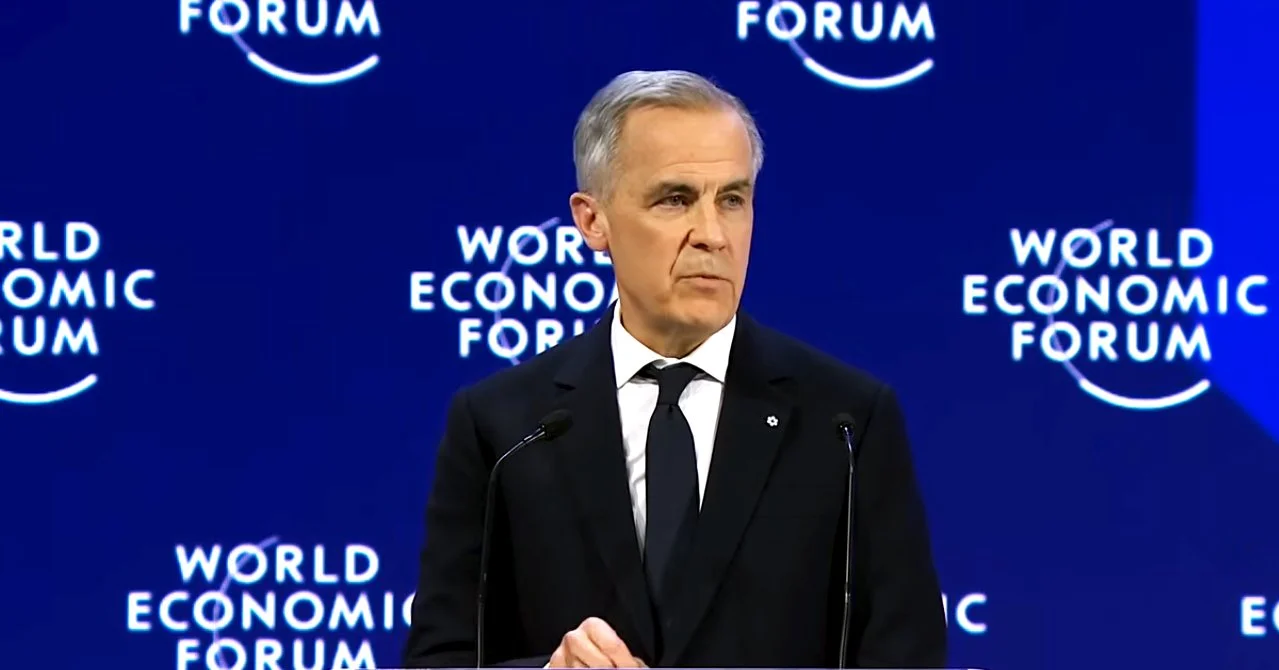
‘We are a stable and reliable partner in a world that is anything but; a partner that builds and values relationships for the long term,’ Prime Minister Mark Carney said in a speech at the World Economic Forum. / SCREENSHOT
Sometimes you have to think the unthinkable if only to avoid it.
In a week that saw steadily escalating rhetoric from Prime Minister Mark Carney and strategic leaks from his team, it became very clear that Canada has been thinking the unthinkable with the United States. Arriving, in the end, at an explicit articulation of Canadian foreign and trade policy that strikes one as muscular middle-powerism and which, as a bonus, seems to have driven President Donald Trump into a rage.
The most startling moment was a leak to the Globe and Mail that the Canadian military was strategizing how to respond to an American invasion. For most Canadians, war with the United States is unthinkable, not simply because there are very few Canadians still alive who can even remember a time when Canada was not America's closest ally.
A mouse fighting an elephant
More concretely, the thought of taking on the United States militarily looks on paper like lunacy, akin to a mouse fighting off an elephant. The U.S. 10th Mountain Division, one of the largest and most combat-deployed divisions in the U.S. Army is based in Fort Drum, in northern New York, just a few hours from Ottawa, Montreal and Toronto.
Overmatched as Canada would obviously be in such a confrontation, the leaked planning suggests that Canada would mount a guerrilla resistance against the U.S. occupiers. It foresees using tactics employed successfully in Afghanistan by the Taliban against the Soviet Union after the latter’s 1979 invasion, and then again by a resurgent Taliban against the United States, Canada, and the rest of NATO after the post-9/11 invasion.
If you think it is odd that Canada’s military is looking to the Taliban for inspiration, you are not alone. But the leak of the so-called high-level plan was also timed to coincide with a leak that Prime Minister Carney is musing about sending Canadian troops to Greenland to join in EU-led military exercises being held there to show solidarity with Europeans in the face of President Trump’s threat to annex that Danish territory. Taken in combination with the government’s plans for one of Canada’s largest peacetime defence build-ups, it is clear that the Prime Minister plans a more muscular role in the world for Canada.
All of this came less than a week after the Prime Minister agreed to a new Strategic Partnership with China. Carney also chose to poke President Donald Trump in the eye by saying that “in terms of the way our relationship has progressed in recent months with China, it is more predictable [than with the U.S.], and you see results coming from that.”
In keeping with his love of sheer bellicosity, the President responded on social media with a fake image of him talking to EU leaders in the Oval Office, with a map of the western hemisphere in the background, the star and stripes draped over Canada and Greenland.
‘Values-based realism’
Prime Minister Carney’s speech at the Davos World Economic Forum capped off the week. It was the most significant prime ministerial statement on Canada's foreign policy since Jean Chrétien’s 2001 address to Parliament, which set Canada's course in the post-9/11 world.
Never mentioning Trump by name, Carney said that Canada's foreign policy, in this age of renewed great power rivalry, would be founded on “values-based realism” and be “principled and pragmatic...Pragmatic in recognising that progress is often incremental, that interests diverge, that not every partner shares our values. We are engaging broadly, strategically, with open eyes. We actively take on the world as it is, not wait for a world we wish to be…We are no longer relying on just the strength of our values, but also on the value of our strength.”
This vision statement is all of a piece with the aggressive global search for trade and investment links in a quest to reduce Canadian reliance on the U.S. economy, making a virtue of our immense natural wealth, our values, our stability, and our reliability at a time of great instability and uncertainty.
Carney’s speech drew a standing ovation.
For his part, the President took direct aim at Prime Minister Carney by name, employing claims that set Canadians’ teeth on edge, saying that “Canada gets a lot of freebies from us. By the way, they should be grateful but they're not,” adding “Canada lives because of the U.S.”
Trump’s speech drew a sitting ovation.
The week that was
The military leaks, the China card, the rhetoric, the Trump eruptions: the Prime Minister’s elbows seem to go back up after months of comparative quiet, rhetorical de-escalation and trade concessions since last spring’s election. But this version of elbows up is much more coherent and thought-through, laying out a vision of Canada as a very muscular middle power ready to lead the response to the new international disorder.
But it also came with a typical Canadian caution. The leak to the Globe and Mail makes it clear to high-octane nationalists that this may come with a high price. It could see Canada degraded from a G-7 nation into a guerrilla movement resisting the vast U.S. military from our vast hinterland.
Call it values-based realism, principled pragmatism, or muscular middlepowerism, the course the Prime Minister has charted will not be without costs or risks; some of them, indeed, unthinkable.
But the mere fact that he is willing to be so explicit and public with his thinking indicates that he has a clear understanding of Canada’s strengths and weaknesses, our risks and our opportunities, as well as a plan for the way forward.
A week in which he shook up Canadians and outlined muscular middlepowerism while expertly trolling President Trump suggests that Carney may have been made for this moment.