Something nervous this way comes
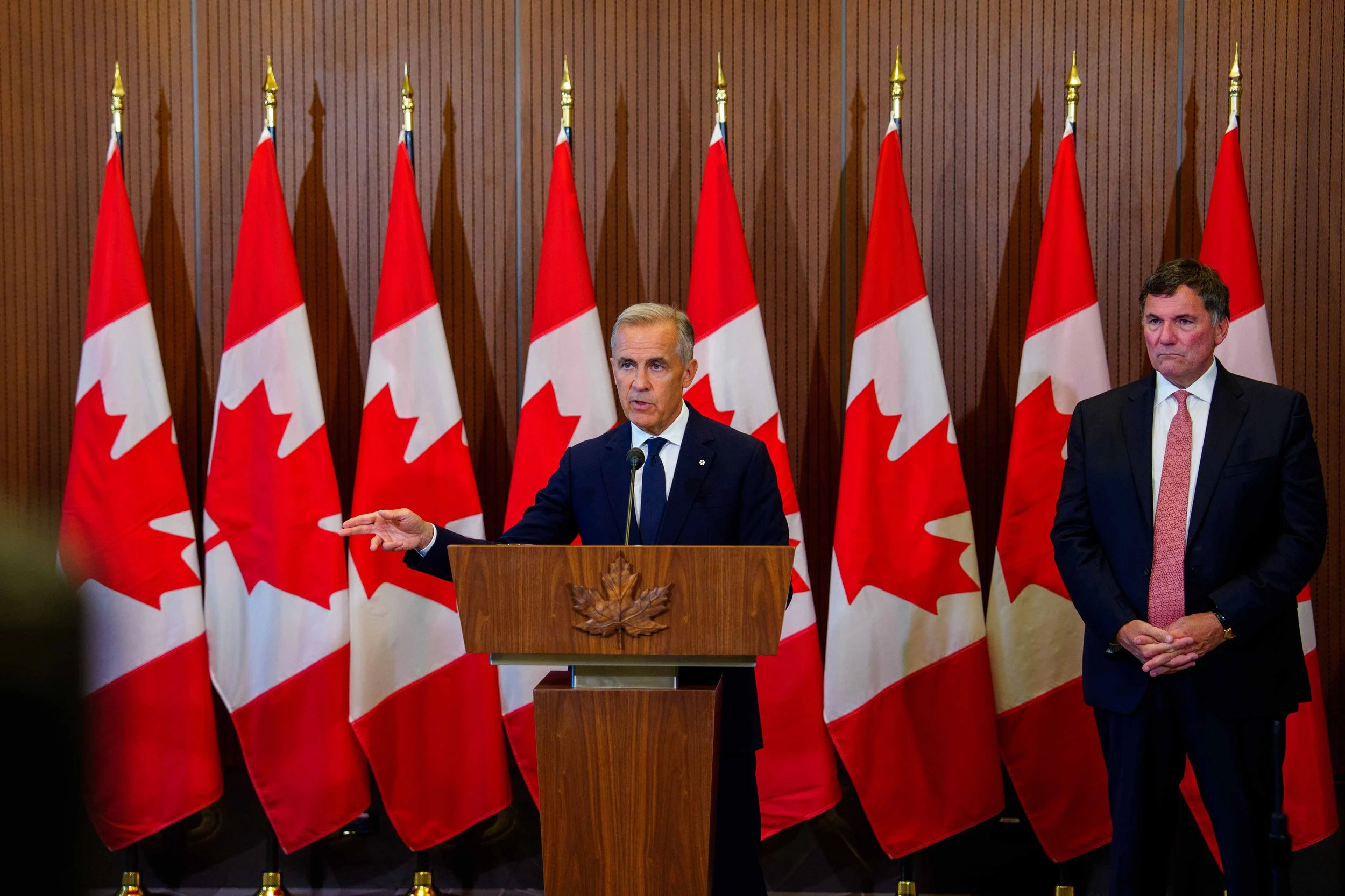
Prime Minister Mark Carney, pictured with Canada-U.S. Trade Minister Dominic LeBlanc, last month after trade talks collapsed with the United States. ‘Few understand the economic dysfunction that can shake bond and capital markets better than Mark Carney,’ writes Ken Polk. / PMO PHOTO
Global bond traders sprinkled a slight drizzle on the “trade war,” “by-election” political colossus that Prime Minister Mark Carney has become. Indeed, before he has time to get comfy with his seeming kingly dominance, that drizzle may become a downpour.
The legendary American political strategist James Carville, once famously said: “I used to think that if there was reincarnation, I wanted to come back as the president, or the pope or a .400 baseball hitter. But now I would like to come back as the bond market. You can intimidate everybody.”
Truer words have rarely been spoken. For proof, you need only look at the political soufflé that was the 49-day government of U.K. Prime Minister Liz Truss. In her infamous “minibudget,” she cut taxes without offsetting spending cuts, and was met with maximal rejection by the bond markets, triggering a sharp upward spike in interest rates. This earned her the dubious title of the shortest-lasting premiership in Britain’s history.
What’s happening in North American and global bond markets, if not yet intimidating, should be of concern.
A bond market tremor
The U.S. 10-year Treasury yield hit its highest level since November 2023, around 4.7%. Yields elsewhere are approaching those at the height of the 2008 financial crisis and before: 30-year Japanese government bonds are near all-time highs at 4.19%; 30-year U.K. yields are at their highest since 1998; Japan's 10-year yield hit 3% for the first time since 1996; France's 10-year hit its highest since 2008; and Germany's 10-year hit its highest since 2011.
The bond market is the one place where the theory of “trickle-down economics” actually works in practice. Higher bond yields trickle down to higher interest rates on government debt, and then down further to higher interest rates for institutional and consumer borrowers. Higher borrowing costs trickle down to reduced investment, higher inflation, and weaker economic growth. It is, in short, a trickle-down of economic pain.
The causes for the recent surge in bond yields are many: U.S. President Donald Trump’s tariff agenda and his misbegotten war on Iran, which have sparked inflation the world over; recent statements by new Federal Reserve Chair Kevin Warsh hinting at an interest rate bump to control inflation; concern about the U.S. national debt, which crossed the $40 trillion mark in August; and also a hangover from massive global government borrowing during the COVID-19 pandemic.
Taken together with the billions being invested globally in AI scaling, they translate to an enormous amount of debt competing for the money of a finite number of investors on Wall Street, Bay Street, London, Shanghai, and Mumbai.
So far, Canada’s bond spike has been comparatively muted. The Canada 10-year yield hit 3.74 per cent, up 19 basis points over the past month and 30 basis points over the past year. The 30-year has jumped to 4.15%. But we are not yet approaching the multi-decade highs seen elsewhere.
Part of this arises from the fact that Canada’s debt situation is better than that of our industrial peers. Indeed, the government never tires of repeating that Canada has the best debt-to-GDP ratio in the G-7. The declaration of an outright trade war with the U.S. has added a unique garnish of uncertainty about Canada that markets are watching closely.
The global confidence game
When it comes right down to it, the global economy is a gigantic confidence game. The value of a stock reflects investors’ confidence in the underlying company’s performance. Bond traders buy corporate or government debt based on their confidence the debt will be redeemed on the terms agreed upon at the time of sale. If that confidence evaporates, for whatever reason, the global confidence game would collapse, potentially triggering a devastating downward spiral in the economy as a whole. This is what happened in the Great Recession of 2008.
Such a bond market loss of confidence in government debt is the nightmare scenario currently troubling the sleep of finance ministries the world over.
While comparatively mild, the trickle-down symptoms are beginning to show in Canada. Even though the Bank of Canada kept its benchmark interest rate steady this week, fixed mortgage rates are climbing. Moreover, the Bank is in a bind as it tries to balance a number of risks from inflation, which climbed over the 2% target in July, due to the trade war.
King Canute in reverse
Perhaps the worst ingredient in this tumult is that Trump, as always, is at centre stage. So far, Trump has displayed his trademark insouciance about what’s happening. With his poll numbers for managing the economy already in the tank, the last thing he wants heading into the home stretch of the November mid-terms is more economic bad news.
Unlike the King Canute of legend, Trump actually seems to think that he can hold back the economic tide. When asked recently if Americans should be concerned about the tension in bond markets, he said: “No, I don't think so. Our country is doing so well despite interest rates.” This was part of his unending campaign to force the Federal Reserve to lower interest rates. In another rather confusing comment, the President, in discussing his option to stabilize the bond market, said: “The ultimate intervention is our military. And if we have to use that, we will.”
The blunt fact that the U.S. national debt has doubled from US$20 trillion since Trump was first elected in 2016 suggests it may be more telling for bond traders than whatever the President may say..
Few understand the economic dysfunction that can shake bond and capital markets better than Carney. As Bank of Canada Governor he helped the Conservative government of Prime Minister Stephen Harper navigate the 2008 banking crisis triggered by the bursting of the U.S. real estate bubble. As Governor of the Bank of England in 2016, Carney helped the U.K. government manage the economic turbulence caused by Brexit.
The difference with those economic shocks and the current tremors in bond markets is that if the gathering storm were ever to erupt, governments would not be the cure for economic upheaval, they would, through their rampant borrowing, be a primary cause.
Prime Minister Jean Chretien used to say nothing in the world is more nervous than a billion dollars. Coming on the heels of the trade war with the U.S., the bond market situation adds another unhelpful context for the coming Canada Investment Summit.
A bunch of nervous billion-dollar investors will be coming to Toronto. The trade war may have triggered a “rally around the Maple Leaf effect” to Carney’s political benefit. But he has to know that his guests will be watching their phones nervously and evaluating Canada’s investment and creditworthiness in a more dispassionate light, to put it politely.
Carney knows only too well that if the Summit is a damp squib, it won’t be personal. Just business.