Feds dig deeper to revive slumping housing market
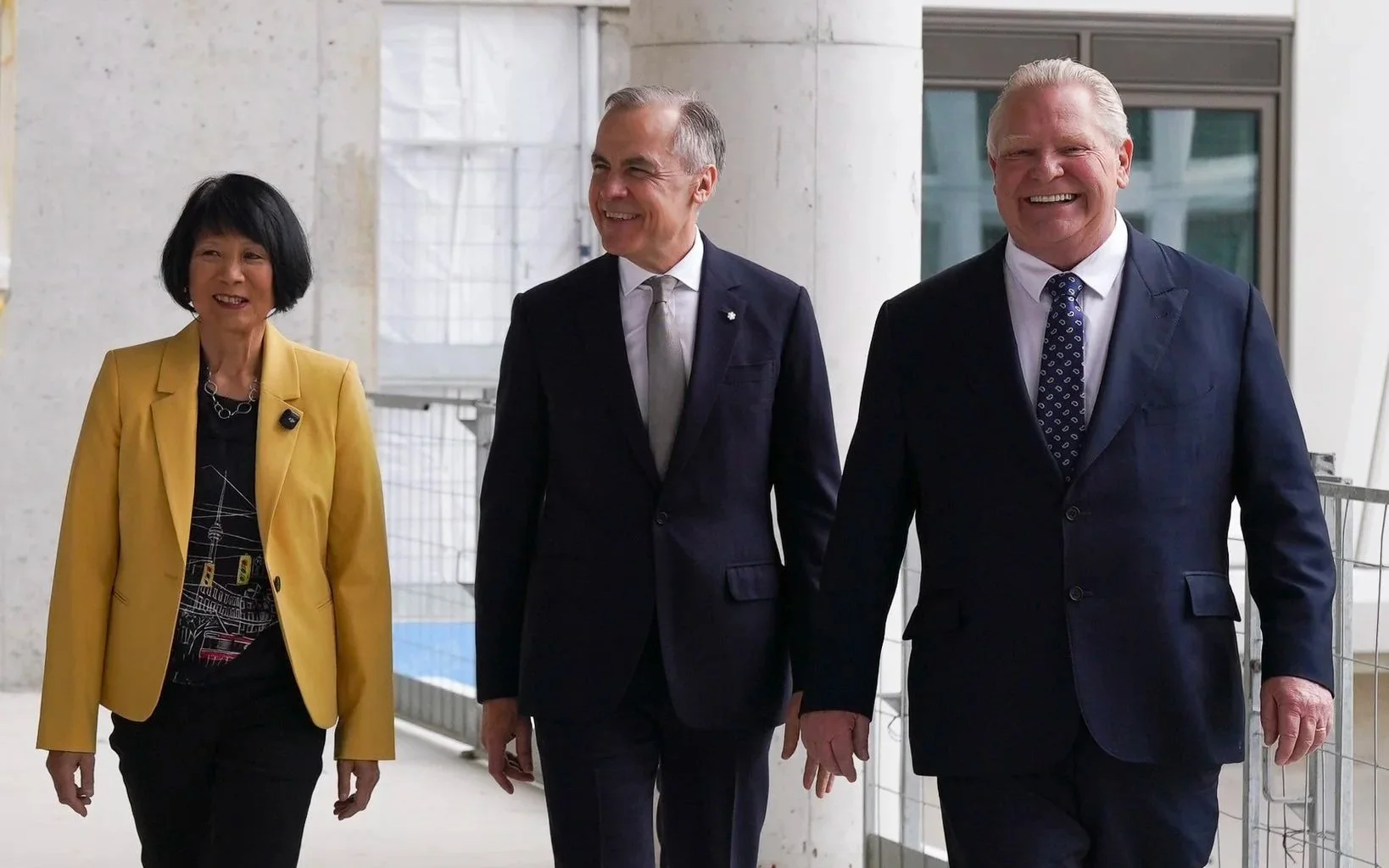
‘To build big and fast, we need to build together. Thank you, Premier @fordnation, and @MayorOliviaChow for your partnership. United, we’re making it easier to build and buy homes for a more affordable Toronto, Ontario, and Canada,’ Prime Minister Mark Carney wrote on social media. / TWITTER PHOTO
Prime Minister Mark Carney joined forces with Ontario Premier Doug Ford this week in another attempt to revive the home-building industry.
Digging deeper with taxpayers’ funds, the two leaders committed to invest $8.8-billion over 10 years in hopes of encouraging home sales and more construction to address the country’s enduring affordability crisis.
It comes at a time when, contrary to the avowed goals of the federal government to unleash a home-building boom, the housing picture remains bleak.
“New construction activity is projected to decline throughout 2026 to 2028, falling well below the historical 10-year average,” according to the CMHC. “Developers face high construction costs, weaker demand and rising inventories of unsold units.
“Condominium starts will be particularly weak, especially in Toronto, where pre-construction sales fell to multi-decade lows in 2025,” the CMHC says. “Many projects are delayed or cancelled as financing thresholds are harder to meet. Developers are focusing on completing projects already underway rather than starting new ones.”
Things have gotten to the point where the Ford government, which announced in 2022 that it planned to get 1.5 million more homes built in the province by 2031, no longer talks about the goal.
Development charge relief
The federal-Ontario spending initiative announced Monday is intended to provide some relief from a key bottleneck in the sales environment — the development charges by cities that covertly add tens of thousands of dollars to house prices.
Municipal governments, lacking the hefty taxing powers of the feds and provinces, have relied on development charges on construction to pay for sewers, roads and other infrastructure needed for expanded residential areas — charges that builders pass on to homebuyers.
But there is widespread agreement that the practice has gotten out of hand and can depress construction or push the cost of homes that do get built out of reach of many buyers.
So the two governments have decided to shift part of the burden of infrastructure development costs from house purchasers to the general tax base. “This will lower upfront costs and create certainty for builders to build affordable homes you can buy and rent,” Carney said.
To access part of the $8.8 billion in infrastructure investment available under the new program, municipalities will be required to cut development charges for three years. Cities that have already done so or agree to reduce them by 50% will get first dibs on the funding.
It’s the latest initiative by the federal government, including reducing HST on home purchases. And it draws on the proposed $1.7 billion in funding for provinces to use however they see fit to boost housing supply.
Housing Minister Gregor Robertson said the new measure will “hopefully” kickstart more construction at a time when the sector faces “very significant” challenges, with buyers in Toronto and Vancouver staying on the sidelines because of uncertainty arising from global events.
“We’ve got to keep taking action until we get the desired effect of getting the market going again … at a time when (homebuying) is a heavy lift for many,” Robertson told CTV.
He said the federal government intends to provide the same breaks on development charges to cities across the country.
Developers are of course responding positively to this kind of support. After the feds and Ontario agreed to stop collecting the entire 13% HST on new construction developments, the reaction was very upbeat, according to the Toronto-based Building Industry and Land Development Association. “This week, sales centres were buzzing, they haven’t been buzzing for two years,” the association’s Dave Wilkes told Global News. “I can’t believe the enthusiasm, the vibe in the industry.”
Is it enough?
But it’s not at all clear whether these measures will really be enough to restart a very badly stalled housing sector and how long it will take, given the slow lead times in construction.
“We’re in uncharted territory,” Mike Moffatt, founding director of the University of Ottawa’s Missing Middle Initiative, commented in the Globe and Mail. He said the federal-provincial incentives are a step in the right direction and should help some middle-class buyers. But “it still probably doesn’t get us anywhere near the 500,000 new homes the federal government has promised.”
Ontario Liberal MPP and housing critic Adil Shamji said the promise to cut development charges is too little and too late — and will only reduce development charges to 2018 levels.
There are also questions about whether municipalities can find other ways to raise cash in the permitting process, and more importantly, whether builders will pass on the savings to homebuyers. Carney said he expects competitive forces in the market will push developers to do so. But we won’t know if that will actually happen until we see how the cost structure evolves.
While it’s impossible to say if the house-building incentives are enough to re-invigorate the industry, one thing is clear: the people of Toronto will notice Carney’s new push to solve the housing mess shortly before the two byelections being held in the city on April 13.