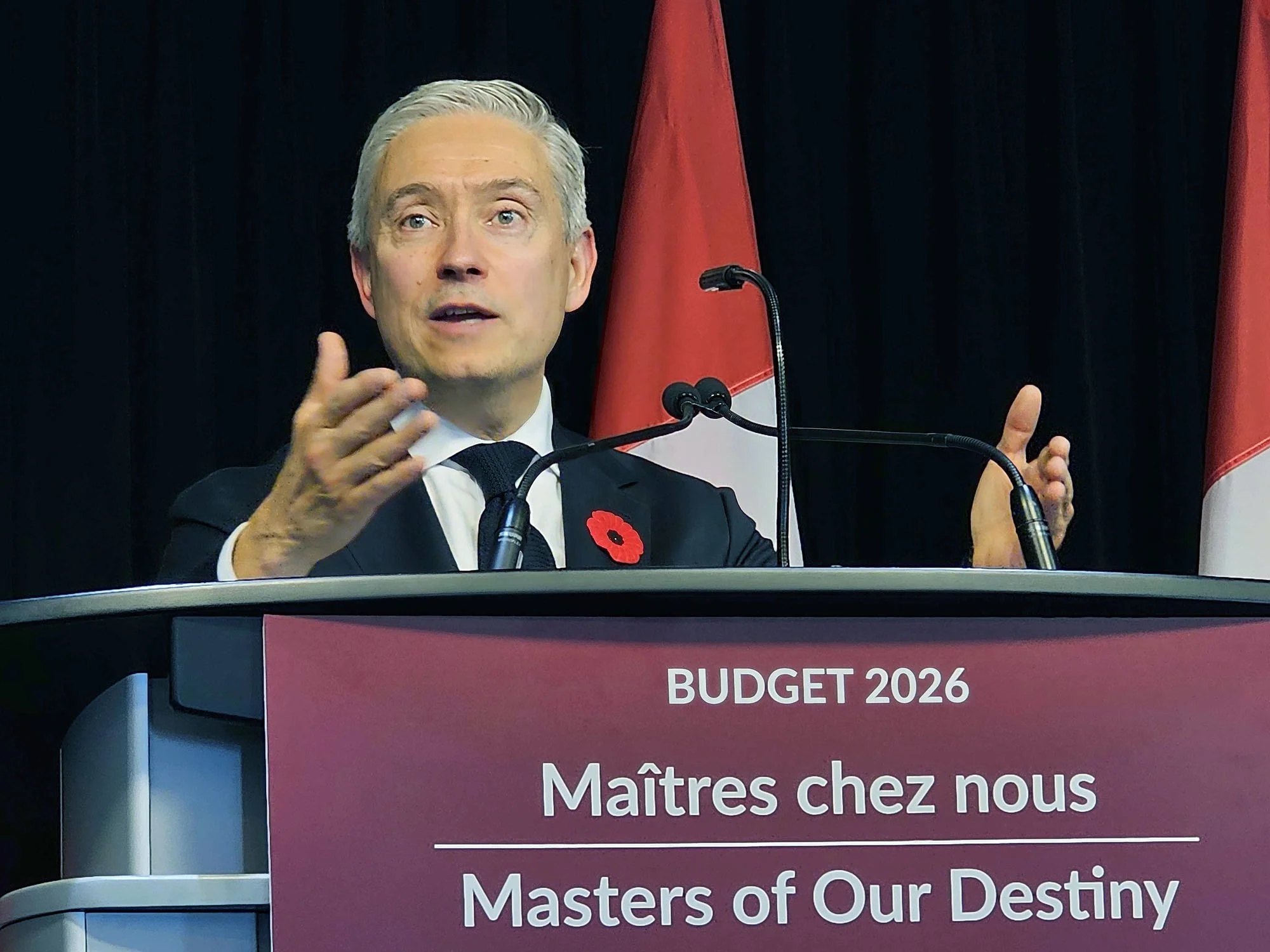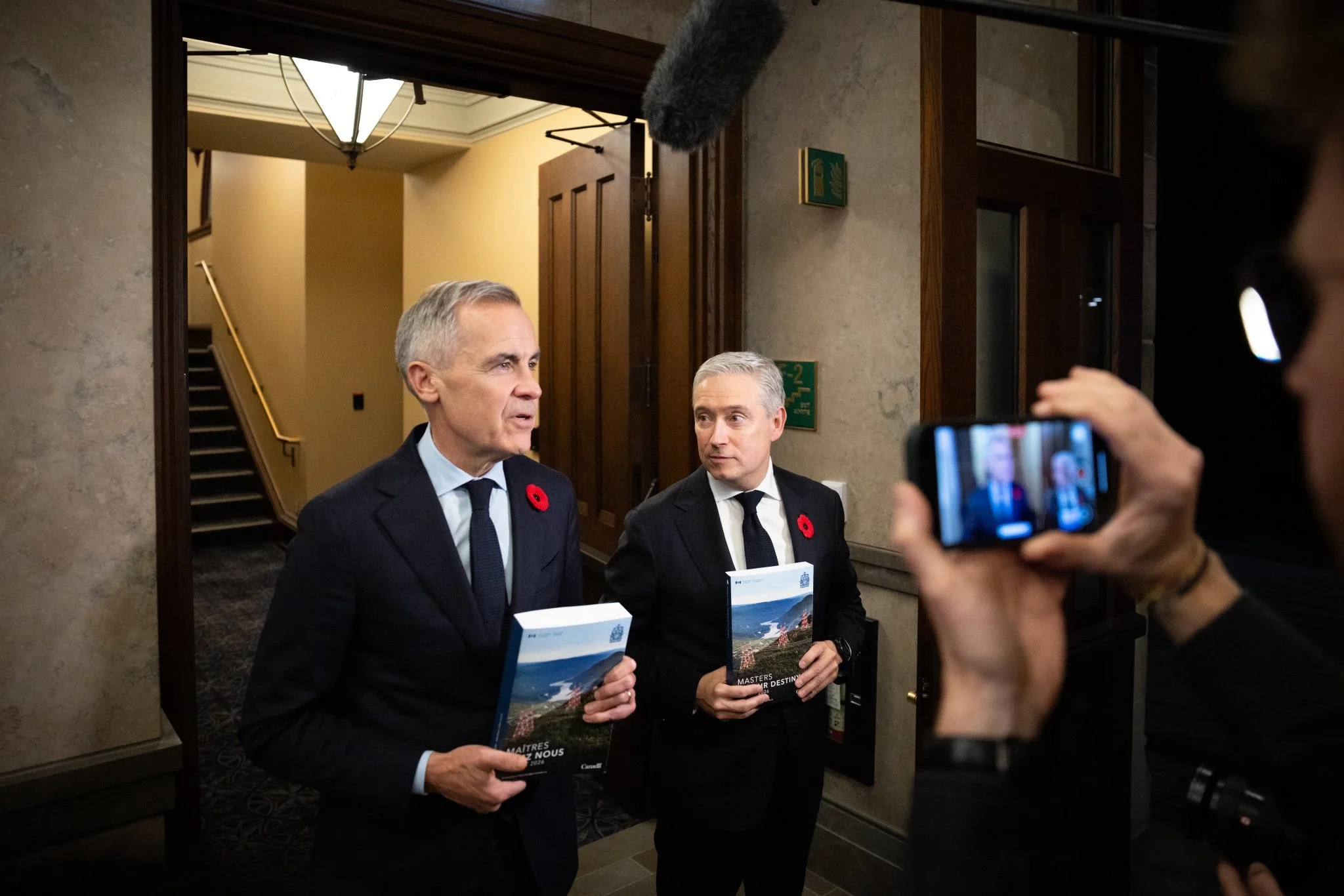
Prime Minister Mark Carney and Finance Minister François-Philippe Champagne pictured in the House of Commons foyer before tabling the 2026 budget. ‘In the face of adversity, we’re seizing opportunities and working together to rebuild stronger,’ Champagne said in his speech. / TWITTER PHOTO
Canada must remain vigilant against economic threats from the United States despite a Democratic win in the midterm elections this week, says former Ambassador to the U.K. and federal cabinet minister Ralph Goodale.
“While earlier this week American voters handed the Trump administration a stern rebuke, it is far too early to conclude that abusive U.S. policies toward Canada are about to change any time soon,” Goodale told Means & Ways.
“It is imperative that we continue to build out the Canadian economy to be bigger, stronger, more resilient and less vulnerable.”
Goodale said Budget 2026 correctly identifies two pressing national priorities: strengthening Canada's economic sovereignty in the face of an unpredictable American neighbour and addressing mounting affordability pressures on Canadian households.
His comments come as fiscal experts acknowledge the ambition of Prime Minister Mark Carney's economic strategy while raising concerns about its costs, execution and underlying assumptions.
Kevin Page, president and CEO of the Institute of Fiscal Studies and Democracy at the University of Ottawa, described the budget as a fundamental shift in governing philosophy, from supporting household prosperity under former prime minister Justin Trudeau to strengthening Canada's capacity to control its economic future under Carney.
The 511-page budget, released Thursday, showed policy actions since the spring economic update exceed $150 billion over five years, with Ottawa injecting an average of $30 billion annually into the economy through deficit financing.
Annual budgetary deficits are projected at roughly $60 billion, or slightly less than 2% of GDP, while federal debt remains around 40% of GDP.
Those figures compare favourably with many other advanced economies, Page wrote in an op-ed, but they do not capture the government's full borrowing requirements. Non-budgetary transactions, including loans, investments and advances through Crown corporations, require approximately $95 billion in additional borrowing annually, pushing total federal financing requirements above 4% of GDP. Debt-servicing costs are projected to grow roughly four times faster than program spending.
Page also noted that Ottawa has effectively spent a $160-billion fiscal planning dividend generated by improved economic forecasts and projected spending reductions rather than using it to lower deficits or borrowing.
A journey that will be ‘difficult, expensive and risky’
"Fiscal room is being used," he wrote. "In different times, fiscal observers and governments would be celebrating a budgetary deficit that dramatically beat estimates. Times have changed. The priority is building capacity in Canada to better control its future. We are at the beginning of the journey. It is going to be difficult, expensive and risky."
Desjardins vice-president and chief economist Jimmy Jean and deputy chief economist Randall Bartlett said the fiscal outlook depends heavily on optimistic revenue projections, elevated oil prices and substantial spending savings. While the federal debt remains on a sustainable path and Canada is not at risk of an imminent downgrade by rating agencies, they said, that position can’t be taken for granted.
“With little fiscal room left, a continued climb in long-term interest rates, re-escalation in the trade war or some other negative external shock could put the federal debt-to-GDP ratio on an unsustainable path,” they wrote in an analysis.
They questioned whether the government's forecast of nearly $120 billion in additional revenues over five years is consistent with projected economic growth. They also argued that its downside scenario understates the consequences of weaker growth and renewed international trade disruptions, and that the absence of an explicit contingency reserve leaves Ottawa vulnerable to setbacks.
Jean and Barlett welcomed the potential benefits of measures designed to stimulate business investment, encourage entrepreneurship and strengthen Canada's productive capacity.
Page also noted: "Budget 2026 is bold. The tax measures to support business investment and development (e.g., productivity mega deduction; Canada Growth incentives) are breaking new ground to drive investment. Combined with planned private and public investments on major projects, the outlook for a major expansion in capital formation is strong."
Goodale warned that sustaining public support will require tangible improvements in business investment, job creation, productivity and economic growth.
“All measures of public opinion give the Prime Minister an unprecedented base of support for the direction he is taking,” he said, adding that Canadians are anxious to see progress. He also stressed the importance of maintaining Canada's Triple-A credit rating and relatively low federal debt-to-GDP ratio.
Conservative Leader Pierre Poilievre said the budget was "a costly credit card budget that Canadians can't afford," and that the official opposition will vote against the budget in the House. He said Carney had broken his election promise to lower the debt-to-GDP ratio.”
"The prime minister will add $765 billion to our national debt, the single biggest borrowing binge in Canadian history — more than Trudeau, more than during COVID, more than any other government in the history of this country — an amount that will lead to higher inflation and interest rates today and higher taxes down the road.”
NDP Leader Avi Lewis said the budget doesn't do anything for regular Canadians. “Well, it is the ‘Christmas came early for the billionaires’ budget,” he said. "Budgets are expressions of a government's priorities. The single biggest item in this entire budget is the $36 billion mega deduction. That's not what Canadians are experiencing as a crisis in the economy today.”